
Personal Use
(Krameria lappacea, CO₂ Extract)
This isn’t an oil that shouts. Rhatany CO₂ smells like the earth remembering. Its scent is soft—subtle, resinous, and woody with a ghost of dry root. But don’t let the quiet fool you. There is gravity here. This is medicine that knows how to hold.
Stillpoint’s Rhatany extract is a CO₂ from the dried roots of Krameria lappacea, wild-harvested and extracted with a trace amount of ethanol, then blended with organic olive oil to make it pourable and ready to work with. Unlike some of the stickier CO₂s, this one is smooth, workable, and potent.
Rhatany root has been used for centuries as a potent astringent, antimicrobial, and protector of skin, gums, and mucosa. It holds fast. It tightens and shields. It’s an anchor when things feel loose—physically, emotionally, and energetically.
Mucosal & Gum Support
Traditionally used to strengthen and protect the delicate tissues of the mouth and gums, Rhatany may support oral care when blended into mouth rinses or tooth oils. It’s known for its toning, astringent, and antimicrobial properties, making it useful in natural oral health formulations and gargles.
Traditionally used to strengthen and protect the delicate tissues of the mouth and gums, Rhatany may support oral care when blended into mouth rinses or tooth oils. It’s known for its toning, astringent, and antimicrobial properties, making it useful in natural oral health formulations and gargles.
Topical Barrier & Skin Integrity
Its lignan-rich chemistry lends itself to soothing inflamed skin, supporting minor wounds, and strengthening the skin barrier. Ideal for lip balms, salves, and herbal ointments, especially in blends meant for recovery, resilience, or post-sun exposure.
Its lignan-rich chemistry lends itself to soothing inflamed skin, supporting minor wounds, and strengthening the skin barrier. Ideal for lip balms, salves, and herbal ointments, especially in blends meant for recovery, resilience, or post-sun exposure.
Anti-Inflammatory and Astringent Action
Applied in low dilution, Rhatany may help tone tissues, reduce mild irritation, and provide a protective layer in topical preparations—especially for areas prone to moisture, sensitivity, or microbial imbalance.
Applied in low dilution, Rhatany may help tone tissues, reduce mild irritation, and provide a protective layer in topical preparations—especially for areas prone to moisture, sensitivity, or microbial imbalance.
Clinical Application Note
Rhatany CO₂ extract is fat-soluble and pourable, making it easy to incorporate into oil-based preparations like salves, balms, ointments, and emulsions. It is not water-soluble and should not be used in hydrosol or aqueous formulas.
-
Recommended dilution: 0.1–2% for topical formulations
-
Blends well with: Olive oil, jojoba, calendula macerate, beeswax-based balms
-
Common carriers: Lip balm bases, herbal body butters, peri-anal or post-sun skin blends
-
Formulation tip: Due to its astringent, tightening nature, Rhatany works best in small amounts and is often paired with soothing herbs like chamomile, plantain, or helichrysum
Do not use internally. For external use only.
Traditional Use
Rhatany root has a long-standing history in South American and European herbal medicine as a powerful astringent, antimicrobial, and mucosal tonic. Traditionally used in the treatment of oral, dental, and skin conditions, its role has always centered on protection, contraction, and defense—physically reinforcing tissues and limiting microbial invasion.
Oral Health + Gum Support
Rhatany was historically infused into mouthwashes, rinses, and powders to treat bleeding gums, mouth ulcers, and sore throats. The root’s high tannin and lignan content gives it a powerful astringent action, helping to tighten inflamed tissue, reduce microbial load, and support recovery in the oral cavity.
Topical Astringent + Skin Protectant
Used externally as a decoction, poultice, or in ointments, Rhatany has been applied to minor wounds, skin irritations, and ulcerations. Its traditional use includes support for eczema, cracked lips, hemorrhoids, and chafed or over-moist areas, especially where fungal or bacterial overgrowth is suspected. It was also included in after-sun balms to help reduce inflammation and strengthen the skin barrier.
Anti-Inflammatory + Tonifying Properties
In both Western and Andean herbal traditions, Rhatany was recognized as a tonic for mucous membranes—used internally in tincture or decoction form to address diarrhea, hemorrhoidal discomfort, and vaginal discharge. While internal use is not recommended with the CO₂ extract, its topical toning properties are ideal for formulations targeting inflamed, lax, or vulnerable skin and tissue.
Botany
Krameria lappacea, commonly known as Rhatany or Peruvian Rhatany, is a low-growing, woody perennial shrub in the Krameriaceae family. Native to the arid, high-altitude regions of Peru and Bolivia, this root-rich plant has long been valued in both Indigenous and European herbal medicine for its powerful astringent and protective properties.
Rhatany thrives in sun-scorched, mineral-rich soils, adapting to rocky slopes and drought conditions with deep, anchoring roots. It is harvested not for its showy parts, but for the strength of its root system—a source of tannins, lignans, and centuries of medicinal use.
Botanical Name: Krameria lappacea
Family: Krameriaceae
Common Names: Rhatany, Peruvian Rhatany, Mapato
Plant Type: Woody perennial shrub
Part Used for Extraction: Dried root
Growth Habit: Compact, low-spreading shrub up to 30–60 cm in height
Flowering Season: Mid to late summer
Harvest Time for Extraction: Root is harvested once mature, typically during dry season for optimal lignan content
Family: Krameriaceae
Common Names: Rhatany, Peruvian Rhatany, Mapato
Plant Type: Woody perennial shrub
Part Used for Extraction: Dried root
Growth Habit: Compact, low-spreading shrub up to 30–60 cm in height
Flowering Season: Mid to late summer
Harvest Time for Extraction: Root is harvested once mature, typically during dry season for optimal lignan content
Physical Characteristics:
-
Leaves: Small, narrow, gray-green; often covered in fine hairs
-
Stems: Woody, gnarled, and reddish in color
-
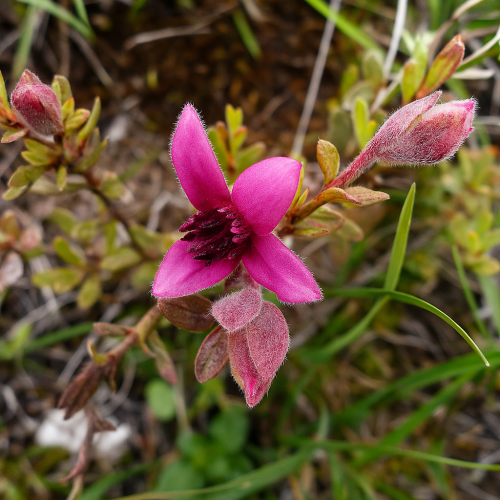
Flowers: Deep red to purple; small but vivid, often pollinated by specialized bees
-
Roots: Thick, reddish-brown, deeply embedded in rocky terrain
Native Habitat + Growth Conditions:
-
Native To: Peru and Bolivia (Andean highlands)
-
Preferred Soil: Dry, mineral-rich, rocky or sandy loam
-
Sunlight: Full sun
-
Climate: Arid to semi-arid; well adapted to drought and high elevation
-
Ecological Notes: Slow-growing; wild populations are limited and ecologically sensitive. Harvesting requires ethical sourcing practices to avoid overexploitation.
Energetic Botanical Signature
Rhatany doesn’t reach upward—it reaches inward. Its power lies underground, where it weaves itself into rock and memory. This root doesn’t expand to impress; it contracts to contain. Its form reflects its function: a firm base, a strong anchor, a quiet but unshakeable presence.
Its flowers bloom like whispers—small flashes of color in harsh terrain. But the real gift is below. Rhatany teaches that containment is a form of compassion, and that sometimes healing comes not from opening more, but from sealing what needs protection.
It is medicine for boundaries, for restoration, for remembering where you begin and end.
