
Every order ships USPS Priority — $10.95 flat-rate USPS Priority shipping on all US orders, no minimum. Free shipping on domestic orders over $299.
Welcome to Stillpoint. Subscribe to our newsletter for sale details and new-product news · One discount code per order · Every order is hand-poured, packed with care in ceremony, and shipped as we receive it.

Pomegranate Seed CO₂ Extract | Skin Renewal, Elasticity + Barrier Support

Punica granatum

  • Pomegranate Seed CO₂ Extract | Skin Renewal, Elasticity + Barrier Support

Average Rating: (see reviews)

$13.00 Ex Tax: $13.00

Essential Facts

  • Latin Name: Punica granatum
  • Country of Origin: Cuba
  • Plant Parts: Dried fruit
  • Note Classification: Base
  • Cultivation Method: Organically Grown
  • Method of Extraction: CO2 Total Extraction
  • Extraction Date: November 2025
  • Aroma: Earthy, Slightly bitter, Soft, Sweet, Warm
  • Energetic Applications: 1st Chakra - survival and support, 2nd Chakra - relationships, creation energy, 4th Chakra - unconditional love, Balancing, Expansive, Grounding, Protective, Transformative
  • Therapeutic Properties: Anti-inflammatory, Anti-oxidant, Astringent, Cicatrisant, Cooling, Strengthening, Tonic, Tonifying, Wound healing
Notes & Use

Personal Use

Pomegranate Seed CO₂-to Extract
Punica granatum

Organic | Rich in Punicic Acid | Skin Renewal, Elasticity & Barrier Support

Pomegranate Seed CO₂-to Extract is a concentrated, lipophilic botanical extract made from the dried seeds of Punica granatum using supercritical carbon dioxide extraction.

This is not an essential oil. It is not a basic pressed carrier oil. It is a CO₂ total extract — meaning carbon dioxide is used under pressure to draw out a rich spectrum of oil-soluble plant constituents from the pomegranate seed, including fatty acids, tocopherols, sterols, and a small amount of squalene.

The finished material is organic Pomegranate Seed CO₂-to Extract, stabilized with 0.1% organic rosemary antioxidant extract. It contains a fatty oil profile with more than 60% punicic acid, a conjugated linolenic acid, along with naturally occurring tocopherols, sterols, and a small amount of squalene.

That chemistry matters.

Pomegranate Seed CO₂ is not just “a nice oil for skin.” Its value is in its dense lipid chemistry, especially its high punicic acid content. Punicic acid is one of the key reasons pomegranate seed extract is so valued in formulas for mature skin, dry skin, sensitive skin, depleted skin, and skin that has been stressed by weather, time, inflammation, or environmental exposure.
This extract belongs in the carrier/base oil category because it is oil-soluble and lipid-based, but it should be understood as an active botanical extract, not a plain carrier oil.

Traditional Therapeutic and Cosmetic Uses of Pomegranate Seed
Pomegranate has a long history of use in traditional wellness and beauty practices. The fruit, peel, juice, flower, bark, and seed have all been used in different ways, but the seed extract is especially valued in modern cosmetic formulation for skin nourishment, antioxidant support, barrier care, and visible skin renewal.

Pomegranate Seed CO₂-to Extract is traditionally and cosmetically used for:
  • Dry skin
  • Mature skin
  • Sensitive skin
  • Irritated-feeling skin
  • Skin that feels depleted, thin, or environmentally stressed
  • Loss of elasticity
  • Fine lines and visible signs of aging
  • Barrier support
  • Skin softness and suppleness
  • Post-sun skin care support, not as a sunscreen
  • Facial oils
  • Massage oils
  • Hand creams
  • Body oils
  • Skin creams and balms
  • Formulas for skin that needs nourishment, comfort, and renewal
The supplier documentation notes that Pomegranate Seed CO₂-to Extract is used in skin care products because of its antioxidant and anti-inflammatory properties and its soothing effect on irritated, dry, and sensitive skin. It also notes that the extract stimulates keratinocyte production. Keratinocytes are part of the epidermis, the uppermost layer of the skin, and help form keratin, which supports the skin’s protective structure and stability.

In plain English: Pomegranate Seed CO₂ is for skin that needs to remember its strength.

It is not trendy fluff. It is dense, rich, restorative seed medicine for skin that has been dried out, worn down, inflamed, depleted, or asked to keep going long after it needed care.

Why CO₂ Extraction Matters
CO₂ extraction uses natural carbon dioxide under pressure to extract plant constituents without leaving solvent residues behind. For Pomegranate Seed CO₂, this process produces a concentrated, oil-soluble extract rich in lipid-based compounds that are especially valuable in skin care.

That is the difference.

A basic pressed oil captures the fatty oil of the seed. A CO₂ total extract can carry a fuller lipophilic profile, including fatty acids, tocopherols, sterols, and other oil-soluble constituents.

With pomegranate seed, that matters because the therapeutic and cosmetic value of the material lives in the seed’s deeper lipid chemistry. This extract gives formulators access to the dense, concentrated intelligence of the seed — not just glide, not just moisture, but real botanical substance.

The supplier documentation identifies this extract as a yellow oil with a viscous consistency at room temperature and a fatty oil profile containing more than 60% punicic acid, plus tocopherols, sterols, and a small amount of squalene.
This makes Pomegranate Seed CO₂-to Extract a beautiful ingredient for formulas focused on skin resilience, softness, elasticity, barrier support, and renewal.

Why Pomegranate Seed CO₂ Is Different from Regular Pomegranate Seed Oil
Pomegranate Seed CO₂-to Extract is different from regular pomegranate seed oil because of how it is extracted and what it carries.

Regular pomegranate seed oil is usually mechanically pressed from the seed. It can be beautiful and useful, but it is not the same as a CO₂ total extract.

Pomegranate Seed CO₂-to Extract is produced through supercritical carbon dioxide extraction, which creates a concentrated, solvent-free, oil-soluble extract with a rich profile of fatty acids and naturally occurring minor constituents.

This extract is:
  • Organic
  • CO₂ extracted
  • Lipophilic and oil-soluble
  • Rich in punicic acid
  • Viscous at room temperature
  • Stabilized with 0.1% organic rosemary antioxidant extract
  • More active and concentrated than a basic carrier oil
  • Best used as a specialty ingredient in targeted skin care formulations
The rosemary antioxidant extract is not there for scent or decoration. It helps stabilize the extract and protect the lipid-rich material from oxidation. That matters because oils and extracts rich in unsaturated fatty acids can be more vulnerable to oxidation when they are not handled and stored properly.

This is not generic “pomegranate oil.” This is a concentrated seed extract with serious skin-care relevance.

Suggested Use
Use as an ingredient in topical skin care formulations.

Suggested formulation range: 0.1–5% of the finished product, depending on the purpose of the formula, the desired richness, and the other ingredients included.

Best suited for:
  • Facial oils
  • Serums
  • Creams
  • Lotions
  • Balms
  • Body oils
  • Massage oils
  • Hand creams
  • Mature skin formulas
  • Dry skin formulas
  • Sensitive skin formulas
  • Barrier-support blends
  • Renewal-focused skin care products
Because this extract is rich and active, small percentages can still bring meaningful benefit. Strong does not always mean “use more.” Sometimes strong means let the ingredient do its work without drowning the formula.

Important Safety

For external use unless used in a legally compliant food or nutraceutical preparation specifically intended for internal use.
For cosmetic and aromatherapy use, apply only as part of a properly formulated topical product.

Do not use on:
  • Broken skin
  • Open wounds
  • Deep cuts
  • Eyes
  • Mucous membranes
  • Actively irritated skin without appropriate professional guidance
Patch testing is recommended, especially for sensitive or reactive skin.
Avoid use with known sensitivity or allergy to pomegranate or rosemary.
Keep away from children.
The safety data sheet states that Pomegranate Seed CO₂-to Extract is not classified as hazardous under GB CLP regulations. It also identifies the material as a yellow liquid, practically insoluble in water, soluble in fat, with a flash point above 65°C.
Aromatic / Physical Profile
  • Yellow oil
  • Viscous consistency at room temperature
  • Characteristic odor
  • Oil-soluble
  • Practically insoluble in water
  • CO₂ total extract
  • Rich in punicic acid
  • Stabilized with organic rosemary antioxidant extract
Storage
Store cool, dry, tightly closed, and away from light.
The supplier notes that unopened containers are stable for at least two years when stored protected from light in a cool, dry place.
Energetic Note

Pomegranate Seed CO₂ is seed medicine.
It carries the energy of regeneration, inner richness, resilience, and life held in reserve. This is not the flashy beauty of the fruit split open in myth and drama — though pomegranate has plenty of that. This is the deeper medicine of the seed: concentrated, protected, potent, and quietly alive.

Energetically, Pomegranate Seed CO₂ speaks to skin and spirit that have become dry, depleted, worn thin, or disconnected from their own vitality. It brings the message of renewal from the inside out — not forced, not frantic, not “anti-aging” nonsense, but real restoration.

Pomegranate teaches that beauty is not about pretending time has not touched us.
Beauty is what happens when life keeps returning.

This extract carries that medicine beautifully: resilience, sensuality, repair, nourishment, and the red-gold intelligence of the seed that knows how to begin again.

Botany

Botanical Name: Punica granatum
Family: Lythraceae
Common Names: Pomegranate, Grenade, Granatapfel
Plant Type: Deciduous shrub or small tree
Part Used: Seeds
Growth Cycle: Perennial
Native Habitat: Traditionally associated with the Mediterranean region, Western Asia, Iran, India, and surrounding dry subtropical regions
Preferred Growing Conditions: Warm climates, full sun, well-drained soil, dry heat, and regions with long growing seasons
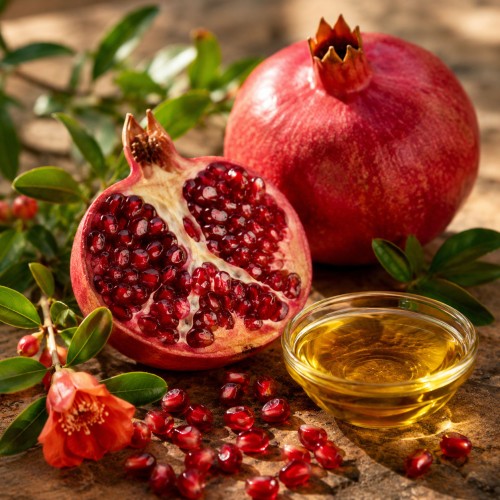
Punica granatum is a long-lived deciduous shrub or small tree known for its leathery leaves, vivid orange-red flowers, and round fruit filled with jewel-like seeds. The fruit is thick-skinned and protective, holding hundreds of red arils inside — each one surrounding a seed that carries the plant’s concentrated lipid medicine.

For this CO₂ extract, the dried seeds are the plant part used. The supplier documentation identifies the raw material as dried Punica granatum seed from organic farming, extracted by supercritical carbon dioxide into an organic Pomegranate Seed CO₂-to Extract.

The seed is where this extract gets its power. Pomegranate Seed CO₂-to Extract contains a fatty oil profile with more than 60% punicic acid, a conjugated linolenic acid, along with naturally occurring tocopherols, sterols, and a small amount of squalene.
That matters because pomegranate’s skin-care value is not only in the beauty of the fruit. It is in the chemistry of the seed — dense, protected, concentrated, and deeply restorative.

Botanically, pomegranate is a plant of containment and abundance. The hard outer rind protects an entire inner world of seeds. This is not a plant that gives itself away casually. It holds its medicine inside a tough exterior, then reveals a red, fertile, jewel-like interior when opened.

The flowers also matter. Pomegranate flowers are bright, fiery, and almost sculptural, often appearing before the fruit forms. They carry the visual signature of vitality, fertility, and creation. The fruit that follows is one of the oldest symbols of life, death, rebirth, fertility, sensuality, and the underworld journey.

In formulation, the seed extract reflects the plant’s deeper intelligence: protection, renewal, resilience, and inner richness. This is why Pomegranate Seed CO₂-to Extract is so beautifully suited for mature, dry, sensitive, environmentally stressed, and depleted-feeling skin. It carries the energy of life held in reserve — the part of the plant that knows how to begin again.

Energetic Botanical Signature
Pomegranate’s botanical signature is one of protected abundance.

Everything about the fruit speaks this language. The outer skin is firm, leathery, and protective. Inside, the fruit opens into a red world of seeds — hundreds of them — held in chambers like little temples of life. Pomegranate does not scatter its medicine loosely. It contains it. Protects it. Ripens it in darkness. Then reveals it in a flood of red, jewel-like vitality.

That is the signature.

Pomegranate teaches that richness is not always on the surface. Sometimes the deepest medicine is held behind a boundary. Sometimes life gathers itself in the hidden places before it returns.

Because this extract comes from the seed, its energetic signature is especially connected to regeneration, resilience, sensuality, fertility, and renewal. Seed medicine is beginning medicine. It is the place where future life is held in concentrated form. Pomegranate Seed CO₂ carries that energy into skin care: not fake youth, not anti-aging panic, not “erase time” nonsense — but true renewal, nourishment, and the restoration of vitality from within.

The CO₂ extraction deepens this signature because it draws out the seed’s oil-soluble chemistry: punicic acid, tocopherols, sterols, and squalene. This gives the extract a dense, embodied quality. It is not light, airy, or decorative. It feels like concentrated red-gold nourishment — seed intelligence made usable for the skin.

Energetically, Pomegranate Seed CO₂ speaks to skin and spirit that have become dry, thin, depleted, guarded, or disconnected from pleasure. It brings a message of replenishment without force. It reminds the body that resilience can be sensual. Protection can be beautiful. Aging can be rich. Renewal does not mean going backward; it means life keeps moving through you.

Pomegranate says: there is still life inside.
There is still sweetness.
There is still fire.
There is still something sacred ripening in the dark.

Energetics

Traditional & Folklore

Pomegranate’s folklore is ancient, layered, and absolutely loaded.

Unlike Arnica, whose story belongs mostly to mountain folk medicine, Punica granatum walks straight through the old mythic gates. Pomegranate belongs to fertility, death, rebirth, sensuality, sacred marriage, abundance, blood, the underworld, and the mystery of life returning after darkness

This is not a quiet little fruit.

In Greek mythology, pomegranate is most famously tied to Persephone. After Persephone was taken into the Underworld, she ate pomegranate seeds there, which bound her to return to that realm for part of each year. Her descent and return became one of the great mythic explanations for the seasonal cycle: Demeter’s grief brings barrenness, and Persephone’s return brings life back to the earth. Britannica describes the pomegranate seed as the reason Persephone could not be completely freed from the Underworld. 

That myth matters for this extract.

Pomegranate is not just a symbol of life. It is life held inside descent. Fertility held inside darkness. Sweetness held behind a hard rind. The seed becomes a threshold object — once eaten, it changes the story. It marks the crossing between maiden and queen, surface and underworld, innocence and initiation.

The Greeks also associated pomegranate with funerary beliefs and ritual. The Metropolitan Museum of Art notes that pomegranates appear throughout Greek art and were connected with the Underworld through the story of Persephone.  So even in ancient visual culture, pomegranate carried that double medicine: death and fertility, loss and return, the grave and the seed.

And that is the whole damn point of pomegranate.
It does not separate life from death.
It does not separate beauty from blood.
It does not separate desire from consequence.
It holds the whole thing.

Pomegranate was also associated with fertility, love, marriage, and abundance in Greek and Roman worlds. Kew notes that in ancient Greece and Rome, the pomegranate symbolized fertility as well as death, and was associated with Aphrodite, goddess of love, and Hera, goddess of marriage and childbirth.

Its many seeds made it an obvious emblem of fecundity, but not in a shallow “pretty fruit” way. This is fertility as mystery — red, hidden, sensual, and powerful.

In Jewish tradition, pomegranate also carries sacred symbolism. It is one of the Seven Species associated with the Land of Israel, and its seeds are traditionally linked with the 613 mitzvot, or sacred obligations, of the Torah. Here again, the fruit becomes more than food. It becomes a symbol of covenant, abundance, righteousness, and sacred responsibility.

In Ayurvedic tradition, pomegranate also has a long history of use, and the supplier literature notes that pomegranate seeds have traditionally been used in Ayurveda for fever and pathological thirst. That gives us another thread: cooling, restoring, replenishing, and bringing the body back toward balance when heat or depletion has taken over.

Magically and symbolically, pomegranate is boundary medicine and threshold medicine.
  • The rind protects.
  • The chambered interior holds.
  • The seeds multiply.
  • The red juice stains.
  • The fruit opens like a secret.

That is why pomegranate has been used symbolically for protection, fertility, love, prosperity, descent work, ancestral connection, underworld journeys, and renewal after loss. It is the fruit of “both/and.” Both womb and tomb. Both feast and mourning. Both sweetness and blood. Both the life you had and the life waiting underneath it.

For Pomegranate Seed CO₂-to Extract, this folklore lands beautifully because we are working with the seed — the part that carries future life in concentrated form.

This is not the flashy outer beauty of the fruit. This is the inner reserve. The protected potential. The medicine of what survives underground, behind the rind, inside the dark, waiting for the right conditions to begin again.

Pomegranate’s folklore is not decorative.
It is ancient initiation medicine.

It says: descend, but do not disappear.

Ripen in the dark.
Protect what is sacred.
Return when it is time.
And when you return, come back with seeds.
Chemistry

Chemical Components

Punica granatum | Organic | Rich in Punicic Acid | Skin Renewal, Elasticity & Barrier Support
Pomegranate Seed CO₂-to Extract is not an essential oil, so its chemistry should not be understood through the usual essential oil lens of top notes, middle notes, base notes, and volatile aromatic compounds.

This is a CO₂ total extract — a concentrated, lipophilic seed extract. That means it carries a richer oil-soluble chemistry from the dried seeds of Punica granatum, including fatty acids and heavier lipid-based constituents that are not the focus of steam-distilled essential oils.

The supplier documentation identifies this extract as an organic Pomegranate Seed CO₂-to Extract stabilized with 0.1% organic rosemary antioxidant extract. It contains a fatty oil profile with more than 60% punicic acid, a conjugated linolenic acid, along with naturally occurring tocopherols, sterols, and a small amount of squalene.

That chemistry is the whole story.

The primary constituent of interest is punicic acid, a rare conjugated fatty acid strongly associated with pomegranate seed oil’s reputation in skin care. Punicic acid is part of what makes this extract so valuable for mature, dry, environmentally stressed, and depleted-feeling skin. This is not just “moisturizing oil.” This is concentrated seed lipid chemistry.

The extract also contains tocopherols, which are naturally occurring vitamin E compounds known in cosmetic formulation for antioxidant support. These help protect the skin and the oil phase of a formulation from oxidative stress. The sterol fraction supports the skin-conditioning and barrier-supporting nature of the extract, while the small amount of squalene adds another layer of lipid affinity and skin nourishment.

This is why Pomegranate Seed CO₂-to Extract is so different from a simple pressed carrier oil. A pressed oil can be beautiful, but this CO₂ total extract offers a concentrated lipid profile with meaningful minor constituents still present. It brings density, richness, and botanical intelligence into a formula.

The rosemary antioxidant extract is also important. It is present at 0.1% and helps stabilize the extract. That matters because oils rich in unsaturated fatty acids can be vulnerable to oxidation. This is practical chemistry, not decorative chemistry. The rosemary antioxidant helps protect the integrity of the material.

Aromatically and physically, the extract is described as a yellow oil with a viscous consistency at room temperature. The safety data sheet also notes that it is practically insoluble in water, soluble in fat, has a characteristic odor, and has a flash point above 65°C.

Because of this chemistry, Pomegranate Seed CO₂-to Extract is best understood as an active lipid botanical extract. It belongs in the carrier/base oil world because it is oil-soluble and skin-nourishing, but it is not a plain carrier oil. It has more substance than that.

Its chemical profile makes it especially useful in formulas designed for:
  • Mature skin
  • Dry skin
  • Sensitive skin
  • Environmentally stressed skin
  • Barrier-support formulas
  • Facial oils
  • Serums
  • Creams
  • Balms
  • Hand creams
  • Renewal-focused skin care
  • Skin that needs softness, resilience, and nourishment
In plain English: this is seed chemistry with backbone.
Pomegranate Seed CO₂ does not bring its value through perfume. It brings its value through lipid intelligence — punicic acid, tocopherols, sterols, squalene, and the dense, restorative chemistry of the seed. It is rich, concentrated, and deeply suited for skin that needs more than a pretty oil.
Recipes & Blends

Recipes & Blends

General Formulation Range
For most finished topical products:
  • 0.1% = subtle support in creams, serums, or facial formulas
  • 1% = good general-use level for facial oils, body oils, and skin-care blends
  • 3% = richer targeted support for dry, mature, depleted, or environmentally stressed skin
  • 5% = upper suggested range for specialty formulations where Pomegranate Seed CO₂ is meant to be a featured active ingredient
Pomegranate Seed CO₂-to Extract is rich and viscous, so small amounts can still bring real value. This is not a “dump half the bottle in because it sounds fancy” ingredient. Let the chemistry work.
The supplier lists the recommended use range as 0.1–5% and identifies the extract as a fatty oil rich in more than 60% punicic acid, with tocopherols, sterols, and a small amount of squalene.

Quick Measurement Guide

For 1 oz / 30 ml finished product:
  • 0.1% Pomegranate Seed CO₂ Extract = 0.03 ml, best measured by weight
  • 1% Pomegranate Seed CO₂ Extract = 0.3 ml, about 6 drops
  • 3% Pomegranate Seed CO₂ Extract = 0.9 ml, about 18 drops
  • 5% Pomegranate Seed CO₂ Extract = 1.5 ml, about 30 drops
For 2 oz / 60 ml finished product:
  • 0.1% = 0.06 ml, best measured by weight
  • 1% = 0.6 ml, about 12 drops
  • 3% = 1.8 ml, about 36 drops
  • 5% = 3 ml, about 60 drops
These are approximate because CO₂ extracts can be thicker and drop size varies. For production, weighing is better than drops. Tiny percentages like 0.1% really need a scale. Eyeballing that is where formulation turns into witchcraft with math problems.

Mature Skin Renewal Facial Oil
Purpose: For mature, dry, depleted, or environmentally stressed skin that needs nourishment, softness, and visible renewal.
Formula for 1 oz / 30 ml
  • Pomegranate Seed CO₂-to Extract (Punica granatum) — 18 drops / about 3%
  • Jojoba (Simmondsia chinensis) — 12 ml
  • Rosehip Seed Oil (Rosa canina or Rosa rubiginosa) — 8 ml
  • Camellia Seed Oil (Camellia oleifera) — 6 ml
  • Argan Oil (Argania spinosa) — 3 ml
Optional essential oils:
  • Frankincense Essential Oil (Boswellia carterii or Boswellia sacra) — 2 drops
  • Carrot Seed Essential Oil (Daucus carota) — 1 drop
  • Lavender Essential Oil (Lavandula angustifolia) — 2 drops
This keeps the essential oil dilution gentle for facial use.

How to Use
Apply 2–4 drops to clean, slightly damp skin. Use once daily or several times per week, depending on skin sensitivity and preference.
Avoid eyes and mucous membranes.

Why It Works
Pomegranate Seed CO₂ brings the dense seed-lipid support, especially punicic acid, tocopherols, sterols, and squalene. Rosehip supports visible renewal and skin texture. Camellia and Jojoba keep the feel elegant and absorbable, while Argan adds richness without making the blend feel like a grease festival.

Dry Skin Barrier Body Oil
Purpose: For dry, tight, weather-worn, or depleted skin that needs comfort and barrier support.
Formula for 2 oz / 60 ml
  • Pomegranate Seed CO₂-to Extract (Punica granatum) — 36 drops / about 3%
  • Sunflower Oil (Helianthus annuus) — 20 ml
  • Jojoba (Simmondsia chinensis) — 15 ml
  • Sesame Oil (Sesamum indicum) — 10 ml
  • Calendula Infused Oil (Calendula officinalis) — 10 ml
  • Avocado Oil (Persea americana) — 5 ml
Optional essential oils:
  • Lavender Essential Oil (Lavandula angustifolia) — 10 drops
  • German Chamomile Essential Oil (Matricaria recutita) — 2 drops
  • Sweet Orange Essential Oil (Citrus sinensis) — 6 drops
How to Use
Massage into dry skin after bathing or showering while skin is still slightly damp.
Avoid broken skin, irritated skin that is actively flaring, and sensitive areas.

Why It Works
Pomegranate Seed CO₂ supports skin that feels dry, thin, tired, or environmentally stressed. Sunflower and Jojoba provide a stable base. Calendula brings classic skin comfort. Avocado adds richness for very dry skin, and Sesame gives the blend a warm, nourishing body.

Sensitive Skin Comfort Oil — No Essential Oils
Purpose: For skin that needs support without added aromatics.
Formula for 1 oz / 30 ml
  • Pomegranate Seed CO₂-to Extract (Punica granatum) — 6 drops / about 1%
  • Jojoba (Simmondsia chinensis) — 12 ml
  • Calendula Infused Oil (Calendula officinalis) — 10 ml
  • Camellia Seed Oil (Camellia oleifera) — 5 ml
  • Squalane — 3 ml
How to Use
Apply a small amount to dry or sensitive-feeling skin as needed.
Patch test first, especially for reactive skin.

Why It Works
Simple. Clean. No essential oils. This is a good option when the goal is comfort, softness, and barrier support without aromatic stimulation. Pomegranate Seed CO₂ brings the active seed chemistry, while Jojoba, Calendula, Camellia, and Squalane create a gentle, skin-friendly base.

Red-Gold Renewal Balm
Purpose: For dry hands, elbows, knees, heels, or areas that feel rough, weathered, or depleted.
Formula for 2 oz / 56 g Balm
  • Pomegranate Seed CO₂-to Extract (Punica granatum) — 1.7 g / about 3%
  • Jojoba (Simmondsia chinensis) — 18 g
  • Calendula Infused Oil (Calendula officinalis) — 15 g
  • Shea Butter (Butyrospermum parkii) — 10 g
  • Beeswax (Cera alba) — 8 g
  • Rosehip Seed Oil (Rosa canina or Rosa rubiginosa) — 3.3 g
Optional essential oils:
  • Frankincense Essential Oil (Boswellia carterii or Boswellia sacra) — 5 drops
  • Lavender Essential Oil (Lavandula angustifolia) — 8 drops
  • Sweet Orange Essential Oil (Citrus sinensis) — 5 drops
How to Make
Melt the beeswax, shea butter, jojoba, and calendula infused oil gently over low heat. Remove from heat. Let cool slightly, then stir in the Pomegranate Seed CO₂, Rosehip Seed Oil, and essential oils. Pour into jars and allow to set.

How to Use
Apply a small amount to dry hands, elbows, knees, heels, or rough areas as needed.
Do not use on open wounds or broken skin.

Why It Works
This balm gives Pomegranate Seed CO₂ a more protective format. The balm holds the extract on the skin longer, while Shea Butter, Beeswax, Jojoba, Calendula, and Rosehip support softness, comfort, and barrier care. This is a beautiful formula for skin that has been asked to do too damn much.

Post-Sun Skin Comfort Oil
Purpose: For skin that feels dry, tight, warm, or depleted after sun exposure. This is not a sunscreen.
Formula for 2 oz / 60 ml
  • Pomegranate Seed CO₂-to Extract (Punica granatum) — 12 drops / about 1%
  • Aloe-infused Oil — 15 ml
  • Jojoba (Simmondsia chinensis) — 15 ml
  • Calendula Infused Oil (Calendula officinalis) — 15 ml
  • Sunflower Oil (Helianthus annuus) — 15 ml
Optional essential oils:
  • Lavender Essential Oil (Lavandula angustifolia) — 10 drops
  • Roman Chamomile Essential Oil (Chamaemelum nobile) — 4 drops
How to Use
Apply to skin after sun exposure when skin is intact.
Do not use on burns, blistered skin, open skin, or severe irritation. This is supportive skin care, not medical treatment.

Why It Works
Pomegranate Seed CO₂ brings antioxidant-rich lipid support, while Calendula, Aloe-infused oil, Jojoba, and Sunflower help comfort dry, tight-feeling skin. Lavender and Roman Chamomile keep the aromatic profile gentle and soothing.

Simple Professional Formula — Featured Active
Purpose: For formulators who want Pomegranate Seed CO₂ as the star ingredient in a clean, elegant oil blend.
Formula for 1 oz / 30 ml
  • Pomegranate Seed CO₂-to Extract (Punica granatum) — 30 drops / about 5%
  • Jojoba (Simmondsia chinensis) — 12 ml
  • Camellia Seed Oil (Camellia oleifera) — 8 ml
  • Rosehip Seed Oil (Rosa canina or Rosa rubiginosa) — 5 ml
  • Argan Oil (Argania spinosa) — 5 ml
How to Use
Apply sparingly to dry, mature, or depleted-feeling skin.
For facial use, start with 2–3 drops and adjust as needed.

Why It Works
This is the richer one. The 5% Pomegranate Seed CO₂ level makes it a true featured active, while the carrier oils keep the formula elegant, nourishing, and usable. It is especially suited for mature skin, dry skin, and skin that needs a stronger renewal-focused formula.

Safety for All Pomegranate Seed CO₂ Recipes
For external cosmetic use unless used in a legally compliant food or nutraceutical preparation specifically intended for internal use.
Patch testing is recommended, especially for sensitive or reactive skin.

Do not use on:
  • Broken skin
  • Open wounds
  • Deep cuts
  • Eyes
  • Mucous membranes
  • Actively irritated skin without appropriate professional guidance
Avoid with known sensitivity or allergy to pomegranate or rosemary.
Keep away from children and pets.
This extract is rich and active. Use within appropriate formulation ranges, especially for facial products and sensitive skin formulas.

Energetic Note
Pomegranate Seed CO₂ is for skin that needs to remember its own richness.
These recipes are not about fighting age like it is some shameful little demon. They are about nourishment, resilience, sensuality, and renewal. Pomegranate does not erase time. She helps the skin and spirit carry time differently.
She is seed medicine: protected, potent, red-gold, and quietly alive.

She says: there is still life inside.
Safety Etc.

Safety Information

Pomegranate Seed CO₂-to Extract is generally considered a low-risk cosmetic ingredient when used appropriately in topical formulations. The safety data sheet states that it is not classified as hazardous under GB CLP regulations, and the supplier lists it for use in cosmetics as well as food flavoring/nutrient applications.

For cosmetic and aromatherapy use, use as an ingredient in properly formulated topical products.

Recommended formulation range:
  • 0.1–5% of the finished product
Patch testing is recommended, especially for sensitive, reactive, allergy-prone, or compromised-feeling skin.
Do not use on:
  • Broken skin
  • Open wounds
  • Deep cuts
  • Eyes
  • Mucous membranes
  • Actively irritated skin without appropriate professional guidance
Avoid use with known sensitivity or allergy to:
  • Pomegranate
  • Rosemary
  • Any ingredient in the finished formulation
Keep away from children and pets.

The extract is practically insoluble in water, soluble in fat, and has a flash point above 65°C, so it should be handled as an oil-based botanical extract and stored properly away from heat, light, and ignition sources.

Store cool, dry, tightly closed, and away from light. The supplier notes that unopened containers are stable for at least two years when stored under appropriate cool, dry, light-protected conditions.

This information is for educational purposes only and has not been evaluated by the FDA. This product is not intended to diagnose, treat, cure, or prevent any disease.

References

  • Buckle, J. Clinical Aromatherapy: Essential Oils in Healthcare. 3rd ed. Churchill Livingstone / Elsevier, 2015.
  • Hoffmann, D. Medical Herbalism: The Science and Practice of Herbal Medicine. Healing Arts Press, 2003.
  • Mills, S., & Bone, K. Principles and Practice of Phytotherapy: Modern Herbal Medicine. 2nd ed. Churchill Livingstone / Elsevier, 2013.
  • Tisserand, R., & Young, R. Essential Oil Safety: A Guide for Health Care Professionals. 2nd ed. Churchill Livingstone / Elsevier, 2014.
  • Battaglia, S. The Complete Guide to Aromatherapy. 3rd ed. Black Pepper Creative, 2018.
  • Mukhopadhyay, M. Natural Extracts Using Supercritical Carbon Dioxide. CRC Press, 2000.
  • Reverchon, E., & De Marco, I. “Supercritical Fluid Extraction and Fractionation of Natural Matter.” The Journal of Supercritical Fluids, 38(2), 146–166, 2006.
  • Aslam, M. N., Lansky, E. P., & Varani, J. “Pomegranate as a Cosmeceutical Source: Pomegranate Fractions Promote Proliferation and Procollagen Synthesis and Inhibit Matrix Metalloproteinase-1 Production in Human Skin Cells.” Journal of Ethnopharmacology, 103(3), 311–318.
  • Rahimi, H. R., Arastoo, M., & Ostad, S. N. “A Comprehensive Review of Punica granatum Properties in Toxicological, Pharmacological, Cellular and Molecular Biology Researches.” Iranian Journal of Pharmaceutical Research, 11(2), 385–400, 2012.
  • European Commission. CosIng Database: Cosmetic Ingredients and Substances. European Commission.

Reviews (1)

Write a review

Note: HTML is not translated!
    Bad           Good
Powered By OpenCart
Stillpoint Aromatics © 2026