
Personal Use
Red Ginger essential oil (Zingiber zerumbet) carries a bold, radiant warmth that blooms as soon as the bottle opens. Unlike the kitchen-familiar zing of common ginger, this oil feels smoother and more floral—think crushed petals dipped in sweet spice with a backnote of clean earth. It has an almost tropical radiance, like sunlight warming wet jungle floor.
This particular batch is steam-distilled from the fresh rhizomes of Zingiber zerumbet grown in Madagascar, harvested at their peak vibrancy. The extraction yields a vibrant golden oil, with a unique aromatic profile due to high levels of zerumbone—a sesquiterpene ketone that lends both intensity and therapeutic potency.
Energetically, this oil doesn’t just sit in the background—it moves through the body like a wave of confidence. There’s something assertive yet soothing about it, as though it clears fog from the mind and ignites a soft fire in the belly.
Clinically, it’s known to be rich in sesquiterpenes and ketones that may support healthy inflammation response and respiratory clarity. Zerumbone, in particular, has been studied for its antioxidant, anti-inflammatory, and analgesic potential.
Therapeutic Applications
Musculoskeletal & Inflammation Support
Red Ginger is traditionally used to soothe sore muscles, arthritic tension, and joint pain caused by stagnation. Its anti-inflammatory properties may help reduce swelling, stiffness, and tenderness, especially when blended into warm compresses or massage formulas. It's a mover of pain—inviting warmth into cold tissues and softening areas of rigidity in both body and psyche.
Musculoskeletal & Inflammation Support
Red Ginger is traditionally used to soothe sore muscles, arthritic tension, and joint pain caused by stagnation. Its anti-inflammatory properties may help reduce swelling, stiffness, and tenderness, especially when blended into warm compresses or massage formulas. It's a mover of pain—inviting warmth into cold tissues and softening areas of rigidity in both body and psyche.
Digestive & Gut Support
Like its cousin, Red Ginger has long been used to aid digestion and relieve nausea, especially where the root of the imbalance is linked to nervous tension or suppressed emotion. It may support healthy gut motility, ease bloating, and stimulate digestive fire, making it a helpful ally for those with sluggish systems or chronic holding patterns in the abdomen.
Like its cousin, Red Ginger has long been used to aid digestion and relieve nausea, especially where the root of the imbalance is linked to nervous tension or suppressed emotion. It may support healthy gut motility, ease bloating, and stimulate digestive fire, making it a helpful ally for those with sluggish systems or chronic holding patterns in the abdomen.
Respiratory & Immune Function
With expectorant and bronchodilatory actions attributed to zerumbone and sesquiterpene ketones, Red Ginger may help ease congested lungs, tightness in the chest, and seasonal respiratory discomfort. Energetically, it supports the release of grief or suppression stored in the lungs, helping the breath return to rhythm.
With expectorant and bronchodilatory actions attributed to zerumbone and sesquiterpene ketones, Red Ginger may help ease congested lungs, tightness in the chest, and seasonal respiratory discomfort. Energetically, it supports the release of grief or suppression stored in the lungs, helping the breath return to rhythm.
Circulatory & Lymphatic Activation
This oil’s warm, stimulating nature may help increase circulation and lymph flow, particularly in blends for cellulite, cold extremities, or fatigue rooted in stagnation. When applied topically in low dilutions, it acts as a gentle catalyst—bringing movement where there’s been stuckness, physically or emotionally.
This oil’s warm, stimulating nature may help increase circulation and lymph flow, particularly in blends for cellulite, cold extremities, or fatigue rooted in stagnation. When applied topically in low dilutions, it acts as a gentle catalyst—bringing movement where there’s been stuckness, physically or emotionally.
Emotional & Nervous System Balancing
Red Ginger is both invigorating and centering. It helps burn off mental fog, fatigue, and lethargy, especially when those states are rooted in depletion or dissociation. It’s particularly helpful for those who feel emotionally chilled, energetically distant, or unable to activate their inner fire after trauma or burnout.
Red Ginger is both invigorating and centering. It helps burn off mental fog, fatigue, and lethargy, especially when those states are rooted in depletion or dissociation. It’s particularly helpful for those who feel emotionally chilled, energetically distant, or unable to activate their inner fire after trauma or burnout.
Traditional Use
Zingiber zerumbet has a long history of use across the tropical regions of Southeast Asia, Polynesia, and the Pacific Islands—where it has served as both a sacred healing root and an everyday remedy for pain, digestion, and purification. Unlike common ginger, Red Ginger has been more associated with topical applications, sacred baths, and energetic cleansing—holding a distinct place in the oral traditions and practices of its native cultures.
Hawaiian & Polynesian Traditions
In Hawaiian herbalism, Red Ginger is known as ʻawapuhi kuahiwi and has traditionally been used as a natural shampoo, scalp rinse, and skin soother. The clear gel from its cone-like inflorescences was applied directly to the body to calm heat and dryness, especially after sun exposure or saltwater bathing. The rhizomes were also chewed or brewed into tea to settle nausea, ease motion sickness, and stimulate digestion before long ocean journeys.
In Hawaiian herbalism, Red Ginger is known as ʻawapuhi kuahiwi and has traditionally been used as a natural shampoo, scalp rinse, and skin soother. The clear gel from its cone-like inflorescences was applied directly to the body to calm heat and dryness, especially after sun exposure or saltwater bathing. The rhizomes were also chewed or brewed into tea to settle nausea, ease motion sickness, and stimulate digestion before long ocean journeys.
In the broader Polynesian region, Red Ginger was used in compresses and poultices to treat bruises, joint pain, and muscular tension. Women often used it during the postpartum period—both internally in teas and externally in warming baths—to support recovery, circulation, and vitality after childbirth.
Ayurvedic & Southeast Asian Herbalism
Though not as widely documented in classical Ayurvedic texts as Zingiber officinale, Zingiber zerumbet is known in Southeast Asia as a "warming bitter"—a plant that supports sluggish digestion, encourages elimination, and revives a tired or congested system. Traditional healers in Malaysia and Indonesia used the fresh rhizome in decoctions to treat bloating, menstrual pain, and slow circulation. It was also used externally in salves and compresses for arthritic conditions and inflammatory skin issues.
Though not as widely documented in classical Ayurvedic texts as Zingiber officinale, Zingiber zerumbet is known in Southeast Asia as a "warming bitter"—a plant that supports sluggish digestion, encourages elimination, and revives a tired or congested system. Traditional healers in Malaysia and Indonesia used the fresh rhizome in decoctions to treat bloating, menstrual pain, and slow circulation. It was also used externally in salves and compresses for arthritic conditions and inflammatory skin issues.
Ceremonial + Energetic Use
Beyond its physical benefits, Red Ginger held a role in purification rituals. In parts of Indonesia, fresh slices of the root were placed around doorways or under pillows to ward off bad dreams and energetic disturbance. In Polynesian ceremonies, it was sometimes used to “call the body back” after shock or fear, and to awaken the senses in times of confusion or malaise. These traditions reflect its deeply moving, circulation-activating presence—not just in blood and breath, but in spirit.
Beyond its physical benefits, Red Ginger held a role in purification rituals. In parts of Indonesia, fresh slices of the root were placed around doorways or under pillows to ward off bad dreams and energetic disturbance. In Polynesian ceremonies, it was sometimes used to “call the body back” after shock or fear, and to awaken the senses in times of confusion or malaise. These traditions reflect its deeply moving, circulation-activating presence—not just in blood and breath, but in spirit.
Botany
Zingiber zerumbet, commonly known as Red Ginger or Awapuhi, is a lush perennial tropical herb in the Zingiberaceae family. Unlike its culinary cousin Zingiber officinale, this species is known for its striking floral cones and thick aromatic rhizomes—not for spice, but for movement, purification, and vitality. Native to Southeast Asia and widely naturalized in Polynesia, Hawaii, India, and the Caribbean, Red Ginger thrives in warm, moist, shaded environments, often growing along forest edges and disturbed soils.
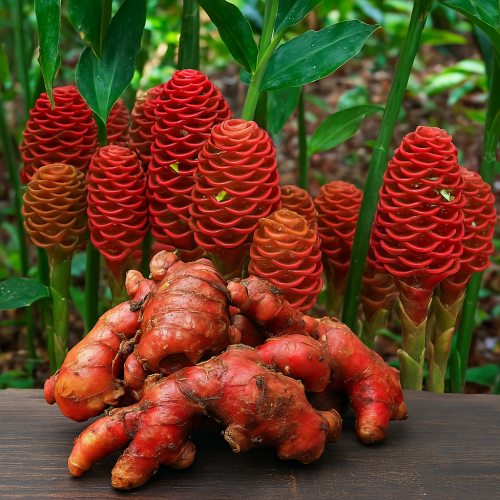
It sends up tall, leafy stalks from knobby underground rhizomes, while its flowers rise separately—vibrant, red, pinecone-shaped bracts filled with a cooling, fragrant gel. Energetically, this plant claims space gently but unmistakably, spreading horizontally through the earth while reaching vertically toward light. It thrives in contrast, holding both moisture and heat, rootedness and brightness.
Botanical Name: Zingiber zerumbet
Family: Zingiberaceae
Common Names: Red Ginger, Awapuhi, Shampoo Ginger, Pinecone Ginger
Plant Type: Perennial tropical herb
Part Used for Distillation: Fresh rhizome
Growth Habit: Upright, clumping; 3–6 feet tall
Flowering Season: Mid to late summer
Harvest Time for Distillation: Late summer to early fall, when rhizomes are fully mature
Family: Zingiberaceae
Common Names: Red Ginger, Awapuhi, Shampoo Ginger, Pinecone Ginger
Plant Type: Perennial tropical herb
Part Used for Distillation: Fresh rhizome
Growth Habit: Upright, clumping; 3–6 feet tall
Flowering Season: Mid to late summer
Harvest Time for Distillation: Late summer to early fall, when rhizomes are fully mature
Physical Characteristics:
-
Leaves: Long, narrow, bright green leaves arranged alternately along leafy stems
-
Stems: Distinct separation between leaf stalks and flowering stalks
-
Flowers: Dense, red, cone-like bracts that resemble pinecones; inner flowers are yellow-white and bloom from the cone
-
Rhizomes: Knobby, aromatic, pale yellow to tan in color
Native Habitat + Growth Conditions:
-
Native To: Southeast Asia and Polynesia
-
Preferred Soil: Rich, loamy, well-drained soil with high moisture retention
-
Sunlight: Partial shade to filtered sunlight
-
Climate: Tropical to subtropical; frost-sensitive and prefers humid environments
-
Ecological Notes: Excellent at colonizing disturbed or degraded soils; supports pollinators and contributes to ecological regeneration in its habitat
Energetic Botanical Signature
Red Ginger is the embodiment of grounded vitality. With its deep, spreading rhizomes and vertical elegance, it reflects a balance between stability and rise—earth and fire, root and bloom. It teaches us how to return to ourselves with presence, to circulate energy where it has pooled or gone dormant, and to activate without force.
Red Ginger is the embodiment of grounded vitality. With its deep, spreading rhizomes and vertical elegance, it reflects a balance between stability and rise—earth and fire, root and bloom. It teaches us how to return to ourselves with presence, to circulate energy where it has pooled or gone dormant, and to activate without force.
This plant moves. It stirs blood, lymph, emotion, breath—and does so with a kind of radiant confidence. It doesn’t push; it pulses. Where we’ve held back, shut down, or burned out, Red Ginger comes in like a sacred instigator: waking, warming, and restoring flow.
It whispers: you don’t have to fight to take up space—you only need to remember it was always yours.
