
Personal Use
Warm | Spiced | Deeply Restorative
Mace CO₂ does not come in sharp. It comes in warm, round, golden, and a little mysterious — like spice rising from the body instead of landing on top of it. The aroma is sweet-spiced, soft, woody, and slightly balsamic, with that familiar nutmeg-like warmth, but smoother, deeper, and more sensual. It feels like the body exhaling after holding itself too tightly for too long.
This is not bright stimulation. It is heat with depth. Warmth with a pulse. A slow return of appetite, comfort, circulation, and inner steadiness.
Mace CO₂ carries the medicine of the aril — the red, lace-like covering that wraps around the nutmeg seed. There is something important in that. This is protective spice. Not armor. Not shutdown. More like warmth returning around the center of the body, around the belly, around the places that have felt cold, tight, underfed, or emotionally braced.
This extract is for the belly that clenches. For the body that has gone cold from stress. For the nervous system that needs warmth without being pushed. For the person who is exhausted, but not asking to be jolted awake — just called back gently, honestly, and with a little fire.
Stillpoint’s Mace CO₂ Extract comes from the dried aril of Myristica fragrans, the same tree that gives us Nutmeg. Mace has a long history as a culinary and traditional botanical ally, valued for its warming, aromatic, digestive, comforting, and restorative qualities. In CO₂ form, the aroma feels fuller and more rounded than a typical steam-distilled oil, with a rich spice depth that makes it beautiful in low dilution.
This extract is for warmth. For digestive comfort. For nervous system softening. For sensuality without performance. For calling the body back into its center when everything has been clenched too damn long.
Therapeutic Applications
Digestive Warmth + Abdominal Comfort
- Mace CO₂ is traditionally aligned with digestive warmth, especially when the belly feels cold, tense, bloated, or slow-moving.
- May assist in abdominal massage blends when digestion feels tight, sluggish, or uncomfortable from stress or nervous system contraction.
- Especially useful when the belly is not just physically uncomfortable, but emotionally guarded — that “I’m holding everything in my gut” feeling.
- Blends beautifully with Ginger, Cardamom, Sweet Orange, Fennel, Coriander Seed, or Black Pepper in formulas meant to support warmth, movement, and digestive ease.
- Best used in very low dilution. Mace has fire, depth, and potency. This is not an oil/extract to dump into a blend like glitter at a preschool craft table.
Cold Tension + Muscular Comfort
- Mace CO₂ may be useful in warming massage blends for areas that feel cold, tight, contracted, or slow to release.
- Particularly suited for muscular discomfort that feels connected to chill, holding, stress, or lack of movement rather than sharp, acute irritation.
- Can bring a gentle warming quality to body oils, salves, and massage formulas when the goal is comfort, circulation, and softening of held tension.
- Pairs well with Plai, Ginger, Black Pepper, Rosemary, Sweet Marjoram, or Copaiba when deeper warmth and physical ease are desired.
- This is not an aggressive “burn through it” kind of warmth. Mace is more like steady heat under the surface — slower, rounder, and more enveloping.
Nervous System Warmth + Emotional Settling
- Mace CO₂ may support the emotional body when stress has created coldness, collapse, guardedness, or a sense of being disconnected from pleasure and ease.
- Its warm, sweet-spiced aroma can help create a sense of safety, comfort, and internal softening without becoming heavy or sedating.
- Useful in blends for emotional depletion, winter heaviness, grief-held tension, or the kind of exhaustion where the system does not need more pressure — it needs warmth.
- Combines beautifully with Frankincense, Sandalwood, Vetiver, Cedarwood, Sweet Orange, or Vanilla CO₂ when the intention is grounding, comfort, and gentle restoration.
- This is an extract for coming back into the body slowly — not with a shove, but with warmth, scent, and enough fire to remind you that you are still here.
Sensual Vitality + Creative Fire
- Mace CO₂ has a naturally sensual quality — warm, spiced, intimate, and body-centered without being overly sweet or performative.
- May be useful in anointing oils, body oils, or personal aromatic blends intended to support embodiment, pleasure, confidence, and creative warmth.
- Especially helpful when sensuality has gone quiet because of stress, grief, exhaustion, shame, or long-term disconnection from the body.
- Blends beautifully with Jasmine, Rose, Sandalwood, Patchouli, Vanilla CO₂, Cardamom, or Sweet Orange in formulas that support warmth, intimacy, and reconnection.
- Mace does not scream “passion.” It whispers, “come back to your body.” Honestly, that is the deeper medicine anyway.
This is an extract that warms the center. Belly, body, breath, desire, and nervous system. Not flashy. Not frantic. Just the slow golden return of heat where life has gone a little cold.
Traditional Use
Digestive Warmth, Comfort + Restoration
Mace has been used for centuries across Ayurvedic, Unani, Chinese, folk, culinary, and traditional medicine systems, where the dried aril of Myristica fragrans was valued as a warming, aromatic, digestive, carminative, comforting, and restorative spice. The same tree gives us both Nutmeg and Mace: Nutmeg from the seed, Mace from the red, lace-like aril that wraps around it.
And that matters.
Mace is not the seed. It is the covering. The veil. The protective red web around the center. So even before we get into the old therapeutic uses, the plant is already telling us something: this is medicine for warmth around the core.
Historically, Mace was used when the stomach was unsettled, digestion was slow, the body felt cold, appetite was low, or the system needed gentle stimulation without harshness. Traditional references describe Nutmeg and Mace as aromatic, stimulant, and carminative spices, used for flatulence, colic, dyspepsia, diarrhea, nausea, and stomach discomfort.
This was never just “holiday spice.”
Mace was kitchen medicine. Belly medicine. Warm-the-center medicine. The kind of plant ally people reached for when the body needed heat, movement, comfort, and a little steadiness brought back into the room.
Digestive Warmth + Stomach Comfort
-
Mace has long been used in traditional systems to support digestion, especially when the stomach feels cold, tense, unsettled, or slow.
-
Traditionally valued as a carminative, it was used to help ease gas, bloating, flatulence, colic, and general digestive discomfort.
-
In Ayurvedic and Far Eastern traditional medicine, Nutmeg and Mace were used to calm the stomach and support digestive and nervous system concerns.
-
Mace was especially suited for digestion that feels heavy, chilly, nervous, or locked up — not hot, inflamed, and angry, but cold, stuck, and guarded.
-
This is the old medicine of warming the belly so the body can soften enough to function again.
Nausea, Appetite + Sluggish Assimilation
-
Traditional references describe the aril of Myristica fragrans — Mace — as being used for nausea, stomach discomfort, and digestive unease.
-
In older digestive use, Mace was valued when appetite was low or food felt difficult to process.
-
Its aromatic warmth made it useful in culinary and medicinal preparations where digestion, appetite, and assimilation needed support.
-
Traditionally, this was not about forcing the body. It was about kindling warmth in the center so digestion could wake up and do its work.
-
Mace belongs in that ancient category of spices that knew the kitchen and the apothecary were never really separate. People just got weird and modern and pretended they were.
Coldness, Weakness + Low Vitality
-
Mace was traditionally understood as a warming spice, used when the body needed heat, stimulation, and restoration.
-
In Unani tradition, Myristica fragrans was described as hot and dry in temperament and used as a digestive, carminative, appetizer, exhilarant, stomachic, nervine, and tonic.
-
This makes Mace appropriate for old-style formulas meant to support people who felt depleted, cold, flat, weak, or low in vitality.
-
It was not “energy” in the frantic sense. It was warmth returning. Appetite returning. The body remembering that it still has a center.
-
Mace carries the old spice medicine of rekindling — not blasting the system awake, but bringing gentle fire back into what has gone dull.
Nervous System Comfort + Settling
-
Historical and traditional sources connect Nutmeg and Mace with nervous system support, including use for nervous complaints, headaches, insomnia, and calming the stomach.
-
Mace’s warmth has traditionally been linked not only to digestion, but to comfort — the kind of comfort that begins in the belly and spreads through the whole system.
-
Useful in the traditional sense when tension, worry, or depletion settled into the gut and made the body feel guarded.
-
This is not sedative medicine in the heavy-handed sense. It is more like spiced steadiness.
-
Mace warms the nervous belly — and sometimes that is exactly where the whole damn story is being held.
Sensuality, Aphrodisiac Use + Embodied Warmth
-
Mace and Nutmeg have also appeared in traditional systems as warming aphrodisiac and vitality-supporting spices.
-
This was not separate from digestion, warmth, and vitality. In older medicine systems, sexual energy, digestive fire, nervous system tone, and life force were often understood as deeply connected.
-
Mace’s traditional aphrodisiac use fits its nature: warm, aromatic, stimulating, comforting, and body-centered.
-
It does not carry the medicine of performance. It carries the medicine of returning sensation to the body.
-
Sensuality here is not drama. It is heat. Presence. Appetite. Embodiment. The return of “yes” where the body has gone cold.
Mace is not flashy medicine.
It is old spice medicine. Belly medicine. Protective warmth. Comfort around the center.
In traditional use, Mace was called on when the stomach was unsettled, the body was cold, appetite was low, vitality had dimmed, or the nervous system needed warmth instead of force.
It does not shove the body into motion.
It wraps heat around the center and says: come back slowly. Come back honestly. Come back through the belly.
Botany
Myristica fragrans, commonly known as Nutmeg or Mace, is a tropical evergreen tree native to the Maluku Islands of Indonesia, historically known as the Spice Islands. A member of the Myristicaceae family, this tree is unusual because it gives us two distinct spices from one fruit: Nutmeg from the seed, and Mace from the red aril that surrounds the seed.
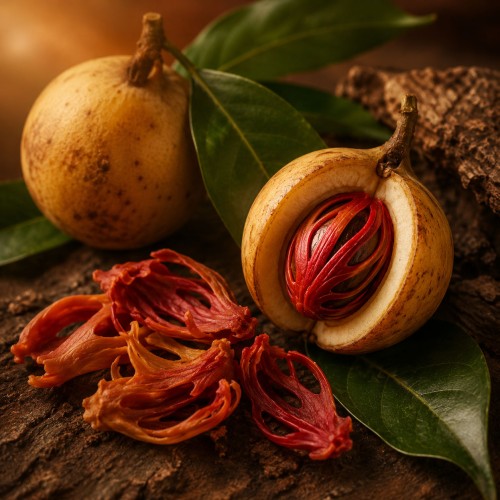
Mace is not a root, bark, leaf, flower, or seed. It is the dried aril — the delicate, lace-like covering that wraps around the nutmeg seed inside the fruit. When the fruit ripens, its fleshy outer husk splits open, revealing the shiny brown seed wrapped in a vivid red to crimson aril. That aril is removed, flattened, and dried, gradually shifting from red to orange, amber, or yellowish-brown as it cures.
The CO₂ extract is produced from this dried aril, capturing the warm, sweet-spiced, aromatic, and resinous depth of Mace in a fuller-bodied form than a typical steam-distilled oil. The plant’s medicine begins right there: not in the center seed itself, but in the protective covering around the center.
Myristica fragrans grows in warm, humid tropical climates with rich soil, consistent moisture, and protection from harsh drying conditions. It is a slow-growing evergreen tree with aromatic leaves, pale yellow to creamy flowers, and pendulous fruits that open when mature. The species is generally dioecious, meaning male and female flowers are usually borne on separate trees, though occasional trees may produce both.
This is not a plant of speed. It is a plant of ripening, containment, heat, fragrance, and revelation. The fruit must mature before it opens. The aril is hidden until the right moment. Then the whole thing splits and shows you the red lace around the seed. Honestly, that is the damn medicine.
Botanical Name: Myristica fragrans
Family: Myristicaceae
Common Names: Mace, Nutmeg, Nutmeg Tree
Plant Type: Tropical evergreen tree
Part Used for CO₂ Extraction: Dried aril surrounding the nutmeg seed
Growth Habit: Aromatic evergreen tree, commonly reaching around 9 meters / 30 feet in cultivation, though taller growth is possible in native conditions
Flowering Season: Varies by tropical region; small fragrant flowers are produced in warm, humid growing conditions
Harvest Time for Mace: Fruits are harvested when mature and split open, revealing the seed and red aril; the aril is removed and dried before extraction
Family: Myristicaceae
Common Names: Mace, Nutmeg, Nutmeg Tree
Plant Type: Tropical evergreen tree
Part Used for CO₂ Extraction: Dried aril surrounding the nutmeg seed
Growth Habit: Aromatic evergreen tree, commonly reaching around 9 meters / 30 feet in cultivation, though taller growth is possible in native conditions
Flowering Season: Varies by tropical region; small fragrant flowers are produced in warm, humid growing conditions
Harvest Time for Mace: Fruits are harvested when mature and split open, revealing the seed and red aril; the aril is removed and dried before extraction
Physical Characteristics
Leaves:
- Glossy, leathery, elliptic leaves
- Aromatic when crushed
- Deep green and evergreen, reflecting the plant’s steady tropical vitality
Trunk + Branches:
- Upright evergreen tree with tiered branching
- Slow-growing and aromatic
- Holds its medicine through structure, patience, and gradual maturation
Flowers:
- Small, pale yellow to creamy, waxy, fragrant flowers
- Male and female flowers are usually produced on separate trees
- Not showy in the dramatic sense, but deeply involved in the plant’s reproductive mystery
Fruit:
- Smooth, yellow to yellow-orange, oval or pear-shaped fruit
- Splits open naturally at maturity
- Reveals a shiny brown seed surrounded by a vivid red, lace-like aril
Seed + Aril:
- The seed becomes Nutmeg
- The red aril becomes Mace
- The aril is removed, flattened, and dried into blade-like pieces before use or extraction
- Mace begins red and soft, then dries into a more amber, orange, or yellowish-brown spice
Roots:
- Tropical tree root system adapted to warm, moisture-rich soils
- Requires stable growing conditions and does not thrive in cold, dry, or harsh environments
Native Habitat + Growth Conditions
Native To:
- Maluku Islands / Moluccas of Indonesia, especially the historic Spice Islands region
Preferred Soil:
- Rich, fertile, well-drained tropical soil
- Benefits from consistent moisture without waterlogging
Sunlight:
- Tropical sun with protection during early growth
- Often cultivated in warm, humid regions where young trees may benefit from shelter
Climate:
- Warm, humid tropical climate
- Sensitive to cold and drying winds
- Requires steady warmth, moisture, and time
Ecological Notes:
- Myristica fragrans is a tropical evergreen tree that produces one fruit holding two spices: Nutmeg at the center, Mace as the protective aril around it.
- Its growth reflects containment, maturation, hidden warmth, and revelation at the proper time.
- The aril’s role is not ornamental fluff. It surrounds, protects, and signals ripeness. That is the energetic doorway of Mace.
Energetic Botanical Signature
Mace surrounds the seed.
That is the first teaching.
It is not the hard center. It is not the outer fruit. It is the red, lace-like aril wrapped around what is still becoming — the threshold between hidden and revealed, protected and exposed, inner life and outer world.
The fruit of Myristica fragrans does not reveal the aril until it is ripe. It opens when the time is right. That is not weakness. That is botanical intelligence.
Energetically, Mace carries the medicine of protected warmth. It reminds us that some things need containment before they are ready to be seen. Some centers need heat before they can open. Some bodies need safety that still allows life to breathe.
This is not armor. And it is not forced exposure.
Mace teaches a different kind of protection — one that warms, steadies, and holds the center without shutting it down.
Its red aril is delicate but not fragile. Beautiful but not decorative. Soft, spiced, and potent, it carries the signature of digestive fire, sensual return, emotional steadiness, and the slow reawakening of appetite for life.
This is the plant teaching:
-
You do not have to rip yourself open to heal.
-
You do not have to harden to stay safe.
-
You do not have to perform aliveness before warmth has returned.
Mace is the medicine of the protected center — the slow return of heat, appetite, sensuality, and presence to the places that have been clenched too long.
It says: come back to the belly. Come back to the body. Come back when you are ready — but do come back.
