
Suggested Uses
nergetic Qualities
✔ Clarity
(Primary signature)
✔ Purifying
(Cuts stagnant emotional + energetic residue)
✔ Protective
(Historically and energetically accurate)
✔ Grounding
(Not warm grounding — but boundary, orientation, “return to center” grounding)
✔ Introspective
(It forces honesty; not gentle, but deeply illuminating)
✔ Transformative
(Bitter medicine that catalyzes change)
✔ Balancing
But only in the sense of clearing distortion to restore clarity
— not soft, harmonizing balancing.
✔ Source Energy
Yes — in the threshold, “piercing truth,” bitter-torch sense.
Personal Use
Artemisia absinthium
Bitter | Cutting | Lunar | Arcane
True Wormwood doesn’t whisper.
It slices through the haze like a cold wind across old stone. This is not an oil that tries to make friends — it’s an oil that wakes the dead parts of you that have gone numb from too much pretending.
It slices through the haze like a cold wind across old stone. This is not an oil that tries to make friends — it’s an oil that wakes the dead parts of you that have gone numb from too much pretending.
The aroma hits with that unmistakable Artemisia bitterness — green yet metallic, sharp yet strangely hollow, like the air right before a storm. There’s a dryness to it, but not a desert dryness… more like the dryness of bone, dust, and old knowledge.
There’s no sweetness here.
No cushioning.
No soft landing.
No cushioning.
No soft landing.
True Wormwood is the medicine of edges — the bitter fortification that reminds you where your boundaries actually live.
Let’s call it what it is:
-
piercingly herbaceous
-
bitter-green with a metallic snap
-
slightly camphoraceous without drifting into menthol
-
dry, austere, lunar-cold
-
a ghost of anise shadowing the edges, but stripped clean of warmth
Aromatically, it sits high and sharp — a blade rather than a root. Where muhuhu pulls you deep into the underworld, True Wormwood lifts you into the threshold space, that odd in-between where intuition sharpens and illusions crack.
This oil is steam distilled from the aerial parts of Artemisia absinthium, the classic “true wormwood” of European ritual, medicine, and magic. In old-world traditions, it was held as both protector and purifier — a plant that could strip away deceit, parasites (literal and energetic), and the fog of unclear thinking. Its bitterness was a teacher long before it ever touched absinthe.
The plant grows like a survivor — silvery, drought-tolerant, unbothered by poor soil, shaking off hardship as if it’s nothing. That same resilience shows up in the oil. True Wormwood doesn’t soothe. It doesn’t ground. It clarifies.
And not gently.
And not gently.
This oil is for:
Truth without anesthesia.
Boundaries that don’t apologize.
Cutting cords, illusions, and old psychic sludge.
Seeing what you’ve been avoiding — and finally having your feet under you enough to face it.
Boundaries that don’t apologize.
Cutting cords, illusions, and old psychic sludge.
Seeing what you’ve been avoiding — and finally having your feet under you enough to face it.
True Wormwood is not a comfort oil.
It’s a recalibration oil.
A “wake the hell up and step into the clean line of your power” oil.
It’s a recalibration oil.
A “wake the hell up and step into the clean line of your power” oil.
If muhuhu rebuilds your spine…
True Wormwood sharpens your sight.
True Wormwood sharpens your sight.
Traditional Use
Therapeutic Applications
(Traditional Use: Whole Plant + Aromatic Use of the Essential Oil)
Digestive Bitters + Stagnation Clearing (Primary Traditional Use)
Across Europe, North Africa, and the Middle East, Artemisia absinthium was one of the most relied-upon bitter tonics for sluggish digestion, lack of appetite, and gut heaviness.
While the essential oil is not used internally, its lineage informs its topical and aromatic role.
Topically and aromatically, True Wormwood may:
-
help ease abdominal tension linked to stress
-
support blends for “heavy” or stagnant digestive patterns
-
encourage a sense of internal wakefulness
-
assist in formulas intended for digestive fatigue or exhaustion
This plant has always been about movement — getting systems that have slowed or collapsed back online.
Traditional Anti-Parasitic + Antimicrobial Defense
Historically used as one of Europe’s strongest “cleansing” herbs, True Wormwood has a long history as a purifier for both internal and external pathogens.
Aromatically and topically, the essential oil may:
-
support blends intended for environmental clearing
-
help reinforce boundaries when the system feels vulnerable
-
contribute to topical preparations for areas needing surface cleansing
-
offer a sharp, resinous presence that feels protective
Not a gentle cleanser — a cutting, high-clarity one.
Circulation Activation + Surface-Level Musculoskeletal Support
Traditional compresses made from wormwood were applied to cold, stiff, or stagnant tissues.
Aromatically and diluted topically, True Wormwood may:
-
support blends for areas where circulation feels slow or underactive
-
help ease tension associated with surface-level stagnation
-
provide a light warming, mobilizing quality
-
add a “wake-up” note to muscle blends
This is not a deep structural oil.
It’s a surface activator, a sharp stimulator.
It’s a surface activator, a sharp stimulator.
Liver + Systemic Cleansing Associations
Historically used in teas and tinctures for liver stimulation, bile flow, and overindulgence recovery, wormwood holds a long-standing connection to internal “resetting.”
Externally and aromatically, the oil may:
-
support cleansing-style blends during times of stagnation
-
help shift the sensation of systemic heaviness
-
contribute a bitter, mobilizing note to detox-oriented formulas
Its bitterness expresses itself everywhere — physically, aromatically, energetically.
Respiratory Clearing + Air “Cutting”
Wormwood preparations were used for coughs, congestion, and seasonal breathing issues.
Aromatically, the essential oil may:
-
support clearer breathing during environmental challenges
-
ease chest tightness from emotional pressure or fatigue
-
help cut through “thick” or stale air patterns
-
enhance steam or diffusion rituals for clearing
This is a sharp air-cleaver, not a softening breath oil.
Skin Cleansing + Boundary Support
Historically applied in poultices and washes for irritated skin and slow-healing abrasions.
Topically (proper dilution), True Wormwood may:
-
support cleansing blends for minor skin discomfort
-
help restore tone in areas needing energetic or environmental clearing
-
reinforce the body’s sense of boundary at the skin level
-
offer a slightly astringent, toning presence
It doesn’t moisturize.
It clarifies.
It clarifies.
Nervous System — Mental Fog + Overwhelm Clearing
Traditionally used for cloudy thinking, emotional heaviness, and sluggish mental states.
Aromatically, True Wormwood may:
-
help cut through fog or confusion
-
support recalibration after emotional depletion
-
help restore sharper perception
-
bring boundaries back into focus when they’ve gone soft
It doesn’t sedate.
It awakens.
It awakens.
Seasonal Vitality + Recovery Context
Historically used before and after illness, during exhaustion, and during prolonged periods of low strength.
Aromatically and topically, True Wormwood may:
-
assist in blends meant for seasonal transitions
-
offer fortifying clarity during recovery
-
support vitality when the system feels dulled or overwhelmed
-
bring bitter, functional support to immune-oriented formulas
This is the “clear and mobilize” ally — not the nurturer.
Energetic Imprint Emerging from Traditional Use
(Not folklore — this is inferred directly from the therapeutic actions.)
True Wormwood carries:
-
clarity
-
boundary
-
sharpness
-
movement
-
purification
-
activation
-
bitter truth
It’s the plant that tells you:
Wake up. Clear it out. Get honest. Move.
Wake up. Clear it out. Get honest. Move.
Botany
Artemisia absinthium, known as True Wormwood, is a hardy perennial herb native to temperate regions of Europe, Western Asia, and North Africa, now naturalized across parts of North America. A member of the Asteraceae family, it stands apart from its relatives with its unmistakable silvery foliage, bitter chemistry, and sharp, penetrating aroma.
This is not a gentle Artemisia.
Not mugwort.
Not desert sagebrush.
True Wormwood is the bitter elder — the plant that announces itself before you even touch it.
Not mugwort.
Not desert sagebrush.
True Wormwood is the bitter elder — the plant that announces itself before you even touch it.
The essential oil is steam-distilled from the aerial parts — leaves and flowering tops — where the plant concentrates its thujone-rich chemistry, responsible for its metallic, bitter-green, incisive scent. This is a plant shaped by wind, sun, hardship, and mineral-rich soils, and it carries that austerity in every part of its being.
True Wormwood doesn’t bend to the environment — it confronts it.
And it survives.
And it survives.
- Botanical Name: Artemisia absinthium
- Family: Asteraceae
- Common Names: True Wormwood, Absinthium, Absinthe Wormwood, Green Ginger (older use), Madderwort
- Plant Type:Perennial herbaceous plant
- Part Used for Distillation:Aerial parts — leaves and flowering tops
Growth Habit
True Wormwood forms upright clumps ranging 0.8–1.5 meters tall, with multiple woody stems arising from a tough perennial root system. It is a plant built for survival more than beauty — though its silver foliage is striking in its own severe way.
-
Stems: Erect, grooved, covered in fine silvery hairs
-
Form: Shrubby, upright, spreading at the base
-
Growth Speed: Moderate; expands steadily in poor soil
Its resilience is legendary.
Give it drought, gravel, wind, or neglect — it will still grow.
Give it drought, gravel, wind, or neglect — it will still grow.
Flowering Season
Small, yellowish, nodding flower heads appear from mid-summer through early fall. They are not showy and not harvested for fragrance — they are ecological, not aromatic.
Harvest Time for Distillation
Traditionally gathered at the height of flowering, when the bitter principles and aromatic compounds are at their strongest.
The aerial parts must be harvested carefully — too late and the bitterness becomes harsh; too early and the aroma is underdeveloped.
Physical Characteristics
Leaves:
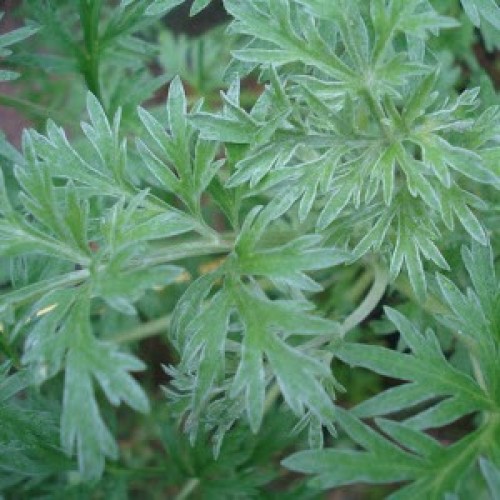
Silvery-green, deeply dissected, soft to the touch, covered in fine hairs that give them their “moonlit” appearance.
Fresh leaves are intensely bitter — almost shockingly so — and aromatic when crushed.
Fresh leaves are intensely bitter — almost shockingly so — and aromatic when crushed.
Stems:
Woody at the base, herbaceous toward the tips, coated in fine grey-white hairs.
Flowers:
Small, round, yellow, nodding clusters.
Bitter. Not fleshy. Not fragrant. Pure function.
Bitter. Not fleshy. Not fragrant. Pure function.
Roots:
A deep, fibrous system that anchors the plant in poor, shifting, or stony soil.
Aroma of the Plant (Not the Oil):
Sharp, bitter-green, metallic, herbaceous, with a penetrating edge — unmistakably Artemisia.
Native Habitat + Growth Conditions
Native To:
-
Europe (central, southern, eastern)
-
Western Asia
-
North Africa
Now naturalized widely, especially in:
-
North America
-
Australia
-
New Zealand
Preferred Soil:
-
Rocky, calcareous, or sandy soils
-
Well-drained, even if nutrient-poor
-
Thrives in alkaline soil conditions
Sunlight:
Full sun — it wants heat, light, and exposure.
Climate:
Tolerates cold winters, dry summers, wind, and drought.
This is a climate survivor.
This is a climate survivor.
Ecological Notes:
-
Highly aromatic leaves deter herbivores
-
Stabilizes poor and erosion-prone soils
-
Supports specific pollinators during late summer
-
Considered invasive in some disturbed habitats due to its adaptability
True Wormwood is a plant of edges — literal and metaphorical.
Roadsides, rocky slopes, abandoned lots, wastelands.
Places where most plants give up.
This one does not.
Roadsides, rocky slopes, abandoned lots, wastelands.
Places where most plants give up.
This one does not.
Energetic Botanical Signature
True Wormwood carries the energy of bitter clarity.
Where some plants soften or soothe, this one wakes, cuts, and exposes what’s stagnant.
Where some plants soften or soothe, this one wakes, cuts, and exposes what’s stagnant.
Its silver leaves reflect light like armor — a plant that stands between worlds:
solar in its resilience, lunar in its appearance, and bitter as truth itself.
solar in its resilience, lunar in its appearance, and bitter as truth itself.
Its signature themes emerge from how and where it grows:
-
survival in harsh, exposed environments
-
clarity in confusion
-
boundary in chaos
-
activation where things have gone slack
-
purification where things have grown stale
-
awakening in systems that have dulled or collapsed
This is not a nurturing plant.
It is a purifier, a boundary-setter, a wakener, an activator.
It is a purifier, a boundary-setter, a wakener, an activator.
Energetically, True Wormwood supports:
-
reclaiming mental clarity
-
cutting energetic stagnation
-
strengthening personal boundaries
-
moving internal heaviness
-
clearing what no longer belongs
-
transitioning out of emotional or physical fog
It is the plant that says:
Face what’s here. Let go of what isn’t. Move.
Face what’s here. Let go of what isn’t. Move.
