
Every order ships USPS Priority — $10.95 flat-rate USPS Priority shipping on all US orders, no minimum. Free shipping on domestic orders over $299.
Welcome to Stillpoint. Subscribe to our newsletter for sale details and new-product news · One discount code per order · Every order is hand-poured, packed with care in ceremony, and shipped as we receive it.

Mace CO₂ se Extract | Warmth + Digestive Support

Myristica fragrans

  • Mace CO₂ se Extract |  Warmth + Digestive Support

Average Rating: (see reviews)

$10.00 Ex Tax: $10.00

Essential Facts

  • Latin Name: Myristica fragrans
  • Country of Origin: Bahrain
  • Botanical Family: Myristicaceae
  • Plant Parts: Dried fruit
  • Note Classification: Middle/Base
  • Cultivation Method: Distiller is Certified Organic
  • Method of Extraction: CO2 Select Extraction
  • Extraction Date: June 2025
  • Approx. Shelf Life: 6 years
  • Chemical Family: Ethers, Monoterpenes
  • Aroma: Rich, Sensual, Slightly bitter, Soft, Spicy, Sweet, Warm, Woody
  • Energetic Applications: 1st Chakra - survival and support, 2nd Chakra - relationships, creation energy, 3rd Chakra - personal power, Grounding, Introspective, Protective, Transformative
  • Therapeutic Properties: Anti-rheumatic, Anti-spasmodic, Aphrodisiac, Carminative, Cephalic, Digestive stimulant, Digestive tonic, Nervine, Stimulant, Stomachic, Tonic, Warming
Notes & Use

Personal Use

Warm | Spiced | Deeply Restorative

Mace CO₂ does not come in sharp. It comes in warm, round, golden, and a little mysterious — like spice rising from the body instead of landing on top of it. The aroma is sweet-spiced, soft, woody, and slightly balsamic, with that familiar nutmeg-like warmth, but smoother, deeper, and more sensual. It feels like the body exhaling after holding itself too tightly for too long.

This is not bright stimulation. It is heat with depth. Warmth with a pulse. A slow return of appetite, comfort, circulation, and inner steadiness.

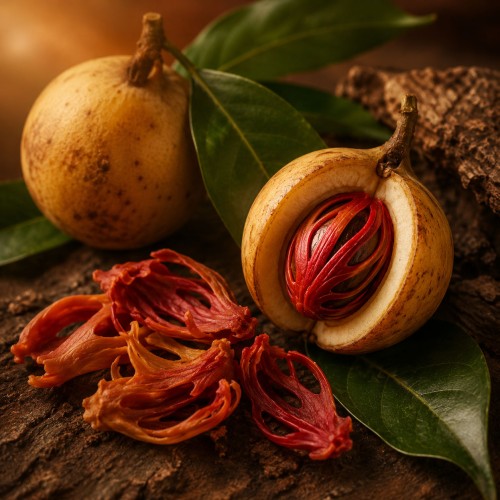
Mace CO₂ carries the medicine of the aril — the red, lace-like covering that wraps around the nutmeg seed. There is something important in that. This is protective spice. Not armor. Not shutdown. More like warmth returning around the center of the body, around the belly, around the places that have felt cold, tight, underfed, or emotionally braced.

This extract is for the belly that clenches. For the body that has gone cold from stress. For the nervous system that needs warmth without being pushed. For the person who is exhausted, but not asking to be jolted awake — just called back gently, honestly, and with a little fire.

Stillpoint’s Mace CO₂ Extract comes from the dried aril of Myristica fragrans, the same tree that gives us Nutmeg. Mace has a long history as a culinary and traditional botanical ally, valued for its warming, aromatic, digestive, comforting, and restorative qualities. In CO₂ form, the aroma feels fuller and more rounded than a typical steam-distilled oil, with a rich spice depth that makes it beautiful in low dilution.

This extract is for warmth. For digestive comfort. For nervous system softening. For sensuality without performance. For calling the body back into its center when everything has been clenched too damn long.

Therapeutic Applications

Digestive Warmth + Abdominal Comfort
  • Mace CO₂ is traditionally aligned with digestive warmth, especially when the belly feels cold, tense, bloated, or slow-moving.
  • May assist in abdominal massage blends when digestion feels tight, sluggish, or uncomfortable from stress or nervous system contraction.
  • Especially useful when the belly is not just physically uncomfortable, but emotionally guarded — that “I’m holding everything in my gut” feeling.
  • Blends beautifully with Ginger, Cardamom, Sweet Orange, Fennel, Coriander Seed, or Black Pepper in formulas meant to support warmth, movement, and digestive ease.
  • Best used in very low dilution. Mace has fire, depth, and potency. This is not an oil/extract to dump into a blend like glitter at a preschool craft table.
Cold Tension + Muscular Comfort
  • Mace CO₂ may be useful in warming massage blends for areas that feel cold, tight, contracted, or slow to release.
  • Particularly suited for muscular discomfort that feels connected to chill, holding, stress, or lack of movement rather than sharp, acute irritation.
  • Can bring a gentle warming quality to body oils, salves, and massage formulas when the goal is comfort, circulation, and softening of held tension.
  • Pairs well with Plai, Ginger, Black Pepper, Rosemary, Sweet Marjoram, or Copaiba when deeper warmth and physical ease are desired.
  • This is not an aggressive “burn through it” kind of warmth. Mace is more like steady heat under the surface — slower, rounder, and more enveloping.
Nervous System Warmth + Emotional Settling
  • Mace CO₂ may support the emotional body when stress has created coldness, collapse, guardedness, or a sense of being disconnected from pleasure and ease.
  • Its warm, sweet-spiced aroma can help create a sense of safety, comfort, and internal softening without becoming heavy or sedating.
  • Useful in blends for emotional depletion, winter heaviness, grief-held tension, or the kind of exhaustion where the system does not need more pressure — it needs warmth.
  • Combines beautifully with Frankincense, Sandalwood, Vetiver, Cedarwood, Sweet Orange, or Vanilla CO₂ when the intention is grounding, comfort, and gentle restoration.
  • This is an extract for coming back into the body slowly — not with a shove, but with warmth, scent, and enough fire to remind you that you are still here.
Sensual Vitality + Creative Fire
  • Mace CO₂ has a naturally sensual quality — warm, spiced, intimate, and body-centered without being overly sweet or performative.
  • May be useful in anointing oils, body oils, or personal aromatic blends intended to support embodiment, pleasure, confidence, and creative warmth.
  • Especially helpful when sensuality has gone quiet because of stress, grief, exhaustion, shame, or long-term disconnection from the body.
  • Blends beautifully with Jasmine, Rose, Sandalwood, Patchouli, Vanilla CO₂, Cardamom, or Sweet Orange in formulas that support warmth, intimacy, and reconnection.
  • Mace does not scream “passion.” It whispers, “come back to your body.” Honestly, that is the deeper medicine anyway.
This is an extract that warms the center. Belly, body, breath, desire, and nervous system. Not flashy. Not frantic. Just the slow golden return of heat where life has gone a little cold.

Traditional Use

Digestive Warmth, Comfort + Restoration

Mace has been used for centuries across Ayurvedic, Unani, Chinese, folk, culinary, and traditional medicine systems, where the dried aril of Myristica fragrans was valued as a warming, aromatic, digestive, carminative, comforting, and restorative spice. The same tree gives us both Nutmeg and Mace: Nutmeg from the seed, Mace from the red, lace-like aril that wraps around it. 

And that matters.

Mace is not the seed. It is the covering. The veil. The protective red web around the center. So even before we get into the old therapeutic uses, the plant is already telling us something: this is medicine for warmth around the core.

Historically, Mace was used when the stomach was unsettled, digestion was slow, the body felt cold, appetite was low, or the system needed gentle stimulation without harshness. Traditional references describe Nutmeg and Mace as aromatic, stimulant, and carminative spices, used for flatulence, colic, dyspepsia, diarrhea, nausea, and stomach discomfort.

This was never just “holiday spice.”

Mace was kitchen medicine. Belly medicine. Warm-the-center medicine. The kind of plant ally people reached for when the body needed heat, movement, comfort, and a little steadiness brought back into the room.

Digestive Warmth + Stomach Comfort
  • Mace has long been used in traditional systems to support digestion, especially when the stomach feels cold, tense, unsettled, or slow.
  • Traditionally valued as a carminative, it was used to help ease gas, bloating, flatulence, colic, and general digestive discomfort.
  • In Ayurvedic and Far Eastern traditional medicine, Nutmeg and Mace were used to calm the stomach and support digestive and nervous system concerns. 
  • Mace was especially suited for digestion that feels heavy, chilly, nervous, or locked up — not hot, inflamed, and angry, but cold, stuck, and guarded.
  • This is the old medicine of warming the belly so the body can soften enough to function again.
Nausea, Appetite + Sluggish Assimilation
  • Traditional references describe the aril of Myristica fragrans — Mace — as being used for nausea, stomach discomfort, and digestive unease. 
  • In older digestive use, Mace was valued when appetite was low or food felt difficult to process.
  • Its aromatic warmth made it useful in culinary and medicinal preparations where digestion, appetite, and assimilation needed support.
  • Traditionally, this was not about forcing the body. It was about kindling warmth in the center so digestion could wake up and do its work.
  • Mace belongs in that ancient category of spices that knew the kitchen and the apothecary were never really separate. People just got weird and modern and pretended they were.
Coldness, Weakness + Low Vitality
  • Mace was traditionally understood as a warming spice, used when the body needed heat, stimulation, and restoration.
  • In Unani tradition, Myristica fragrans was described as hot and dry in temperament and used as a digestive, carminative, appetizer, exhilarant, stomachic, nervine, and tonic. 
  • This makes Mace appropriate for old-style formulas meant to support people who felt depleted, cold, flat, weak, or low in vitality.
  • It was not “energy” in the frantic sense. It was warmth returning. Appetite returning. The body remembering that it still has a center.
  • Mace carries the old spice medicine of rekindling — not blasting the system awake, but bringing gentle fire back into what has gone dull.
Nervous System Comfort + Settling
  • Historical and traditional sources connect Nutmeg and Mace with nervous system support, including use for nervous complaints, headaches, insomnia, and calming the stomach. 
  • Mace’s warmth has traditionally been linked not only to digestion, but to comfort — the kind of comfort that begins in the belly and spreads through the whole system.
  • Useful in the traditional sense when tension, worry, or depletion settled into the gut and made the body feel guarded.
  • This is not sedative medicine in the heavy-handed sense. It is more like spiced steadiness.
  • Mace warms the nervous belly — and sometimes that is exactly where the whole damn story is being held.
Sensuality, Aphrodisiac Use + Embodied Warmth
  • Mace and Nutmeg have also appeared in traditional systems as warming aphrodisiac and vitality-supporting spices. 
  • This was not separate from digestion, warmth, and vitality. In older medicine systems, sexual energy, digestive fire, nervous system tone, and life force were often understood as deeply connected.
  • Mace’s traditional aphrodisiac use fits its nature: warm, aromatic, stimulating, comforting, and body-centered.
  • It does not carry the medicine of performance. It carries the medicine of returning sensation to the body.
  • Sensuality here is not drama. It is heat. Presence. Appetite. Embodiment. The return of “yes” where the body has gone cold.
Mace is not flashy medicine.
It is old spice medicine. Belly medicine. Protective warmth. Comfort around the center.

In traditional use, Mace was called on when the stomach was unsettled, the body was cold, appetite was low, vitality had dimmed, or the nervous system needed warmth instead of force.

It does not shove the body into motion.
It wraps heat around the center and says: come back slowly. Come back honestly. Come back through the belly.

Botany

Myristica fragrans, commonly known as Nutmeg or Mace, is a tropical evergreen tree native to the Maluku Islands of Indonesia, historically known as the Spice Islands. A member of the Myristicaceae family, this tree is unusual because it gives us two distinct spices from one fruit: Nutmeg from the seed, and Mace from the red aril that surrounds the seed.

Mace is not a root, bark, leaf, flower, or seed. It is the dried aril — the delicate, lace-like covering that wraps around the nutmeg seed inside the fruit. When the fruit ripens, its fleshy outer husk splits open, revealing the shiny brown seed wrapped in a vivid red to crimson aril. That aril is removed, flattened, and dried, gradually shifting from red to orange, amber, or yellowish-brown as it cures.

The CO₂ extract is produced from this dried aril, capturing the warm, sweet-spiced, aromatic, and resinous depth of Mace in a fuller-bodied form than a typical steam-distilled oil. The plant’s medicine begins right there: not in the center seed itself, but in the protective covering around the center.

Myristica fragrans grows in warm, humid tropical climates with rich soil, consistent moisture, and protection from harsh drying conditions. It is a slow-growing evergreen tree with aromatic leaves, pale yellow to creamy flowers, and pendulous fruits that open when mature. The species is generally dioecious, meaning male and female flowers are usually borne on separate trees, though occasional trees may produce both.

This is not a plant of speed. It is a plant of ripening, containment, heat, fragrance, and revelation. The fruit must mature before it opens. The aril is hidden until the right moment. Then the whole thing splits and shows you the red lace around the seed. Honestly, that is the damn medicine.

Botanical Name: Myristica fragrans
Family: Myristicaceae
Common Names: Mace, Nutmeg, Nutmeg Tree
Plant Type: Tropical evergreen tree
Part Used for CO₂ Extraction: Dried aril surrounding the nutmeg seed
Growth Habit: Aromatic evergreen tree, commonly reaching around 9 meters / 30 feet in cultivation, though taller growth is possible in native conditions
Flowering Season: Varies by tropical region; small fragrant flowers are produced in warm, humid growing conditions
Harvest Time for Mace: Fruits are harvested when mature and split open, revealing the seed and red aril; the aril is removed and dried before extraction

Physical Characteristics
Leaves:
  • Glossy, leathery, elliptic leaves
  • Aromatic when crushed
  • Deep green and evergreen, reflecting the plant’s steady tropical vitality
Trunk + Branches:
  • Upright evergreen tree with tiered branching
  • Slow-growing and aromatic
  • Holds its medicine through structure, patience, and gradual maturation
Flowers:
  • Small, pale yellow to creamy, waxy, fragrant flowers
  • Male and female flowers are usually produced on separate trees
  • Not showy in the dramatic sense, but deeply involved in the plant’s reproductive mystery
Fruit:
  • Smooth, yellow to yellow-orange, oval or pear-shaped fruit
  • Splits open naturally at maturity
  • Reveals a shiny brown seed surrounded by a vivid red, lace-like aril
Seed + Aril:
  • The seed becomes Nutmeg
  • The red aril becomes Mace
  • The aril is removed, flattened, and dried into blade-like pieces before use or extraction
  • Mace begins red and soft, then dries into a more amber, orange, or yellowish-brown spice
Roots:
  • Tropical tree root system adapted to warm, moisture-rich soils
  • Requires stable growing conditions and does not thrive in cold, dry, or harsh environments
Native Habitat + Growth Conditions
Native To:
  • Maluku Islands / Moluccas of Indonesia, especially the historic Spice Islands region
Preferred Soil:
  • Rich, fertile, well-drained tropical soil
  • Benefits from consistent moisture without waterlogging
Sunlight:
  • Tropical sun with protection during early growth
  • Often cultivated in warm, humid regions where young trees may benefit from shelter
Climate:
  • Warm, humid tropical climate
  • Sensitive to cold and drying winds
  • Requires steady warmth, moisture, and time
Ecological Notes:
  • Myristica fragrans is a tropical evergreen tree that produces one fruit holding two spices: Nutmeg at the center, Mace as the protective aril around it.
  • Its growth reflects containment, maturation, hidden warmth, and revelation at the proper time.
  • The aril’s role is not ornamental fluff. It surrounds, protects, and signals ripeness. That is the energetic doorway of Mace. 
Energetic  Botanical Signature
 
Mace surrounds the seed.
 
That is the first teaching.
It is not the hard center. It is not the outer fruit. It is the red, lace-like aril wrapped around what is still becoming — the threshold between hidden and revealed, protected and exposed, inner life and outer world.
 
The fruit of Myristica fragrans does not reveal the aril until it is ripe. It opens when the time is right. That is not weakness. That is botanical intelligence.
Energetically, Mace carries the medicine of protected warmth. It reminds us that some things need containment before they are ready to be seen. Some centers need heat before they can open. Some bodies need safety that still allows life to breathe.
 
This is not armor. And it is not forced exposure.
 
Mace teaches a different kind of protection — one that warms, steadies, and holds the center without shutting it down.
Its red aril is delicate but not fragile. Beautiful but not decorative. Soft, spiced, and potent, it carries the signature of digestive fire, sensual return, emotional steadiness, and the slow reawakening of appetite for life.
 
This is the plant teaching:
  • You do not have to rip yourself open to heal.
  • You do not have to harden to stay safe.
  • You do not have to perform aliveness before warmth has returned.
Mace is the medicine of the protected center — the slow return of heat, appetite, sensuality, and presence to the places that have been clenched too long.


It says: come back to the belly. Come back to the body. Come back when you are ready — but do come back.
Energetics

Energetic Properties

Protected Center • Belly Warmth • Sensual Reawakening
Mace CO₂ does not blast the door open.
It warms the threshold.

This is an extract for the places in us that have been clenched, hidden, guarded, or quietly waiting for enough safety to return. Its medicine is warm, spiced, intimate, and deeply body-centered — not loud, not frantic, not performative.

Mace carries the energy of the red aril: the protective covering around the nutmeg seed. That gives it a very specific spiritual and emotional signature. This is not hard protection. This is not “build the wall higher” medicine. This is warmth around the center so life can begin moving again.

She says:
  • You do not have to force yourself open.
  • You do not have to stay closed forever either.
  • Come back through warmth.
Mace CO₂ supports the emotional body when stress, grief, shame, exhaustion, or long-term bracing has made the system feel cold, tight, or disconnected from pleasure. It helps soften the places that have been protecting themselves for good reason, while still honoring the need for safety.

This is the important distinction: Mace does not rip the guard down.  She warms what the guard has been protecting.

Energetic Themes
  • Warming the emotional center after stress, grief, depletion, or long-term bracing
  • Supporting the return of appetite — for food, pleasure, life, creativity, intimacy, and embodiment
  • Helping soften guardedness without stripping away necessary protection
  • Supporting digestive fire when the belly holds tension, worry, or emotional contraction
  • Encouraging sensuality without performance, pressure, or shame
  • Bringing comfort to places that feel cold, tight, undernourished, or disconnected
  • Supporting the slow return of vitality after emotional shutdown or exhaustion
  • Helping the body feel safe enough to inhabit itself again
  • Holding space for emotional ripening instead of forced exposure
  • Supporting transitions where something inside is ready to open, but only with warmth, patience, and respect
Emotional Support
Emotionally, Mace CO₂ may be supportive when someone feels guarded, shut down, cold inside, or disconnected from their own desire and vitality.
This is not the oil for pushing someone into bravery before they are ready. This is not “get over it” medicine. Thank God, because no.

Mace is for the person who has been holding too much in the belly. The one who is technically functioning, but not really inhabiting the body with warmth. The one whose nervous system has confused protection with closure.

Mace may be supportive for:
  • Emotional coldness after stress or grief
  • Guardedness around intimacy, pleasure, or receiving
  • Shame held in the belly or sacral center
  • Exhaustion that has flattened desire
  • Fear of being seen before one feels ready
  • Feeling disconnected from sensuality, appetite, creativity, or body wisdom
  • The need for comfort without collapse
  • The need for protection without hardening
Energetically, Mace helps soften the frozen edge around the center. It does not demand a grand opening. It simply brings enough heat that the inner life can begin to move again.

Spiritual Use
Spiritually, Mace CO₂ is a beautiful ally for rituals of embodiment, protected opening, sensual healing, digestive fire, emotional warmth, and returning to the body after contraction.
It can be especially supportive when someone is not ready for big outward movement, but knows something inside needs to thaw.
Use Mace CO₂ when the intention is:
  • Returning to the body after grief, stress, shame, or emotional shutdown
  • Warming the belly before meditation, ceremony, breathwork, journaling, or self-inquiry
  • Creating rituals around ripening, readiness, transition, and inner safety
  • Supporting the theme of “I can open when I am ready”
  • Reclaiming pleasure without forcing it, performing it, or turning it into another damn assignment
  • Anointing the belly, sacral area, solar plexus, or heart space in very low dilution
  • Creating protection rituals that keep the heart warm instead of locked
  • Working with the body as sacred ground, not a problem to be fixed
Mace is especially useful in rituals where the work is not about pushing forward, but about returning inward with enough warmth to listen.

Chakra Connections
Mace CO₂ speaks strongly to the Sacral Chakra, Solar Plexus Chakra, and Root Chakra, with a gentle bridge into the Heart Chakra when emotional protection and tenderness are part of the work.'

Root Chakra | Safety, Grounding + Embodied Presence
Mace supports the Root Chakra through warmth, containment, and the feeling of being safely held in the body.
It may be useful when the system feels:
  • Cold or disconnected
  • Ungrounded after stress or grief
  • Unsafe in the body
  • Overexposed or energetically raw
  • In need of warmth, stability, and basic comfort
Mace does not ground by making the body heavy. It grounds by warming the center and helping the nervous system remember, “I am here. I am held. I can return slowly.”

Sacral Chakra | Sensuality, Pleasure + Creative Flow
The Sacral Chakra is one of Mace CO₂’s strongest energetic homes.
Its warm, spiced, sensual nature supports the return of pleasure, appetite, creativity, emotional flow, and embodied desire — especially when those parts have gone quiet from shame, grief, exhaustion, or long-term self-protection.
Mace may be useful in Sacral Chakra work for:
  • Reconnecting with sensuality
  • Softening shame around pleasure or desire
  • Supporting creative warmth
  • Restoring emotional flow after contraction
  • Inviting intimacy without pressure
  • Remembering that the body is not just a survival vehicle — it is a living, feeling, sacred place
This is not performative sensuality. This is not fake goddess cosplay. This is the real thing: warmth returning to the waters.

Solar Plexus Chakra | Digestive Fire, Confidence + Inner Heat
Mace supports the Solar Plexus through digestive warmth, confidence, and the slow return of inner fire.
It may be helpful when the will feels dim, the belly feels tight, or confidence has been buried under stress and emotional bracing.
Mace may support Solar Plexus work around:
  • Digestive fire and assimilation
  • Quiet confidence
  • Inner warmth
  • Personal power without force
  • Emotional digestion
  • Moving from guardedness into steady presence
It does not bring the sharp push of Black Pepper. Mace brings a more rounded fire — softer, sweeter, but still deeply activating at the center.

Heart Chakra | Warm Protection + Softening Without Collapse
Mace is not primarily a Heart Chakra oil, but it can be deeply supportive when the heart has gone guarded because the body does not feel safe.
It helps create warmth beneath the armor.
Mace may support Heart Chakra work when someone needs:
  • Protection without emotional shutdown
  • Softening without overexposure
  • Warmth around grief
  • Tenderness with boundaries
  • The ability to stay open without becoming porous
  • A reminder that guardedness was once intelligent, but may not need to run the whole damn show forever
Mace does not demand vulnerability. It creates the conditions where vulnerability may eventually become possible.

Ritual + Blending Uses
Mace CO₂ can be used in very low dilution in anointing oils, body oils, belly oils, sensual blends, protection oils, meditation blends, and ritual formulas where warmth, embodiment, and protected opening are the intention.

It pairs beautifully with:
  • Cardamom for digestive warmth, emotional clarity, and gentle movement
  • Ginger for deeper heat, circulation, and vitality
  • Sweet Orange for brightness, comfort, and emotional lift
  • Sandalwood for sacred embodiment and grounding
  • Frankincense for breath, spirit, and inner steadiness
  • Vanilla CO₂ for softness, sensuality, and comfort
  • Rose for heart warmth and emotional tenderness
  • Jasmine for sensual awakening and sacred pleasure
  • Patchouli for embodiment, grounding, and sensual depth
  • Vetiver for rooted safety and nervous system settling
  • Coriander Seed for digestive ease, lightness, and emotional warmth
This is the extract for warming the center — not so you can rush out into the world and prove something, but so you can remember there is still life inside you.

Affirmation
  • I can stay protected without staying closed.
  • I can return to my body with warmth, patience, and trust.
  • I do not have to force myself open before I am ready.
Energetic Note
Mace CO₂ carries the medicine of the protected center. It helps warm the belly, soften emotional bracing, and invite the slow return of appetite, sensuality, creativity, and presence. This is not the fire that burns through everything. This is the fire that waits at the center until the body remembers it is safe enough to come home.

Traditional & Folklore

Before it became a flavor in baked goods, holiday blends, custards, sauces, and old family recipes, Mace was part of the great spice story — traded, guarded, fought over, prescribed, cooked with, and valued as both medicine and treasure.

Mace comes from Myristica fragrans, the same tree that gives us Nutmeg. But Mace is not the seed. It is the red, lace-like aril wrapped around the seed — the bright covering revealed only when the fruit ripens and splits open.

That image matters.

In folklore and energetic understanding, Mace holds the mystery of hidden warmth, protection, ripening, and revelation. It is what appears when the fruit is ready to open. Not before. Not because someone forced it. Because the timing was right.

This was never just spice.
This was warmth, appetite, protection, sensuality, digestion, and value wrapped around the seed of life.

Old Spice Medicine
Across traditional systems, Mace was used as a warming aromatic spice, often connected with digestion, stomach comfort, appetite, and vitality.

It belonged to the old category of kitchen medicine — the kind of plant people reached for before the kitchen and the apothecary got divorced by modern thinking.

Mace was used when the body needed:
  • Warmth in the belly
  • Support for sluggish digestion
  • Help with gas, bloating, or abdominal discomfort
  • Appetite and assimilation
  • Comfort when the stomach felt cold, nervous, or unsettled
  • Gentle stimulation when vitality felt low
Energetically, this gives Mace the medicine of rekindling the center.

Not explosive fire. Not sharp force. A slower, sweeter, spiced warmth that helps the body remember how to receive, digest, and soften.

The Red Aril + Protective Magic
The folklore of Mace begins with its form.
It is red. It is lacy. It surrounds the seed.

That makes it a natural symbol of protection, containment, and sacred covering. Not the kind of protection that locks life away, but the kind that keeps the center warm until it is ready.
In energetic work, Mace can be understood as a plant ally for:
  • Protecting the vulnerable center without shutting it down
  • Holding warmth around grief, shame, fear, or emotional contraction
  • Creating boundaries that still allow tenderness
  • Supporting people who feel exposed, raw, or not quite ready to open
  • Helping the body remember that safety and softness can exist together
This is not “don’t bring that crap over here” protection like Black Pepper.
Mace is quieter.

It says: “This center is sacred. We are not throwing it open for every fool with shoes.”
And honestly, good.

Sensuality, Fertility + Embodied Warmth
Because Mace has long been associated with warmth, appetite, vitality, and stimulation, it also carries traditional connections to sensuality and aphrodisiac use.

But this is not cheap seduction medicine.
Mace is not about performance. It is not about pushing desire. It is not about becoming some ridiculous candlelit version of yourself with a silk robe and a fake voice. What a world.

Mace supports sensuality through warmth, comfort, appetite, and embodiment.
Its traditional aphrodisiac thread makes sense because sexual energy, digestive fire, creativity, and life force have always been linked in older systems of medicine. When the belly is cold, the body braced, the nervous system exhausted, and the spirit guarded, pleasure often disappears first.

Mace helps call that warmth back.

It carries the folklore of:
  • Sensual return
  • Creative fire
  • Reawakening appetite
  • Softening shame around pleasure
  • Reconnecting to the body as a living, feeling place
  • Allowing desire to rise from safety instead of pressure
This is sacred sensual medicine. Warm. Spiced. Embodied. Patient.

Wealth, Trade + Hidden Value
Like Nutmeg, Mace was part of the historic spice trade and was once incredibly valuable. These spices moved through empires, trade routes, colonial hunger, medicine systems, kitchens, and royal courts.

That history is complicated as hell, because spice wealth was never just romantic adventure. It also carried conquest, control, exploitation, and blood. We do not need to sanitize that.

But energetically, Mace still carries the signature of value.
A small, delicate part of the fruit became precious because of its aroma, flavor, potency, rarity, and medicine. It reminds us that what is hidden, delicate, or easily overlooked may hold enormous power.

Mace teaches:
  • Value is not always loud
  • Delicacy is not weakness
  • What protects the center may be as powerful as the center itself
  • Small medicine can carry enormous force
  • Beauty and potency can live in the same body
Mace is not flashy, but it is valuable.
And that is a very different thing.

Dream, Mystery + Inner Ripening
Mace also belongs to the world of mystery spices — warm, fragrant, intoxicating, and slightly dreamlike.
Its connection to Nutmeg gives it an old association with sleep, dreams, altered states, and inner worlds. Used wisely and respectfully, it carries that threshold quality: not fully waking, not fully sleeping, but somewhere in the warm interior landscape where the psyche speaks in symbols.

Energetically, Mace supports the inner ripening process.

The fruit opens when it is ready. The red aril is revealed when maturity has been reached. The seed is exposed, but not abandoned. It is still wrapped.

That is a powerful spiritual teaching.
Mace is for the moments when something inside is preparing to open, but not quite ready to be handled by the world.

It supports:
  • Dreamwork and inner listening
  • Rituals of readiness and transition
  • Protection during emotional vulnerability
  • Softening around old shame or guardedness
  • Trusting the timing of one’s own unfolding
  • Honoring what is still forming beneath the surface
Mace does not rush revelation.
It waits for ripeness.

The Medicine of the Protected Center
Mace is old spice medicine.

It warms the belly, comforts the nervous system, protects the vulnerable center, and helps the body remember appetite — for food, touch, pleasure, creativity, warmth, and life itself.

In folk memory, Mace lives as the red covering around the seed: delicate but not weak, beautiful but not decorative, protective but not closed.

It does not say, “Open now.”
It says, “Warm first. Ripen first. Trust the center. Then open.”
Chemistry

Chemical Components

Spiced Warmth, Aromatic Depth + Potent Inner Fire
Mace CO₂ has chemistry with a pulse.

It is warm, sweet-spiced, aromatic, slightly woody, and softly penetrating — but underneath that beautiful spice is a serious chemical backbone. This extract is not just “pretty warmth.” It is concentrated plant fire from the dried aril of Myristica fragrans, produced by supercritical CO₂ extraction.

According to the supplier specification, Mace CO₂-se extract contains approximately 75–90% essential oil, along with 10–30% myristicin, and additional naturally occurring aromatic compounds including elemicin, safrole, methyl eugenol, and monoterpenes, especially α-pinene, β-pinene, and sabinene.

This is not a simple citrus-bright oil. It is not a soft floral. It is not a sleepy base note. Mace CO₂ lives in the tension between volatile aromatic lift, warm spice depth, and potent phenylpropanoid-type constituents that require respect.

It has beauty, yes.
It also has teeth.
And that is exactly why we use it wisely, in low dilution, with clear purpose.

Main Chemical Families + Constituents

Volatile Essential Oil Fraction
The supplier specification lists Mace CO₂ as containing 75–90% essential oil, meaning most of this extract is made up of volatile aromatic compounds that give Mace its characteristic warm, spicy, fragrant profile.
This essential oil fraction contributes to:
  • The warm, sweet-spiced aroma
  • The aromatic lift that reaches the senses quickly
  • The traditional association with digestive warmth and stomach comfort
  • The extract’s use in perfumery, cosmetics, and fragrance applications
  • The feeling of warmth moving through the belly and body
Energetically, this volatile fraction is the part of Mace that rises. It carries the scent upward while the deeper spice pulls awareness back into the center.

That is part of Mace’s magic: it lifts and warms at the same time.

Monoterpenes
α-Pinene, β-Pinene + Sabinene
The supplier notes that Mace CO₂ contains monoterpenes, mainly α-pinene, β-pinene, and sabinene.
These lighter aromatic molecules help create the brighter, more diffusive part of the scent. They keep Mace from becoming too dense or heavy, giving the extract lift, movement, and that subtle fresh-spiced edge beneath the warmth.

Monoterpenes may contribute to:
  • Aromatic brightness and diffusion
  • A sense of movement in the blend
  • The fresh, spicy lift beneath the sweet warmth
  • Traditional digestive and clearing associations
  • The feeling that warmth is spreading rather than sitting heavily in one place
Energetically, these monoterpenes are the breath moving through the spice.

They keep the fire from becoming stagnant. They help Mace feel warm, alive, and mobile rather than thick, sleepy, or overly heavy.

Myristicin
Myristicin is one of the defining constituents here, and it deserves respect.
The supplier specification lists 10–30% myristicin in this Mace CO₂ extract.

That is a meaningful amount, and it is one of the reasons this material needs careful formulation. Myristicin is naturally found in Myristica fragrans and contributes to the characteristic warm, spicy, nutmeg-like aromatic profile. It is part of what gives Mace its depth, potency, and slightly intoxicating aromatic quality.

Myristicin may contribute to:
  • The deep, warm, characteristic Mace aroma
  • The extract’s rich spice body
  • The traditional association with warmth, belly comfort, and inner stimulation
  • The dreamlike, mysterious, threshold-like quality of the aroma
  • The need for cautious, low-dose aromatic and topical use
Energetically, myristicin feels like the hidden ember inside the aril.
It is not the bright spark on top. It is the deeper, strange, interior warmth — the part that says this plant is not playing around.

Elemicin
Elemicin is another naturally occurring aromatic constituent listed in the supplier specification.
In the aroma, elemicin contributes to the warm, spicy, slightly sweet, and complex character of Mace. It belongs to the deeper aromatic personality of the extract — the part that makes Mace feel less like a simple spice note and more like a full-bodied, old-world aromatic.

Elemicin may contribute to:
  • Sweet-spiced depth
  • Warm aromatic complexity
  • The soft, almost balsamic undertone of the extract
  • The sensual and interior quality of the aroma
  • The feeling of warmth held around the center
Energetically, elemicin supports the “inner room” feeling of Mace.
It is warm, enclosed, fragrant, and intimate — like stepping into a space where something has been waiting to ripen.

Safrole + Methyl Eugenol
This is where we tell the truth and do not get cute.

The supplier specification lists safrole and methyl eugenol as naturally occurring constituents in Mace CO₂, and also notes that these are limited substances under food and cosmetic regulations.

The Safety Data Sheet classifies the extract with several hazard statements, including skin irritation, possible allergic skin reaction, suspected genetic defects, suspected cancer, aspiration hazard, flammability, and aquatic toxicity.

That does not mean “panic.”

It means formulate like a grown-up.

Safrole and methyl eugenol are part of whythis material must be used carefully, conservatively, and within appropriate safety limits. They also help explain why Mace CO₂ has such aromatic intensity and why a very small amount can carry a whole blend.

These constituents reinforce the need for:
  • Very low dilution
  • Professional formulation
  • No internal use unless under properly qualified guidance and within applicable regulations
  • No direct skin application
  • Careful attention to dermal safety limits
  • Avoiding use with children, during pregnancy, and in vulnerable populations unless guided by a qualified professional
  • Respect for regulatory limits in cosmetic and aromatic products
Energetically, this is the boundary line in the chemistry.
Mace is warm, beautiful, sensual, and restorative — but it is not casual. Its chemistry says: use me with reverence, precision, and restraint.

Good medicine often has boundaries.

Minor + Trace Components
Like all botanicals, the exact chemistry of Mace CO₂ can vary depending on growing conditions, harvest, drying, storage, origin, and extraction parameters.

The supplier describes this extract as a yellow to light red, clear oil with typical smell, produced from dried Myristica fragrans arillodes through supercritical CO₂ extraction, with no solvent residues.

Minor and trace constituents may contribute to:
  • Aroma complexity
  • Warmth and spice nuance
  • Slight woody or balsamic undertones
  • The fuller-bodied profile of the CO₂ extract
  • Differences between Mace CO₂ and a simple steam-distilled essential oil
This is part of why CO₂ extracts can feel so complete. They often hold a rounder, richer aromatic body than the volatile oil alone.

Therapeutic Implications of This Chemistry

Digestive Warmth
The warm, spicy, aromatic chemistry of Mace CO₂ aligns with the plant’s traditional use for digestive and intestinal concerns. The supplier specification notes traditional use of Mace in Ayurvedic medicine for digestive or intestinal problems, and in Indonesian folk medicine for stomach ailments, pain, and rheumatism, while also clearly stating that effectiveness has not been proven.
In topical belly blends, Mace CO₂ may be chosen when the intention is:
  • Warmth around the abdomen
  • Support for sluggish-feeling digestion
  • Comfort when the belly feels cold, tense, or guarded
  • Aromatic support for appetite and assimilation
  • Helping the body soften around the center
This is belly fire, but not a bonfire.
It is a small, concentrated ember.

Warming Body Support
The monoterpene-rich essential oil fraction, combined with the heavier aromatic spice constituents, gives Mace CO₂ a warming, penetrating quality that may be useful in very low dilution in massage or body oil formulations.

It may be considered for blends focused on:
  • Cold, tight areas
  • Muscular tension associated with chill or contraction
  • Warming body oils
  • Comforting massage blends
  • Formulas where warmth and softness are both desired
This is not the sharp, peppery heat of Black Pepper.
Mace is rounder. More interior. More enveloping.
It warms from the center outward.

Emotional Warmth + Nervous System Comfort
Mace CO₂’s chemistry supports its emotional and energetic identity beautifully. The aroma is warm, intimate, and body-centered, making it well suited for blends intended to support emotional comfort, sensual return, and reconnection with the body.

It may be useful when someone feels:
  • Cold inside
  • Emotionally guarded
  • Disconnected from pleasure
  • Tense in the belly
  • Depleted or flat
  • Braced from long-term stress
  • In need of warmth rather than stimulation
This is not chemistry that screams “motivation.”
It whispers, “come closer to yourself.”

Sensuality + Embodiment
The warm spice profile, depth, and aromatic potency of Mace CO₂ make it especially relevant in sensual, sacral, and embodiment blends.

Its chemistry supports formulations for:
  • Sacral chakra work
  • Sensual reconnection
  • Creative warmth
  • Body oil rituals
  • Anointing the belly or pelvis in very low dilution
  • Reclaiming pleasure without force
Mace does not create fake heat.
It reminds the body where the heat lives.

Grounded Potency + Safety Respect
Because Mace CO₂ contains potent naturally occurring constituents, including myristicin, safrole, and methyl eugenol, this extract should be treated as a powerful formulation material — not a casual everyday oil. The SDS lists it as restricted to professional users and identifies multiple hazards, including skin irritation, sensitization, suspected mutagenicity, suspected carcinogenicity, aspiration hazard, flammability, and aquatic toxicity.

That means the practical Stillpoint approach is:
  • Use very low dilutions
  • Avoid direct application to skin
  • Avoid internal use
  • Avoid casual use around children, pregnancy, nursing, or medically vulnerable people
  • Do not use in the bath where irritation risk can increase
  • Keep away from heat, sparks, and open flame
  • Keep away from pets unless specifically and professionally formulated with species safety in mind
  • Respect environmental concerns and avoid release into waterways
This chemistry asks for precision.
Not fear. Precision.

The Chemistry as Medicine
Mace CO₂ is a rich, warm, concentrated extract with a high volatile oil fraction, meaningful myristicin content, and naturally occurring spice constituents that give it depth, sensuality, digestive warmth, and aromatic power.

It is beautiful, but it is not soft in the safety sense.
It is warm, but not casual.
It is sensual, but not reckless.

Mace CO₂ carries the chemistry of protected fire: bright monoterpenes, deep spice molecules, potent aromatic compounds, and a red-aril medicine that says warmth must be handled with respect.

This is not the oil you pour freely.
This is the extract you use drop by drop, like a tiny red ember placed exactly where warmth needs to return.
Recipes & Blends

Recipes & Blends

Warm the Center Belly Oil
Physical Support | Digestive Warmth + Abdominal Tension

Mace CO₂ Extract (Myristica fragrans): 1 drop
Cardamom Essential Oil (Elettaria cardamomum): 8 drops
Ginger Essential Oil (Zingiber officinale): 4 drops
Sweet Orange Essential Oil (Citrus sinensis): 14 drops
Coriander Seed Essential Oil (Coriandrum sativum): 8 drops
Roman Chamomile Essential Oil (Chamaemelum nobile): 5 drops

This belly blend is designed for moments when digestion feels cold, tight, nervous, slow, or emotionally clenched. Mace CO₂ brings concentrated spiced warmth to the center, Cardamom supports digestive comfort, Ginger adds deeper heat and movement, Sweet Orange brings brightness and ease, Coriander Seed softens digestive tension, and Roman Chamomile helps calm the belly without making the blend feel heavy.

Massage gently over the abdomen in a clockwise direction after diluting in a suitable carrier oil. Keep the dilution low. Mace CO₂ is potent, and one drop is doing plenty here. We are warming the belly, not setting off a tiny spice grenade.


Spiced Comfort Body Oil
Physical Support | Cold Tension + Muscular Comfort

Mace CO₂ Extract (Myristica fragrans): 1 drop
Plai Essential Oil (Zingiber cassumunar): 8 drops
Sweet Marjoram Essential Oil (Origanum majorana): 8 drops
Copaiba Balsam (Copaifera officinalis): 10 drops
Lavender Essential Oil (Lavandula angustifolia): 9 drops
Black Pepper Essential Oil (Piper nigrum): 4 drops

This warming body oil blend is for areas that feel cold, tight, overheld, or slow to soften. Mace CO₂ brings rounded spice warmth, Plai supports physical comfort and ease, Sweet Marjoram helps soften muscular tension, Copaiba adds deep balsamic support, Lavender balances the blend, and Black Pepper adds gentle movement without letting Mace carry the whole fire by itself.
Use in a low-dilution massage oil for localized adult body application. Avoid use on broken, irritated, inflamed, or highly sensitive skin. This is a warming blend, so do not use before heat exposure, sauna, hot bath, or intense sun.


Protected Center Anointing Oil
Energetic Support | Guardedness, Safety + Emotional Softening

Mace CO₂ Extract (Myristica fragrans): 1 drop
Frankincense Essential Oil (Boswellia carterii): 10 drops
Sandalwood Essential Oil (Santalum album): 6 drops
Sweet Orange Essential Oil (Citrus sinensis): 12 drops
Cedarwood Atlas Essential Oil (Cedrus atlantica): 7 drops
Rose Absolute (Rosa damascena): 1 drop
Vetiver Essential Oil (Chrysopogon zizanioides): 3 drops

This blend is for the person who does not need to be cracked open — they need to feel safe enough to soften. Mace CO₂ warms the protected center, Frankincense steadies the breath, Sandalwood brings sacred embodiment, Sweet Orange adds comfort and emotional warmth, Cedarwood Atlas strengthens the inner structure, Rose softens the heart, and Vetiver anchors the whole thing into the body.

Use as a very low-dilution anointing oil for the belly, solar plexus, sacral area, heart space, or pulse points during meditation, prayer, journaling, or quiet ritual. This is not a “perform your healing” blend. This is a “sit with yourself and come back honestly” blend.


Return to Pleasure Blend
Energetic Support | Sensuality, Creativity + Sacral Warmth

Mace CO₂ Extract (Myristica fragrans): 1 drop
Jasmine Absolute (Jasminum grandiflorum): 2 drops
Patchouli Essential Oil (Pogostemon cablin): 6 drops
Vanilla CO₂ Extract (Vanilla planifolia): 5 drops
Sweet Orange Essential Oil (Citrus sinensis): 14 drops
Cardamom Essential Oil (Elettaria cardamomum): 6 drops
Sandalwood Essential Oil (Santalum album): 6 drops

This blend is for sensual return without pressure, performance, or shame. Mace CO₂ brings warmth back to the sacral center, Jasmine opens the sensual and emotional body, Patchouli grounds desire into the skin, Vanilla CO₂ brings softness and comfort, Sweet Orange restores joy, Cardamom adds warm movement, and Sandalwood holds the whole blend in sacred embodiment.
Use in a very low-dilution body oil, ritual oil, or anointing blend for sacral chakra work, creative practice, intimacy with self, or any moment when pleasure has gone quiet and needs warmth instead of force.

This is not “be sexy on command” medicine.
This is come back to the body. Come back to the warmth. Come back to the part of you that still knows how to want.


Affirmation
I return to the warmth at my center.
I can stay protected without staying closed.
I allow pleasure, appetite, creativity, and life to come back slowly, honestly, and in their own time.

General Safety Note
Always dilute essential oil and CO₂ extract blends in a suitable carrier oil before applying to the skin. Avoid use on broken, irritated, inflamed, or highly sensitive skin. Perform a patch test when using a new oil, extract, or blend. Use extra caution during pregnancy, nursing, with children, elders, pets, or when taking medications. Consult a qualified healthcare provider or certified aromatherapist when needed.

For Mace CO₂ specifically, use with serious respect. This extract is highly concentrated and contains naturally occurring constituents including myristicin, safrole, methyl eugenol, elemicin, α-pinene, β-pinene, and sabinene. The supplier SDS classifies it with hazards including skin irritation, possible allergic skin reaction, suspected genetic defects, suspected cancer, aspiration hazard, flammability, and aquatic toxicity.

Use very low dilution. Avoid direct skin application. Avoid internal use. Avoid use in the bath. Keep away from heat, sparks, open flame, children, and pets. This is a beautiful extract, but it is not casual medicine. Tiny drop. Big presence. That’s the work.
Safety Etc.

Safety Information

Mace CO₂ is a beautiful, warm, deeply aromatic extract — and it needs to be used with serious respect.

This is not a casual kitchen-spice oil. This is a concentrated CO₂ extract from the dried aril of Myristica fragrans. According to the supplier specification, this extract contains approximately 75–90% essential oil, 10–30% myristicin, and additional naturally occurring constituents including elemicin, safrole, methyl eugenol, and monoterpenes such as α-pinene, β-pinene, and sabinene. The supplier also notes that this material is intended for professional users and is not intended for direct application to the skin.

This matters.

Mace CO₂ has gorgeous warmth, but it also contains restricted and safety-significant constituents. Safrole and methyl eugenol are specifically listed by the supplier as limited substances under food and cosmetic regulations. The Safety Data Sheet classifies the extract with hazards including skin irritation, allergic skin reaction, suspected genetic defects, suspected cancer, aspiration hazard, flammability, and aquatic toxicity.

So the Stillpoint rule is simple:
  • Use it low.
  • Use it intentionally.
  • Do not wing it.
Topical Use
Mace CO₂ should always be diluted before topical use and should never be applied neat to the skin.
Because of its potency and safety profile, this extract is best used at very low dilution in adult formulations. Think trace-level aromatic contribution, not “let’s make the whole blend smell like Mace because it’s delicious.” No. Absolutely not. Tiny drop. Big presence.

For most adult topical applications, keep Mace CO₂ extremely conservative and use only when there is a clear formulation purpose.

Best suited for:
  • Low-dilution anointing oils
  • Belly oils
  • Localized massage blends
  • Ritual body oils
  • Perfume or aromatic blends created by experienced formulators
Avoid applying to large areas of the body unless the formula has been professionally calculated for dermal safety.
Skin Sensitivity

Mace CO₂ may cause skin irritation or allergic skin reaction. The SDS specifically lists it as a skin irritant and skin sensitizer.

Avoid use on:
  • Broken skin
  • Irritated skin
  • Inflamed skin
  • Freshly shaved skin
  • Highly sensitive or reactive skin
  • Areas with dermatitis, eczema, rash, or active irritation
  • Mucous membranes
Patch testing is recommended, but patch testing does not magically make a potent material safe for overuse. It only tells you how that skin responds to that formula in that moment.

Phototoxicity
Mace CO₂ is not typically discussed as a phototoxic material in the way certain expressed citrus oils are.
Still, because this extract contains potent aromatic constituents and can be irritating, avoid applying it before intense heat exposure, sauna, hot baths, or prolonged sun exposure. Not because it is “phototoxic” in the classic citrus sense, but because heat plus irritating aromatics can turn into a skin drama nobody asked for.

Internal Use
Internal use is not recommended unless under the direct supervision of a qualified practitioner trained in aromatic medicine, toxicology, and regulatory safety.

So no casual internal use. No “one drop in tea.” No wellness-influencer nonsense. Mace as a culinary spice is one thing. Mace CO₂ extract is another animal entirely.

Pregnancy + Lactation
Avoid use during pregnancy and lactation unless guided by a qualified professional with specific safety training.
Because this extract contains constituents of concern, including myristicin, safrole, and methyl eugenol, this is not the material I would casually include in pregnancy, nursing, fertility, belly, or hormonal blends.

When in doubt, leave it out.

Pediatric Use
Avoid use with babies and young children.
For older children, Mace CO₂ should only be considered by experienced formulators and only at extremely low dilution when clearly appropriate. In most cases, choose something gentler.

There are plenty of beautiful warm aromatics that do not carry this level of safety complexity. We do not need to prove anything by using the spiciest little goblin in the cabinet on a child.

Pets + Animal Use
Avoid use with pets unless formulated by someone specifically trained in animal aromatherapy and species-specific safety.
Do not diffuse heavily around animals. Do not apply to pets. Do not use around cats, birds, small mammals, or medically fragile animals.

Mace CO₂ is potent, concentrated, and chemically complex. The poodles do not need to be part of this experiment. Neither does anyone else’s cat.

Medical Considerations
Use extra caution or avoid use with people who are:
  • Pregnant or nursing
  • Trying to conceive
  • Children or elders
  • Medically fragile
  • Highly chemically sensitive
  • Managing liver conditions
  • Managing cancer or a history of hormone-sensitive or chemically sensitive cancers
  • Taking multiple medications
  • Prone to skin reactions, allergies, or sensitization
  • Working with neurological conditions or seizure disorders
Because the SDS lists suspected mutagenicity and suspected carcinogenicity, this extract should be treated as a professional formulation material, not a casual wellness oil.

This does not mean panic.
It means precision.

Diffusion + Inhalation
Use only in very small amounts in aromatic blends.
Mace CO₂ is powerful, warm, and penetrating. Heavy diffusion is not recommended, especially in enclosed spaces, around children, pets, elders, pregnant people, or medically sensitive individuals.

Use cautiously in:
  • Personal inhalers
  • Perfume blends
  • Ritual aroma blends
  • Very short diffusion sessions
  • Low-dose aromatic formulations
Avoid prolonged diffusion. Avoid diffusing in small rooms without ventilation. Avoid diffusing around pets or anyone with respiratory sensitivity.
This is not an “all day in the diffuser” material. This is a tiny aromatic ember, not a fog machine.


Professional Use + Formulation Responsibility
The supplier clearly states this extract is for professional users only and is meant as a basic ingredient for product formulation, not for direct use on skin or direct consumption.

For finished products, formulators are responsible for ensuring:
  • Safe dilution
  • Appropriate dermal limits
  • Regulatory compliance
  • Allergen and restricted-substance review
  • Proper labeling
  • Appropriate use directions
  • Clear contraindications
This is where “natural” does not mean “do whatever.” Nature is powerful. That is the whole point.

General Safety Note
Always dilute essential oils and CO₂ extracts in a suitable carrier oil before applying to the skin. Avoid use on broken, irritated, inflamed, or highly sensitive skin. Perform a patch test when using a new oil, extract, or blend. Use extra caution during pregnancy, nursing, with children, elders, pets, or when taking medications. Consult a qualified healthcare provider or certified aromatherapist when needed.

For Mace CO₂ specifically, use with serious respect. It is warm, sensual, aromatic, and deeply beautiful — but it is also concentrated, chemically complex, and not casual.

Use it drop by drop.
Low dilution is your friend here.
Mace brings the ember. You do not need to burn the house down.

References

  • Ashokkumar, K., Simal-Gandara, J., Murugan, M., Dhanya, M. K., & Pandian, A. (2022). Nutmeg (Myristica fragrans Houtt.) essential oil: A review on its composition, biological, and pharmacological activities. Phytotherapy Research.
  • Elfia, H. Y., & Susilo, S. (2023). An update on the pharmacology, phytochemistry, and toxicity of Myristica fragrans Houtt. as a source of treatment: A scoping review. Journal of Applied Pharmaceutical Science.
  • Luo, J., et al. (2025). Myristica fragrans: A comprehensive review of its botanical characterization, traditional uses, phytochemistry, and pharmacological properties. Journal of Ethnopharmacology.
  • Sultan, M. T., et al. (2023). Nutritional and therapeutic potential of nutmeg (Myristica fragrans): A review. Cogent Food & Agriculture.
  • Tisserand, R., & Young, R. (2014). Essential Oil Safety: A Guide for Health Care Professionals. 2nd ed. Churchill Livingstone Elsevier.
  • Battaglia, S. The Complete Guide to Aromatherapy. Perfect Potion.
  • Holmes, P. Aromatica: A Clinical Guide to Essential Oil Therapeutics. Singing Dragon.
  • Lawless, J. The Encyclopedia of Essential Oils. Conari Press.
  • Miller, J. A., & Miller, L. Ayurveda and Aromatherapy: The Earth Essential Guide to Ancient Wisdom and Modern Healing. Lotus Press.
  • Frawley, D., & Lad, V. The Yoga of Herbs: An Ayurvedic Guide to Herbal Medicine. Lotus Press.
  • Parthasarathy, V. A., Chempakam, B., & Zachariah, T. J., eds. Chemistry of Spices. CABI.
  • Peter, K. V., ed. Handbook of Herbs and Spices. Woodhead Publishing.
  • Raghavan, S. Handbook of Spices, Seasonings, and Flavorings. CRC Press.

Reviews (0)

Write a review

Note: HTML is not translated!
    Bad           Good
Powered By OpenCart
Stillpoint Aromatics © 2026