
Every order ships USPS Priority — $10.95 flat-rate USPS Priority shipping on all US orders, no minimum. Free shipping on domestic orders over $299.
Welcome to Stillpoint. Subscribe to our newsletter for sale details and new-product news · One discount code per order · Every order is hand-poured, packed with care in ceremony, and shipped as we receive it.

Linden Blossom CO₂ Extract for Calm + Emotional Balance

Tilia cordata

  • Linden Blossom CO₂ Extract for Calm + Emotional Balance

Average Rating: (see reviews)

$18.00 Ex Tax: $18.00

Essential Facts

  • Latin Name: Tilia cordata
  • Country of Origin: Austria
  • Botanical Family: Anacardiaceae
  • Plant Parts: Flowers
  • Note Classification: Top/Middle
  • Cultivation Method: Distiller is Certified Organic
  • Method of Extraction: CO2 Select Extraction
  • Extraction Date: June 2025
  • Approx. Shelf Life: 8 years
  • Chemical Family: Aldehydes, Esters, Monoterpenols, Sesquiterpenols
  • Batch: lindblos
  • Aroma: Exotic, Floral, Fresh, Rich, Slightly sweet, Sweet, Warm
  • Energetic Applications: 3rd Chakra - personal power, 4th Chakra - unconditional love, 5th Chakra - speaking truth, Balancing, Expansive, Meditative, Unconditional love, Uplifting
  • Therapeutic Properties: Anti-anxiety, Anti-inflammatory, Anti-oxidant, Anti-spasmodic, Anti-tussive, Calming, CNS depressant, Cooling, Immune support, Nervine, Strengthening, Tonic
Notes & Use

Personal Use

Linden Blossom CO₂ (Tilia cordata / Tilia platyphyllos)
Honeyed | Soft | Luminous

Linden Blossom doesn’t demand attention—it draws you in gently. The aroma is warm, floral-honeyed, with soft green undertones and a faint whisper of hay and sunlight. There’s a rounded sweetness here, but it isn’t sugary. It feels like golden air at dusk—tender, expansive, quietly reassuring.
This is not a sharp floral. It doesn’t pierce. It soothes.

Where some blossoms intoxicate, Linden comforts. It wraps rather than dazzles. There’s a softness to the scent that feels almost maternal—protective without smothering. It settles the chest. It lengthens the breath. It feels like exhaling after holding too much for too long.

The CO₂ extraction preserves the delicate aromatic molecules that steam distillation can miss—capturing more of the blossom’s true nectar-like depth. The result is fuller, more dimensional, and closer to the living flower.

Stillpoint’s Linden Blossom CO₂ is extracted from the fragrant blossoms of Tilia cordata or Tilia platyphyllos, trees long revered across Europe for their calming and heart-soothing properties. Traditionally prepared as teas to support rest, emotional ease, and upper respiratory comfort, linden has been associated with gentleness, emotional resilience, and heart-centered calm.

This oil is for softening.
For quieting heat.
For remembering that strength does not have to be hard.

Therapeutic Applications

Nervous System Soothing + Emotional Tension Support
Traditionally used as a linden blossom infusion to calm restlessness, emotional agitation, and mild nervous tension
May assist in easing states of irritability, stress, and mental overactivity
Particularly supportive when tension manifests as tightness in the chest or shallow breathing
Linden has long been associated with heart-centered calm—gently settling without sedating. It may help regulate the stress response when someone feels wired but depleted.

Sleep + Evening Wind-Down Support
Historically used in European herbal traditions as a bedtime tea
May support relaxation before sleep, especially when sleeplessness is tied to emotional rumination or nervous agitation
Blends beautifully with Roman Chamomile (Chamaemelum nobile), Sweet Orange (Citrus sinensis), or Lavender (Lavandula angustifolia) for nighttime rituals
This is not a knockout oil. It softens the edges so the body can choose rest.

Respiratory + Upper Airway Comfort
Traditionally used for dry coughs, throat irritation, and mild upper respiratory discomfort
May assist in soothing inflamed mucous membranes when blended appropriately
Its demulcent herbal reputation translates aromatically into softening dryness and irritation energetically and physically
Pairs well with Myrtle (Myrtus communis), Black Spruce (Picea mariana), or Frankincense (Boswellia carterii) for gentle respiratory support.

Cardiovascular + Stress-Heat Regulation
In traditional European herbalism, linden was used during states of “nervous heat” — where emotional stress elevates heart rate or creates flushing
May support relaxation of vascular tension associated with stress
Often considered helpful when emotional strain manifests physically as palpitations or pressure
This is not a cardiac drug claim—it reflects long-standing traditional use of linden flowers for calming stress-related cardiovascular responses.

Digestive Tension + Stress-Linked Discomfort
Historically used to ease digestive upset associated with nervous strain
May assist when digestive discomfort is linked to emotional holding or sympathetic nervous activation
When the nervous system softens, digestion often follows.

Linden Blossom does not overpower.
It restores gentleness to systems that have been braced for too long.

Traditional Use


The blossoms of Tilia cordata and Tilia platyphyllos were gathered each early summer and dried for use throughout the year. In many European households, linden flower infusion was considered a foundational home remedy—especially during times of nervous strain and seasonal illness.
It was prepared simply: a warm infusion of the dried flowers, taken alone or blended with other gentle herbs such as chamomile or lemon balm.

Nervous Tension + Emotional Strain
Used traditionally for irritability, restlessness, and nervous agitation
Often offered during periods of grief, emotional upset, or mental overexertion
Considered appropriate for both children and elders because of its mild, non-harsh character

Sleep + Nighttime Restlessness
Prepared as an evening infusion when sleeplessness was associated with worry or rumination
Valued for calming without heaviness

Fever + Seasonal Illness
Used during colds and fevers to encourage perspiration
Often combined with rest and warming blankets to assist the body’s natural heat-regulating processes

Dry Cough + Throat Irritation
Taken traditionally to soothe irritated upper airways
Its gentle demulcent quality in infusion form was valued for softening dryness

Linden blossom was not considered heroic medicine.
It was dependable household medicine—used regularly, not dramatically.

Botany

Tilia cordata and Tilia platyphyllos, known as Linden or Lime Blossom, are large deciduous trees belonging to the Malvaceae family. Native to Europe and parts of Western Asia, linden trees are often found lining village streets, forest edges, and communal green spaces where their expansive canopy provides shade and shelter.
 
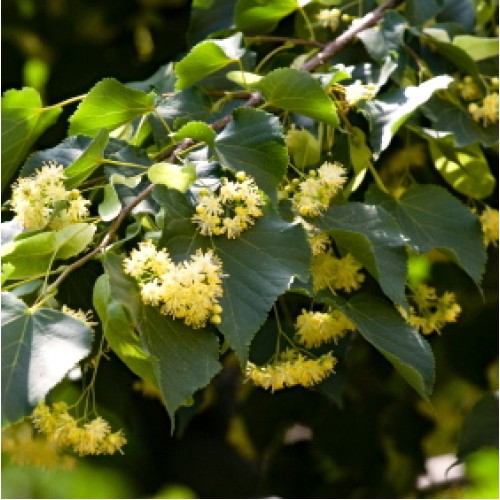
Linden is a long-lived tree with a broad, heart-shaped crown and finely serrated leaves. In early to mid-summer, she produces clusters of small, pale yellow blossoms attached to narrow bracts. These blossoms release a warm, honeyed fragrance that can perfume entire neighborhoods at peak bloom. Stillpoint’s extract is obtained through supercritical CO₂ extraction of the blossoms, preserving the delicate aromatic compounds that are often diminished during steam distillation and capturing the fuller nectar-like depth of the living flower.
 
Botanical Name: Tilia cordata / Tilia platyphyllos
Family: Malvaceae
Common Names: Linden, Lime Blossom, Basswood
Plant Type: Deciduous hardwood tree
Part Used for Extraction: Blossoms (with bracts)
Growth Habit: Broad-canopied tree, typically reaching 20–40 meters
Flowering Season: Early to mid-summer
Harvest Time for Extraction: At peak bloom, when fragrance and nectar production are strongest
 
Physical Characteristics:
Leaves: Heart-shaped, serrated, vibrant green during growing season
Bark: Smooth and gray in youth, becoming ridged with age
Flowers: Small, pale yellow to cream, borne in drooping clusters, intensely fragrant
Bracts: Narrow, leaf-like structures attached to flower clusters
Roots: Deep and stabilizing, supporting a wide canopy spread
Native Habitat + Growth Conditions:
Native To: Europe and Western Asia
Preferred Soil: Moist, well-drained loamy soils
Sunlight: Full sun to partial shade
Climate: Temperate climates with moderate rainfall

Ecological Notes: A significant nectar source for bees and pollinators; widely planted for shade, longevity, and ecological support

Energetic Botanical Signature
Linden teaches us that softness is not fragility.
She does not give her medicine from a wound, but from a bloom. Her fragrance arrives in season — warm, honeyed, generous — and then it passes. She does not cling to her flowering. She trusts the rhythm.
 
Her leaves are shaped like hearts, and her canopy creates shelter not through force, but through extension. She widens. She shades. She cools heated air simply by being fully herself.
 
Her energy reminds us that calm can be structured. That gentleness can hold boundaries. That strength can create space for others without collapsing its own roots.
 
She teaches that opening fully — and releasing fully — are part of the same cycle.
Energetics

Energetic Properties

Linden Blossom holds the energy of gentle regulation. She does not cocoon in the dark — she opens the window and lets warm air in. Her presence is calming without dulling, softening without collapsing structure.
Her vibration is maternal but not smothering. Expansive but not overwhelming. She supports the nervous system when it has been braced for too long — especially in those who appear strong on the outside yet feel internally tight, vigilant, or emotionally overheated.

This is an oil for people who are “holding it together.”
For those who are competent, capable, and quietly exhausted.

Use this oil when your chest feels tight, when your breath stays high in the lungs, when irritability masks fatigue. Her honeyed warmth restores emotional circulation and allows the body to shift from guarded to receptive.

Energetic Themes:
• Softening hypervigilance
• Cooling emotional heat and irritability
• Restoring gentleness to self-talk
• Reopening the heart after subtle constriction
• Supporting safe emotional expression

Chakra Resonance:
Heart (Anahata) – Encourages spaciousness, compassion, and emotional circulation
Solar Plexus (Manipura) – Eases tension held in control, perfectionism, or internal pressure
Throat (Vishuddha) – Supports calm, steady communication without emotional charge

Spiritual Use:
Linden Blossom is beautiful in rituals of reconciliation — with oneself or with others. She supports prayer, forgiveness practices, and heart-centered meditation. Because of her historic association with communal gathering and harmony, she is well suited for group ceremony, women’s circles, and shared sacred space.

Anoint the chest before meditation to deepen breath awareness.
Diffuse during conflict resolution work to soften reactivity.
Blend with Rose (Rosa damascena), Neroli (Citrus aurantium var. amara), or Sandalwood (Santalum album) for heart-opening ritual.

Affirmation:
I soften without losing my strength.
I open without abandoning myself.

Traditional & Folklore

Tilia cordata / Tilia platyphyllos
Long before linden blossoms were dried for evening tea, the linden tree was considered sacred across much of Europe. Among Germanic, Slavic, and Baltic cultures, linden was known as the “Tree of Peace.” She often stood at the center of villages where justice was administered, marriages were witnessed, and disputes were settled beneath her canopy.
 
She was not decorative.
She was guardian.

The Tree of Freya
In Norse tradition, linden was associated with Freya, goddess of love, fertility, and protection. It was believed she favored the linden as a dwelling place. Offerings of bread, milk, and woven ribbons were sometimes left at the roots in gratitude or petition.
To stand beneath a blooming linden was said to invite harmony into one’s life.

Village Justice + Communal Harmony
Throughout Central Europe, linden trees were planted intentionally near town squares and churches. Court proceedings were held beneath their branches, reinforcing the belief that the tree fostered fairness, truth, and reconciliation.
The tree became a living symbol of balance in community life.

Protection Rituals
In Slavic folklore, linden branches were hung inside homes to protect against lightning, illness, and misfortune.
Carvings made from linden wood were used as protective talismans because the tree was believed to carry steady, benevolent energy.
Linden did not repel through force.
She protected through presence.

Love + Dream Lore
Linden blossoms appeared in love charms and bridal wreaths, believed to bless unions with peace and longevity.
Flowers were placed beneath pillows to encourage truthful dreams and soften restless sleep.
Lightly burned blossoms were used to calm unsettled energy within the home.

A Tree of Reconciliation
Across traditions, linden carried the frequency of making peace — with neighbors, with lovers, with oneself.
She is not a tree of conquest.
She is a tree of gathering.
Her folklore reminds us that protection does not always roar. Sometimes it hums. Sometimes it flowers.
Chemistry

Chemical Components

What Linden Smells Like—Chemically
Linden’s aroma tends to express in three “layers,” each with its own chemical backbone:
1) The Honey-Floral Heart (the “linden bloom” feeling)
This comes largely from aromatic alcohols and their esters, which give that rounded, nectar-like floral body.
2) The Green-Air Top (freshness, lift, soft leafiness)
This is where you see green alcohols/aldehydes—the kind of compounds that read as “summer air” rather than “perfume.”
3) The Skin-Warm Base (soft animalic depth, sensual calm)
In tiny trace amounts, certain compounds add warmth and realism—so it doesn’t smell like a flat floral candle.
Those three layers are why linden can feel simultaneously comforting, luminous, and quietly hypnotic.

Key Components (and why they matter)
(Exact percentages vary wildly by species, region, and flowering stage, so we’re naming the “repeat players,” not pretending there’s one fixed recipe.)

2-Phenylethyl Alcohol (Phenethyl Alcohol)
• Classic “true floral” alcohol—soft, rosy, narcotic-gentle
• Builds the rounded floral core that reads as human and warm
Often identified as a major floral scent component in linden/headspace work. 

Phenylacetaldehyde
• Honey-floral, airy, slightly green-sweet
• One of the compounds that can make linden smell like nectar + warm air rather than sharp perfume
Reported in floral aroma work on Tilia species and perfumery discussions of the linden profile. 

Farnesol + Farnesyl Acetate (Sesquiterpene alcohol + ester)
• Smooth, creamy-floral, long-lasting
• Adds soft fixation and “rounded edges” in blends
Frequently linked with linden blossom’s characteristic drydown in perfumery descriptions. 

Benzyl Alcohol + Related Benzenoids
• Mild sweet floral “body” note
• Supports the sense of honeyed fullness without becoming sugary
These benzenoid compounds commonly show up in floral volatile profiles. 

Green alcohols/aldehydes (C6–C9 range)
• Fresh, leafy, airy, “sunlit”
• Prevents linden from collapsing into a heavy floral
This class is frequently discussed as part of the “fresh” portion of the linden profile. 

Indole (trace)
• At trace levels: sensual, real-flower depth
• Too much: “dirty floral.” At trace: alive.
Perfumery discussions of linden commonly include indole as part of the profile’s realism. (

Therapeutic Implications of Chemistry (without pretending it’s a drug)

Nervous System Soothing / Downshift Support
Linden’s “soothing” reputation maps more to how floral alcohols and soft esters interact with the limbic system than to one singular pharmacological hammer. This is an oil that often reads as calming and de-arming, not sedating.

Emotional “Heat” Modulation
That honey-floral core + airy green top often lands as:
less irritability, less tight chest, more breath.
(That’s experiential aromatherapy language—still real.)

Blend Function: Soft Fixative + Atmosphere Builder
Farnesol/farnesyl acetate territory is part of why linden can extend a blend and make it feel more coherent—like it holds the whole thing together without stealing the show. 

Why CO₂ Extraction Changes the Linden Experience
Steam distillation can flatten delicate florals. CO₂ tends to preserve a broader range of aromatic constituents because it’s low-heat and enclosed, helping protect fragile molecules and retain both top and base nuance. 
Practical result:

• more “living flower” realism
• more honeyed depth
• smoother drydown
• better performance in ritual/perfume style blends


Recipes & Blends

Recipes & Blends

1. Heart-Softening Calm Oil
For emotional tension, irritability, or tightness in the chest
15 mL Jojoba (Simmondsia chinensis)
3 drops Linden Blossom CO₂
2 drops Sweet Orange (Citrus sinensis)
1 drop Roman Chamomile (Chamaemelum nobile)

→ Apply over heart center and upper chest during moments of emotional constriction or overstimulation.
Use when you feel competent on the outside but tight underneath.
This blend encourages breath depth and emotional circulation without sedation.

2. Evening Nervous System Wind-Down
For rumination, overthinking, or difficulty shifting into rest
15 mL Apricot Kernel Oil (Prunus armeniaca)
3 drops Linden Blossom CO₂
2 drops Lavender (Lavandula angustifolia)
1 drop Sandalwood (Santalum album or Santalum spicatum)

→ Massage onto shoulders, back of neck, and soles of feet before bed.
Supports transition from “doing” into resting.
This is not a knockout blend. It softens the edges so sleep can come naturally.

3. Breath + Solar Plexus Release Oil
For shallow breathing, control tension, or internal pressure
15 mL Fractionated Coconut Oil
3 drops Linden Blossom CO₂
2 drops Green Myrtle (Myrtus communis)
1 drop Neroli (Citrus aurantium var. amara)
→ Apply across diaphragm and upper abdomen.
Inhale slowly. Expand the ribs consciously.
This blend supports parasympathetic shift and emotional decompression.

4. Reconciliation Diffuser Blend
For conflict resolution, women’s circles, or heart-centered dialogue
In diffuser:
4 drops Linden Blossom CO₂
3 drops Rose (Rosa damascena)
2 drops Frankincense (Boswellia carterii)
1 drop Sweet Orange (Citrus sinensis)

→ Diffuse during group work, mediation, or sacred gatherings.
Linden carries communal harmony energy. This blend encourages open speech without emotional escalation.

5. Gentle Fever + Recovery Chest Oil
For convalescence, emotional heat, or nervous irritability during illness
15 mL Tamanu (Calophyllum inophyllum) or Jojoba
3 drops Linden Blossom CO₂
2 drops Ravintsara (Cinnamomum camphora, ct. 1,8-cineole)
1 drop Lavender (Lavandula angustifolia)

→ Massage lightly over chest and upper back.
Use during recovery when the body feels heated or overstimulated.
This is supportive, not aggressive. It cools and soothes rather than stimulating.
 

6. Open Without Armor Anointing Oil
For softening guardedness and allowing safe emotional expression
10 mL Jojoba (Simmondsia chinensis)
3 drops Linden Blossom CO₂
1 drop Rose Otto (Rosa damascena)
1 drop Neroli (Citrus aurantium var. amara)
1 drop Sandalwood (Santalum album)

→ Apply to heart center, inner wrists, and behind ears before vulnerable conversations or integration work.
This blend supports emotional openness without losing boundaries.
It is for the strong ones who are tired of bracing.

7. Circle of Peace Diffuser Ritual
For reconciliation, women’s circles, forgiveness work, or self-peace
In diffuser:
4 drops Linden Blossom CO₂
2 drops Frankincense (Boswellia carterii)
2 drops Green Myrtle (Myrtus communis)
1 drop Sweet Orange (Citrus sinensis)

→ Diffuse during journaling, prayer, group ceremony, or conflict resolution.
This is not a “spiritual fireworks” blend.
It steadies the field.
It lowers emotional volume.
It invites conversation without defensiveness.
Safety Etc.

Safety Information

Linden Blossom CO₂ is considered a low-risk aromatic when properly diluted. It is not known to be phototoxic and is generally well tolerated in topical applications.
As with all botanical extracts, individual sensitivity is possible.

Dermal Use
• Dilute to 0.5–2% for general adult topical use
• For sensitive skin, elderly, or facial applications, remain closer to 0.5–1%
• Perform a patch test prior to broader application
• Avoid applying to broken or compromised skin
Because this is a CO₂ extract, it may feel slightly richer or more tenacious on the skin than a steam-distilled oil. Proper dilution ensures comfort and absorption.

Children + Elder Use
Linden’s traditional reputation is gentle; however, the CO₂ extract is more concentrated than an herbal infusion.
• For children over 6, use at 0.25–0.5% dilution
• Avoid use with infants unless under guidance of a qualified aromatherapist
• For elderly clients, begin low and increase only if well tolerated

Pregnancy + Nursing
No known specific contraindications for properly diluted aromatic use.
Remain conservative at ≤1% dilution and avoid excessive or prolonged application.

Internal Use
Not recommended for internal ingestion unless under guidance of a licensed professional trained in clinical aromatherapy and internal dosing.
Traditional use of linden as tea does not automatically translate to safety of concentrated CO₂ extract internally.

Diffusion
• Safe for intermittent diffusion (20–30 minutes at a time)
• Ensure adequate ventilation
• Avoid prolonged continuous diffusion

Medication Considerations
Linden flower preparations have historically been associated with mild vasorelaxant and calming effects. While aromatic exposure is significantly different from herbal ingestion, use caution with individuals on:
• Strong sedatives
• Blood pressure medications
• Complex cardiac protocols
When in doubt, consult a qualified healthcare professional.

Linden is gentle.
But gentle does not mean casual.Respect the plant.
Respect the concentration.
Respect the body.

References

Botanical + Taxonomic Sources
Plants of the World Online. (n.d.). Tilia cordata Mill. Royal Botanic Gardens, Kew. Retrieved [insert access date], from https://powo.science.kew.org
Plants of the World Online. (n.d.). Tilia platyphyllos Scop. Royal Botanic Gardens, Kew. Retrieved [insert access date], from https://powo.science.kew.org
U.S. Department of Agriculture. (n.d.). GRIN-Global taxonomy for plants: Tilia cordata; Tilia platyphyllos. Retrieved [insert access date], from https://npgsweb.ars-grin.gov

Traditional Herbal Medicine
Blumenthal, M., Goldberg, A., & Brinckmann, J. (Eds.). (2000). Herbal medicine: Expanded Commission E monographs. American Botanical Council.
European Medicines Agency. (2012). Assessment report on Tilia cordata Mill., Tilia platyphyllos Scop., flos. EMA.
European Medicines Agency. (2012). Community herbal monograph on Tilia cordata Mill., Tilia platyphyllos Scop., flos. EMA.
Hoffmann, D. (2003). Medical herbalism: The science and practice of herbal medicine. Healing Arts Press.
Mills, S., & Bone, K. (2013). Principles and practice of phytotherapy: Modern herbal medicine (2nd ed.). Churchill Livingstone.

Aromatic Chemistry + Essential Oil Science
Baser, K. H. C., & Buchbauer, G. (Eds.). (2015). Handbook of essential oils: Science, technology, and applications (2nd ed.). CRC Press.
Joulain, D., & König, W. A. (1998). The atlas of spectral data of sesquiterpene hydrocarbons. E. B.-Verlag.
Tisserand, R., & Young, R. (2014). Essential oil safety: A guide for health care professionals (2nd ed.). Churchill Livingstone.
Price, S., & Price, L. (2012). Aromatherapy for health professionals (4th ed.). Churchill Livingstone.

Folklore + Ethnobotanical Context
Grimm, J., & Grimm, W. (1883/2004). Teutonic mythology (J. S. Stallybrass, Trans.). Dover Publications. (Original work published 1883)
Rätsch, C. (2005). The encyclopedia of psychoactive plants: Ethnopharmacology and its applications. Park Street Press.
Vickery, R. (1995). Garlands, conkers and mother-die: The folklore of plants. Hambledon Press.

Related Products

Chamomile, Roman Essential Oil

Chamomile, Roman Essential Oil

..

$17.00 Ex Tax: $17.00

Reviews (3)

Write a review

Note: HTML is not translated!
    Bad           Good
Powered By OpenCart
Stillpoint Aromatics © 2026