
Every order ships USPS Priority — $10.95 flat-rate USPS Priority shipping on all US orders, no minimum. Free shipping on domestic orders over $299.
Welcome to Stillpoint. Subscribe to our newsletter for sale details and new-product news · One discount code per order · Every order is hand-poured, packed with care in ceremony, and shipped as we receive it.

Myrtle, Green Essential Oil | Respiratory Support + Skin Cleansing | Albania

Myrtus Communis

  • Myrtle, Green  Essential Oil | Respiratory Support + Skin Cleansing | Albania

Average Rating: (see reviews)

$12.00 Ex Tax: $12.00

Essential Facts

  • Latin Name: Myrtus Communis
  • Country of Origin: Cook Islands
  • Botanical Family: Myricaceae
  • Plant Parts: Leaves, Twigs/Branches
  • Note Classification: Top/Middle
  • Cultivation Method: Distiller is Certified Organic
  • Method of Extraction: Steam or Hydro Distillation
  • Extraction Date: Jujly 2025
  • Approx. Shelf Life: 6 years
  • Chemical Family: Monoterpenes, Oxides
  • Aroma: Cool, Fresh, Green, Slightly camphoraceous, Slightly green, Slightly sweet
  • Energetic Applications: 4th Chakra - unconditional love, 5th Chakra - speaking truth, 6th Chakra - perspective, 7th Chakra - higher information, Balancing, Clarity, Expansive, Protective, Purifying, Transformative
  • Therapeutic Properties: Anti-microbial, Anti-rheumatic, Anti-viral, Astringent, Cephalic, Decongestant, Depurative, Disinfectant, Expectorant, Immune support, Lymphatic support, Nervine, Tonic
Notes & Use

Suggested Uses

4th Chakra - unconditional love

5th Chakra - speaking truth

6th Chakra - perspective

Balancing

Clarity

Expansive

Protective

Purifying

Transformative


Uplifting

Personal Use

What Stillpoint “Nose”
Green Myrtle Essential Oil — Myrtus communis
Origin: Albania

Clear | Green | Restorative

Green Myrtle from Albania comes in like clean air moving through the chest after the body has been holding too much. Its aroma is fresh, green, softly camphoraceous, and slightly sweet, with a crisp Mediterranean brightness that feels both cleansing and gentle. There is breath in this oil. Space. A quiet kind of strength.

This is an oil for the lungs, the skin, the mouth, the lymph, and the emotional body when everything feels congested — physically, mentally, energetically, or all of the above because, honestly, the body loves to make one giant group project out of our stress.
Green Myrtle has long been valued as a respiratory and cleansing botanical ally, especially for breath, mucus, skin clarity, oral freshness, and gentle purification.

The Albanian expression has a beautiful clarity to it — greener, brighter, and more mountain-air than heavy medicinal. It feels like standing on a sun-warmed hillside where the air is full of leaves, minerals, and sea memory.
Stillpoint’s Green Myrtle essential oil is steam distilled from the leaves and small branches of Myrtus communis, an evergreen Mediterranean shrub known for its aromatic foliage, white flowers, and blue-black berries. Myrtle has been used traditionally for respiratory comfort, skin care, oral cleansing, household freshness, digestive support, and ceremonial purification throughout Mediterranean cultures.

This oil is for clearing without harshness. For opening the breath. For refreshing the skin and spirit. For returning to yourself when life has made your inner air feel stale.

Therapeutic Applications

Respiratory Support + Clear Breathing
  • Green Myrtle is traditionally used to support clear breathing, especially when the chest feels heavy, damp, congested, or tired.
  • It may assist in blends for seasonal respiratory discomfort, mucus, sinus stuffiness, and breath that feels restricted or shallow.
  • Its fresh aromatic profile makes it useful in chest rubs, steam inhalation blends, diffuser formulas, and respiratory massage oils when used appropriately.
  • It is often chosen when a gentler respiratory oil is desired, especially for people who find stronger oils like Eucalyptus or Rosemary too forceful.
Skin Support + Gentle Cleansing
  • Green Myrtle has traditionally been used in skin care for oily, congested, blemish-prone, or imbalanced skin.
  • It may support topical formulas where the goal is cleansing, clarifying, and helping the skin feel fresh without being overly aggressive.
  • Its aromatic chemistry gives it a useful place in facial oils, cleansing balms, spot-support blends, and skin-supportive body oils.
  • It combines beautifully with Lavender, Tea Tree, Manuka, Frankincense, or Rosalina when the skin needs both clarity and kindness.
Dental + Oral Cleansing Support
  • Green Myrtle has a long history of traditional use for mouth freshness, gum care, and cleansing oral preparations.
  • It may support natural oral care formulas when used at very low dilution and only in appropriate, professionally formulated products.
  • Its fresh, green, slightly camphoraceous aroma makes it useful in aromatic blends intended to support a clean-feeling mouth and fresh breath.
  • It should never be used casually in the mouth or swallowed; oral use requires proper training, dilution, formulation, and safety awareness.
Lymphatic + Tissue Freshness
  • Green Myrtle may support massage blends for areas that feel puffy, stagnant, heavy, or slow-moving.
  • Its fresh, green, gently clearing nature makes it useful in body oils meant to support movement, drainage, and tissue vitality.
  • It is especially helpful when the body feels damp, sluggish, or energetically “full” in a way that needs lightness rather than heat.
  • It pairs well with Cypress, Juniper Berry, Grapefruit, Lemon, or Atlas Cedar in blends for gentle movement and body clearing.
Nervous System + Emotional Clearing
  • Green Myrtle may support the nervous system when stress has settled into the breath, chest, throat, or emotional field.
  • Its aroma can help create a feeling of space when the mind feels crowded, the heart feels compressed, or the body feels emotionally congested.
  • This is a beautiful oil for grief breath — the kind of breath that gets shallow when the body is trying not to feel everything at once.
  • It can be used in diffuser blends, anointing oils, and quiet ritual work when someone needs clearing, steadiness, and a softer return to themselves.

Traditional Use

Green Myrtle has been used throughout Mediterranean herbal, household, and traditional medicine systems for centuries, where the leaves, berries, and aromatic branches of Myrtus comunis were valued for breath, cleansing, skin care, digestion, and purification.

This was a plant that lived close to daily life. Myrtle was practical medicine — the kind kept near the home, used in washes, infusions, steams, foods, wines, and household preparations. It was beautiful, yes, but it was also useful. And useful matters.
Known as a fresh, aromatic, evergreen plant of cleansing and renewal, Myrtle was traditionally used when the body felt damp, congested, stale, irritated, or burdened. It supported the breath, refreshed the skin, toned tissue, helped clear household air, and brought a sense of cleanliness back into the body and home.

Breath + Respiratory Freshness
  • Myrtle leaves were traditionally used in preparations for coughs, congestion, mucus, and chest heaviness.
  • The aromatic leaves were used in teas, syrups, infusions, and steam-like preparations to support clearer breathing.
  • Myrtle was valued when the lungs felt damp, full, or burdened by seasonal respiratory discomfort.
  • Its fresh, penetrating aroma made it useful when the breath needed opening without overwhelming the system.
Skin Cleansing + Tissue Toning
  • Myrtle was traditionally used in washes, compresses, and bathing preparations for skin freshness and cleansing.
  • Its astringent qualities made it useful for oily, congested, irritated, or imbalanced skin.
  • Myrtle preparations were used to help tone tissue and support a clean, refreshed feeling on the skin.
  • It was valued in traditional body care when the skin needed both purification and gentle strength.
Dental + Oral Cleansing
  • Myrtle leaves were traditionally used to freshen the mouth and support oral cleanliness.
  • The aromatic foliage was used in mouth rinses, chewing preparations, and cleansing herbal formulas.
  • Myrtle was valued for breath freshness and gum care in traditional household practice.
  • Its clean, green, slightly camphoraceous character made it a natural fit for oral cleansing traditions.
Digestive + Culinary Use
  • Myrtle berries have been used in Mediterranean food and drink traditions, including flavoring for meats, sauces, liqueurs, and wines.
  • The leaves and berries were traditionally used to support digestion and help the body process rich or heavy foods.
  • Myrtle was sometimes used as an aromatic seasoning where its bitter-green, resinous quality brought both flavor and digestive support.
  • Its use in food traditions reflects its practical role as a plant that belonged to the table as well as the medicine cabinet.
Household Cleansing + Freshness
  • Myrtle branches and leaves were traditionally used to freshen rooms, linens, bathing water, and household spaces.
  • The aromatic foliage was valued for its clean scent and practical cleansing presence.
  • Myrtle was used in domestic preparations where freshness, order, and purification were needed.
  • This was home medicine in the old sense — body, breath, skin, kitchen, and room all connected.
Vitality + Everyday Restoration
  • Myrtle was traditionally valued as an evergreen plant that brought freshness and renewal into daily life.
  • Its leaves were used when the body or home felt stale, damp, tired, or in need of clearing.
  • Myrtle supported the kind of restoration that happens through breath, cleanliness, order, and simple botanical care.
  • It carries the medicine of returning to freshness — not dramatic, not flashy, just clean life moving again.
Green Myrtle is old Mediterranean medicine.

Practical. Green. Clean. Restorative.

In traditional settings, it was used to clear the breath, freshen the skin, support the mouth, cleanse the home, and bring the body back into a state of simple, living order.

Botany

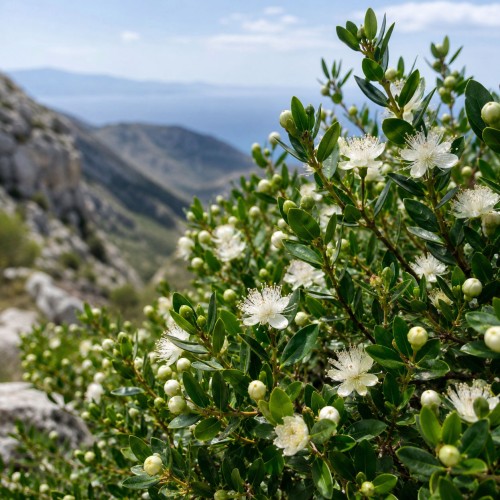
Myrtus communis,commonly known as Green Myrtle, Common Myrtle, or True Myrtle, is an evergreen shrub or small tree native to the Mediterranean region. A member of the Myrtaceae family, Myrtle belongs to the same aromatic botanical family as Eucalyptus, Tea Tree, Niaouli, Cajeput, and Clove — plants known for their strong aromatic presence and practical cleansing value.

The essential oil is steam distilled from the leaves and small branches of the plant. These glossy green leaves contain tiny aromatic oil glands that release Myrtle’s fresh, green, softly camphoraceous scent when crushed, warmed, or distilled.
Green Myrtle grows in sun, wind, rocky soil, coastal air, and dry Mediterranean heat. It stays green through stress. It does not need perfect conditions to hold its medicine. That is part of its signature: freshness under pressure, breath inside difficulty, and life that keeps returning to itself.

Botanical Name: Myrtus communis
Family: Myrtaceae
Common Names: Green Myrtle, Common Myrtle, True Myrtle, Myrtle
Plant Type: Evergreen shrub or small tree
Part Used for Distillation: Leaves and small branches
Growth Habit: Dense, woody, aromatic evergreen shrub that may grow upright, rounded, or bushy depending on climate and pruning
Flowering Season: Typically spring to summer, depending on region and growing conditions
Harvest Time for Distillation: Leaves and small branches are harvested when aromatic concentration is suitable for distillation, often during active growth seasons

Physical Characteristics
Leaves:
Small, glossy, deep green, leathery leaves with a pointed oval shape and visible aromatic oil glands when held to the light.
Stems:
Woody, branching stems that form a dense shrub structure and support the plant’s compact evergreen growth.
Flowers:
White to pale cream flowers with delicate petals and prominent stamens, giving the plant a bright, star-like appearance in bloom.
Fruits:
Small rounded berries that ripen from green to dark blue-black and have been used traditionally in Mediterranean food and drink preparations.
Roots:
A woody root system adapted to Mediterranean soils, helping the plant anchor into dry, rocky, mineral-rich terrain.

Native Habitat + Growth Conditions

Native To:
The Mediterranean region, including southern Europe, North Africa, and parts of western Asia.
Preferred Soil:
Well-drained, rocky, sandy, or mineral-rich soil; tolerant of leaner soils once established.
Sunlight:
Full sun to partial sun, with strong preference for bright Mediterranean light.
Climate:
Warm, dry to semi-dry Mediterranean climates with seasonal rainfall, coastal influence, and good air movement.
Ecological Notes:
Green Myrtle is adapted to heat, wind, rocky terrain, and seasonal dryness. Its evergreen nature reflects endurance, freshness, and the ability to remain vibrant even when the environment is demanding.

Energetic Botanical Signature
Green Myrtle stays green. That sounds simple, but it is not small medicine. This plant holds its leaves through heat, wind, dryness, and shifting Mediterranean weather. It does not collapse into drama. It keeps breathing. It keeps its aromatic intelligence close to the surface, ready to release when touched.

Its leaves carry the signature of freshness, clarity, and quiet cleansing. Its white flowers bring lightness. Its dark berries bring depth. Its whole form speaks to balance — breath and body, cleansing and softness, resilience and renewal.
This is a plant that teaches: You can clear without becoming harsh. You can stay green after hard seasons. You can return to breath, order, and inner freshness without making a big production out of it.
Energetics

Energetic Properties

Breath • Purification • Returning to Inner Freshness

Green Myrtle is an oil of clean return. It does not blast the door open. It clears the room, opens the window, and lets the body remember that breath is still available.

This is an oil for the moments when you feel emotionally congested, energetically stale, or quietly burdened by everything you’ve been carrying. It works through the chest, throat, lungs, skin, and field — the places where grief, stress, old words, and other people’s energy tend to collect.

Green Myrtle from Albania has a bright, green, mountain-air quality. It feels clarifying without being sharp, restorative without being sleepy, and cleansing without being aggressive. It brings the system back to freshness.
It says, “Breathe again. Clear what is no longer yours. Come back to the living green inside you.”'

Energetic Themes:
  • Clearing emotional congestion from the chest, throat, lungs, and energetic field.
  • Supporting breath when grief, stress, or overwhelm has made the body feel tight or restricted.
  • Helping release stale emotional residue, especially after conflict, illness, heavy caregiving, or long periods of stress.
  • Restoring a sense of inner cleanliness, clarity, and emotional freshness.
  • Supporting gentle boundaries when someone feels energetically full, porous, or overly affected by the emotions of others.
  • Helping the spirit return to order after chaos, heaviness, or emotional crowding.
  • Encouraging renewal without forcing a dramatic rebirth moment. Sometimes the medicine is just opening the damn window.
Chakra Connections

Heart Chakra
  • Green Myrtle supports the heart when grief, sadness, or emotional pressure has made the chest feel heavy or guarded.
  • It may help create a sense of spaciousness around the heart so feeling can move without flooding the system.
  • This is a beautiful oil when the heart needs clearing, softness, and room to breathe.
Throat Chakra
  • Green Myrtle supports the throat when unspoken words, swallowed truth, or emotional restraint has created tension in the voice and breath.
  • It may assist practices focused on honest expression, gentle release, and clearing what has been held too long.
  • Its green, respiratory nature makes it especially useful when the throat feels emotionally loaded or energetically congested.
Third Eye Chakra
  • Green Myrtle can support mental clarity when the mind feels foggy, crowded, or overstimulated.
  • It may help clear emotional noise so intuition can come through with less static.
  • This is not a dramatic visionary oil; it is a clean-the-glass oil. The information is easier to receive when the inner window is clear.
Crown Chakra
  • Green Myrtle supports spiritual freshness, especially after heavy emotional work, illness, grief rituals, or energetic contact with dense environments.
  • It may assist in clearing the field before prayer, meditation, ceremony, or quiet listening.
  • Its energy feels devotional in a simple way — clean breath, clean space, clear connection.
Spiritual Use:
  • Ideal for rituals focused on breath, clearing, renewal, emotional release, and spiritual freshness.
  • Supportive in practices where grief, stress, or exhaustion has settled into the lungs, chest, or throat.
  • Useful before meditation, prayer, energy work, or client sessions when the practitioner wants to clear the field without becoming overly stimulated.
  • Beautiful in cleansing sprays, diffuser blends, anointing oils, and breathwork rituals where the goal is gentle purification and return.
  • Pairs beautifully with oils like Frankincense, Rosalina, Cypress, Lavender, Lemon, Cedarwood, or Neroli to create blends that are clarifying, heart-opening, and emotionally restorative.
Energetic Cautions:
  • Green Myrtle can bring awareness to where grief or emotional heaviness has been sitting in the breath. That can feel tender.
  • For someone in acute grief or emotional overwhelm, keep the dilution low and the ritual simple. The goal is space, not excavation.

  • This oil is best used with softness when the nervous system is already raw, because even gentle clearing can stir what the body has been holding.

  • It may feel too “clean” or clearing for someone who is craving warmth, depth, or heavy grounding; pair it with Vetiver, Cedarwood, Patchouli, or Frankincense when more anchoring is needed.
This is the oil for opening the inner air — not to erase what happened, not to bypass the grief, but to give the body enough space to breathe while it carries what is real.

Affirmation:
I return to breath. I clear what is no longer mine. I let fresh life move through me again.

Traditional & Folklore

Green Myrtle is one of those plants that carries beauty, cleansing, love, protection, and sacred threshold energy all at once. Before it was studied for its respiratory or skin-supportive properties, Myrtus communis lived in the old Mediterranean imagination as a plant of blessing, purification, fertility, devotion, and renewal.

This was not a random pretty shrub sitting in the background.

Myrtle was woven into weddings, temples, homes, funerary rites, love traditions, and purification practices. It belonged to the places where life changes form — maiden to bride, grief to remembrance, house to sanctuary, body to spirit, ordinary space to sacred space.

That alone tells you something.
This was a plant of clean passage. Green, fragrant, protective, and deeply tied to the sacred feminine.

Sacred Feminine + Love Medicine
  • Myrtle has long been associated with love, beauty, fertility, and the goddess traditions of the Mediterranean world.
  • In Greek and Roman tradition, Myrtle was strongly connected with Aphrodite and Venus, goddesses of love, beauty, sensuality, and generative life.
  • Myrtle wreaths were used in wedding traditions as symbols of love, union, blessing, and fertility.
  • This was not love as cheap romance. This was love as life force — the green current that keeps returning, blooming, joining, and renewing.
  • Energetically, Myrtle carries the medicine of the heart that can stay open without losing itself.
Purification + Sacred Cleansing
  • Myrtle was traditionally used as a plant of purification, especially in spaces, ceremonies, and transitions.
  • Its evergreen leaves and clean aromatic presence made it a natural ally for clearing stagnant energy and preparing a space for sacred use.
  • Myrtle branches were used in ritual settings to bless, cleanse, and mark what was being made holy.
  • This is the old-world version of clearing the room — not with drama, not with smoke and theatrics, but with green aromatic intelligence.
  • Myrtle says: make the space clean enough for truth to enter.
Wedding, Blessing + Threshold Medicine
  • Myrtle appears again and again in wedding customs, bridal wreaths, garlands, and blessing rituals.
  • It was used to honor the threshold between one life and another — single life to married life, girlhood to womanhood, household to lineage.
  • Because it stays green, Myrtle became a symbol of lasting love, continuity, fidelity, and life that endures.
  • Myrtle does not symbolize explosive passion that burns out in five minutes. It symbolizes green devotion. Love with roots. Love that breathes.
  • In energetic work, this makes Green Myrtle a beautiful ally for commitments, vows, blessings, and new beginnings that need both freshness and staying power.
Protection + Household Blessing
  • Myrtle was also used as a protective plant in Mediterranean folk traditions.
  • Branches were kept, carried, or placed in homes as symbols of blessing, protection, and good fortune.
  • Its aromatic leaves were believed to help keep spaces fresh, spiritually clean, and aligned with household harmony.
  • Myrtle protection is cleaner, greener, quieter. It protects by restoring order.
  • It clears the air, blesses the threshold, and reminds the home what it is supposed to feel like.
Death, Remembrance + Continuity
  • Myrtle also has associations with remembrance, mourning, and the continuation of life beyond visible loss.
  • Evergreen plants often carried this symbolism because they remained alive and green when other plants faded or died back.
  • Myrtle’s presence in funerary and memorial contexts speaks to its deeper medicine: life continues, love continues, the green thread does not break just because form changes.
  • This is where Myrtle becomes more than pretty.
  • It holds both love and grief. Bridal wreath and mourning branch. Beginning and ending. Breath and farewell.
  • That is real medicine.
Renewal + The Green Return
  • Myrtle’s evergreen nature gives it a strong symbolic connection to renewal, resilience, and return.
  • It stays green through heat, wind, dryness, and seasonal change, making it a plant of continuity and living freshness.
  • In folk memory, Myrtle belongs to the kind of renewal that does not require spectacle.
  • It is quiet. It is steady. It is the green returning after the hard season.
  • Energetically, Green Myrtle helps clear what has grown stale so life can move again.
  • Not forced rebirth. Not fake positivity. Actual renewal.
  • The breath opens. The room clears. The heart remembers green.
Green Myrtle is ancient Mediterranean threshold medicine. It blesses love, clears the home, protects the field, honors grief, and carries the sacred feminine through the ordinary acts of breath, beauty, devotion, and renewal.

In folk memory, it lives as the evergreen branch at the doorway — fresh, fragrant, protective, and quietly holy.
Chemistry

Chemical Components

Clear Breathing, Gentle Purification & Green Restoration
Green Myrtle is a monoterpene- and oxide-rich oil with a softer ester and monoterpenol presence that gives it that beautiful balance: clear, green, fresh, and respiratory without feeling like it is trying to knock your head off.

Its chemistry often includes constituents such as 1,8-cineole, α-pinene, limonene, linalool, myrtenyl acetate, and myrtenol, though the exact profile can vary by origin, harvest, plant part, climate, and distillation. Myrtle oils from different regions can lean more cineole-rich, more pinene-rich, more ester-softened, or more herbaceous depending on the batch.

This Albanian Green Myrtle feels especially aligned with breath, clarity, and clean green movement. It has lift, but it is not frantic. It has respiratory strength, but it is not harsh. It has a cleansing quality, but it still feels emotionally kind.
That is the beauty of Myrtle chemistry: it clears without bulldozing.

Main Chemical Families:

Monoterpenes
Green Myrtle commonly contains a strong monoterpene presence, especially constituents such as α-pinene and limonene, with other monoterpenes appearing depending on the batch.
  • Known for their fresh, bright, clearing, and air-moving aromatic qualities.
  • Give Green Myrtle its crisp, green, expansive top note.
  • Support the oil’s traditional use for breath, respiratory freshness, and cleansing.
  • Help explain why Green Myrtle feels opening and clarifying rather than heavy or sedating.
  • Bring movement to places that feel stale, damp, crowded, or energetically full.
Energetically, the monoterpenes are the fresh air portion of Green Myrtle’s medicine. They open the window. They move the old air out. They remind the body that breath can return.

Oxides
Green Myrtle often contains 1,8-cineole, the oxide also found in oils such as Eucalyptus, Rosemary ct. cineole, Niaouli, Ravintsara, and Cajeput.
  • Known for its respiratory-supportive and clearing aromatic qualities.
  • Contributes to Myrtle’s usefulness in blends for clear breathing, mucus, chest heaviness, and seasonal respiratory support.
  • Gives the oil its clean, slightly camphoraceous lift without making it feel overly sharp.
  • Supports the oil’s traditional use in chest rubs, diffuser blends, steams, and respiratory massage oils.
  • Helps create the feeling of space in the breath and upper body.
This is part of why Green Myrtle is such a beautiful respiratory oil. It has that cineole clarity, but it usually feels rounder and greener than the big eucalyptus hammer. Sometimes the body does not need a hammer. Sometimes it needs clean air and a little respect.

Esters
Green Myrtle may contain myrtenyl acetate, an ester that gives the oil some of its softer, smoother, more balancing character.
  • Helps soften the sharper edges of the cineole and monoterpene profile.
  • Contributes to Myrtle’s gentle, slightly sweet-green aromatic body.
  • May support the oil’s calming and emotionally restorative qualities.
  • Helps explain why Green Myrtle can feel clearing without feeling abrasive.
  • Gives the oil a more rounded presence in respiratory, skin, and emotional-clearing blends.
This is the part of Myrtle that keeps it from becoming all “medicinal blast.” The ester presence gives it grace. It clears the room without slamming the door.

Monoterpenols
Green Myrtle may contain monoterpenols such as linalool and myrtenol, depending on the specific batch and origin.
  • Contribute to the oil’s gentle skin-supportive and balancing qualities.
  • Add softness, aromatic depth, and emotional ease.
  • Support its usefulness in skin care blends where cleansing and calm are both needed.
  • Help round out the sharper respiratory notes with a more tender aromatic layer.
  • Bring a subtle nervous-system steadiness to the oil’s clearing action.
Energetically, this is where Green Myrtle touches the emotional body. It does not just clear the lungs. It helps clear the feeling of being burdened.

Key Constituents:
1,8-Cineole
1,8-cineole is one of the key constituents commonly found in Green Myrtle essential oil and is strongly connected to its respiratory profile.
  • Supports the oil’s traditional role in blends for clear breathing and respiratory freshness.
  • Contributes to the clean, camphoraceous lift in the aroma.
  • Helps move the feeling of dampness, mucus, heaviness, or congestion in the chest and head.
  • Makes Green Myrtle useful in diffuser blends, chest oils, steam inhalation blends, and seasonal respiratory support formulas.
Energetically, 1,8-cineole is the breath-opening messenger. It says: make space, move the heaviness, let air back in.

α-Pinene
α-Pinene gives Green Myrtle part of its bright, forest-like, green-resinous clarity.
  • Adds freshness, lift, and a sense of open air.
  • Supports the oil’s clearing and respiratory-supportive character.
  • Contributes to the feeling of spaciousness in the aroma.
  • Helps explain why Green Myrtle feels connected to mountain air, evergreen resilience, and clean movement.
α-Pinene is the “green air” note. It is the part that makes Myrtle feel like the body is standing outside again after being trapped in a stale room for too long.

Myrtenyl Acetate
Myrtenyl acetate is one of the signature constituents often associated with Myrtle essential oil.
  • Adds a softer, smoother, slightly sweet-green quality to the aroma.
  • Helps balance the sharper cineole and pinene aspects.
  • Supports the oil’s emotional gentleness and restorative quality.
  • Contributes to Myrtle’s reputation as a respiratory oil that can feel kinder than stronger cineole-heavy oils.
This is one of the reasons Green Myrtle has such beautiful emotional intelligence. It clears, yes, but it does not strip the field raw.

Limonene
Limonene may be present in meaningful amounts depending on the batch and origin.
  • Adds brightness and freshness to the aroma.
  • Supports the oil’s cleansing and mood-lightening associations.
  • Helps keep the profile lively and open.
  • Contributes to the sense of renewal, movement, and fresh start.
Limonene is the little spark of sunlight in the green. It keeps Myrtle from feeling flat or overly medicinal.

Linalool + Myrtenol
Linalool and myrtenol may appear in smaller but meaningful amounts depending on the oil.
  • Add softness, balance, and a more rounded aromatic body.
  • Support Myrtle’s use in skin care and emotional-clearing blends.
  • Help connect the oil’s respiratory action with a calmer nervous-system feel.
  • Bring a subtle tenderness to the oil’s otherwise clean, clearing profile.
These constituents are part of the reason Green Myrtle can be used when the body needs clarity but the spirit still needs kindness.

Minor Components:
Trace constituents may include other monoterpenes, oxygenated monoterpenes, sesquiterpenes, and related aromatic molecules depending on the region, harvest conditions, leaf chemistry, storage, and distillation method.

That matters, especially because Green Myrtle from Albania, Corsica, and Morocco may each carry a different aromatic and therapeutic emphasis. One may be brighter and more cineole-forward. Another may be softer, sweeter, or more ester-rich. Another may feel more herbal, green, or resinous. Same plant. Different land. Different weather. Different conversation.

Therapeutic Implications of This Chemistry:

Respiratory support:
The 1,8-cineole and α-pinene content supports Green Myrtle’s traditional use in blends for clear breathing, mucus, chest heaviness, sinus stuffiness, and seasonal respiratory discomfort.

Gentle clearing:
The monoterpene-rich profile gives the oil movement, brightness, and cleansing energy without making it feel dense or heavy.

Skin freshness:
The combination of monoterpenes, monoterpenols, and aromatic oxygenated compounds supports its use in formulas for oily, congested, blemish-prone, or imbalanced skin.

Oral cleansing support:
Its fresh, green, cineole-rich aroma aligns with traditional use in mouth-freshening and oral-cleansing preparations when formulated safely and appropriately.

Lymphatic and tissue movement:
The fresh, moving chemistry makes Green Myrtle useful in massage blends for tissue that feels puffy, damp, sluggish, or stagnant.

Emotional clearing:
Green Myrtle’s chemistry can help create a sense of inner spaciousness when stress, grief, illness, or energetic overload has made the breath feel tight and the field feel crowded.

Grounded freshness:
Because of its softer ester and monoterpenol notes, Green Myrtle does not just clear. It restores. It helps the body feel fresh without feeling forced.

This chemistry does not come in like a siren. It does not shout. It opens the breath, clears the field, freshens the skin, and brings the body back to clean green order.

Green Myrtle helps move what has gone stale, open what has become tight, and remind the body that clarity can be gentle.
Recipes & Blends

Recipes & Blends

Clear Chest Breathing Blend
Physical Support | Respiratory Freshness + Clear Breathing

Green Myrtle Essential Oil (Myrtus communis): 10 drops
Rosalina Essential Oil (Melaleuca ericifolia): 8 drops
Frankincense Essential Oil (Boswellia carterii): 8 drops
Cedarwood Atlas Essential Oil (Cedrus atlantica): 6 drops
Lavender Essential Oil (Lavandula angustifolia): 8 drops

This blend is designed for the chest, breath, and upper respiratory system when the body feels congested, heavy, damp, or emotionally tight around the lungs. Green Myrtle supports clear breathing and fresh movement, Rosalina brings gentle respiratory support with a softer touch, Frankincense steadies the breath, Cedarwood Atlas grounds the formula and helps the chest feel supported, and Lavender brings balance so the blend stays calm and usable.

Dilute in a suitable carrier oil before applying to the chest, upper back, or soles of the feet. A 1–2% dilution is generally appropriate for most adult body applications. Avoid applying near the eyes, nostrils, or mucous membranes.

Fresh Skin + Gentle Clearing Blend
Physical Support | Oily, Congested + Blemish-Prone Skin

Green Myrtle Essential Oil (Myrtus communis): 6 drops
Manuka Essential Oil (Leptospermum scoparium): 5 drops
Lavender Essential Oil (Lavandula angustifolia): 8 drops
Frankincense Essential Oil (Boswellia carterii): 6 drops
Geranium Essential Oil (Pelargonium graveolens): 5 drops

This blend is designed for skin that feels oily, congested, irritated, or out of balance. Green Myrtle brings gentle cleansing and freshness, Manuka supports skin clarity, Lavender helps calm the appearance of irritation, Frankincense supports mature or stressed skin, and Geranium helps bring balance to skin that feels emotionally and physically reactive.

Dilute very well in a suitable carrier oil, cream, or unscented facial base before applying to the skin. For facial use, stay low — around 0.5–1% dilution is generally more appropriate. Avoid the eye area, broken skin, and overly sensitized skin.

Open the Inner Window Blend
Energetic Support | Emotional Congestion + Breath Release

Green Myrtle Essential Oil (Myrtus communis): 9 drops
Neroli Essential Oil (Citrus aurantium var. amara): 4 drops
Frankincense Essential Oil (Boswellia sacra): 8 drops
Cypress Essential Oil (Cupressus sempervirens): 8 drops
Sweet Orange Essential Oil (Citrus sinensis): 11 drops

This blend is for the moments when grief, stress, or emotional heaviness has settled into the chest and breath. Green Myrtle opens the inner air, Neroli softens the heart, Frankincense steadies the spirit, Cypress supports release and transition, and Sweet Orange brings warmth back into the emotional body without pretending everything is magically fine.

Use in ritual, meditation, diffuser blends, or body oil when the chest feels tight, the heart feels crowded, or the breath needs permission to move again.

Clear the Threshold Blend
Energetic Support | Purification, Boundaries + Sacred Space

Green Myrtle Essential Oil (Myrtus communis): 10 drops
Juniper Berry Essential Oil (Juniperus communis): 8 drops
Lemon Essential Oil (Citrus limon): 8 drops
Cedarwood Virginia Essential Oil (Juniperus virginiana): 7 drops
Clary Sage Essential Oil (Salvia sclarea): 7 drops

This blend is designed for clearing the field, refreshing the space, and helping the body return to energetic order after too much noise, too many people, or too much emotional residue. Green Myrtle brings clean renewal, Juniper Berry clears heaviness, Lemon brightens the atmosphere, Cedarwood Virginia strengthens the boundary, and Clary Sage helps loosen emotional clutter so it can move out.

Use before energy work, client sessions, prayer, writing, breathwork, or any moment when the room — or your own damn field — needs to feel clean again.

Affirmation
I return to breath, clarity, and green renewal. I clear what is no longer mine and make room for life to move through me again.

General Safety Note:
Always dilute essential oil blends in a suitable carrier oil before applying to the skin. Avoid use on broken or irritated skin. Perform a patch test when using a new oil or blend. Use extra caution during pregnancy, nursing, with children, elders, pets, or when taking medications. Consult a qualified healthcare provider or certified aromatherapist when needed.

For Green Myrtle specifically, use with awareness around the face and respiratory tract because it may contain 1,8-cineole. Keep away from the eyes, nostrils, and mucous membranes. Use caution with young children and avoid casual internal or oral use unless working under appropriate professional guidance. Green Myrtle is gentle in spirit, but it still deserves respect.
Safety Etc.

Safety Information

Green Myrtle essential oil is generally considered gentle when used appropriately, but it still needs to be respected as an essential oil — concentrated, aromatic, and biologically active. Gentle does not mean “use it like water.” It means the oil has a softer energetic and aromatic touch when formulated wisely.

Because Green Myrtle may contain 1,8-cineole, it should be used with care around young children, the face, the nose, and the respiratory tract. This oil is beautiful for breath and clearing, but we do not need to shove it directly into the airway like we’re trying to exorcise a sinus cavity.

Topical Use: Recommended dilution is generally 0.5–2% for most adult applications. For facial care, 0.5–1% is usually more appropriate.

Skin Sensitivity: Green Myrtle is generally considered mild, but irritation is still possible, especially if used undiluted, overused, oxidized, or applied to sensitive skin. Avoid applying to broken, inflamed, freshly shaved, or highly reactive skin. Patch testing is recommended.

Phototoxicity: Green Myrtle essential oil is not known to be phototoxic.

Internal Use: Not recommended for internal use unless supervised by a qualified practitioner trained in aromatic medicine.

Pregnancy & Lactation: Use with caution during pregnancy and lactation. Low dilution is recommended, and professional guidance is best when there are medical concerns or a high-risk pregnancy.

Pediatric Use: Use caution with children because Green Myrtle may contain 1,8-cineole. Avoid use with infants and very young children. For children over 6, use only in very low dilution and avoid application near the face, nose, chest, or mucous membranes.

Respiratory Considerations: Use caution with people who have asthma, reactive airways, chronic respiratory conditions, or strong sensitivity to cineole-rich oils. Diffuse gently, briefly, and in well-ventilated spaces.

Medical Considerations: Use caution with highly sensitive individuals, people with seizure disorders, serious respiratory conditions, or those taking multiple medications. When in doubt, work with a qualified aromatherapist or healthcare provider.

Oral + Dental Use: Green Myrtle has traditional use in oral cleansing, but the essential oil should not be used casually in the mouth or swallowed. Oral care products require proper formulation, very low dilution, and professional safety awareness.

Storage: Store in a cool, dark place away from heat, light, and oxygen. Green Myrtle contains monoterpenes that can oxidize over time, and oxidized oils are more likely to cause skin irritation. Keep the cap tightly closed and replace if the aroma becomes flat, harsh, sour, or unpleasantly sharp.

Green Myrtle is best used when the body, breath, skin, or spirit needs clearing, freshness, and gentle restoration. It is a beautiful oil when used wisely: clean, green, respiratory, emotionally spacious, and steady without being heavy.

References

  • Aleksic, V., & Knezevic, P. Antimicrobial and antioxidative activity of extracts and essential oils of Myrtus communis L. Microbiological Research, 2014.
  • Al-Maharik, N., et al. Myrtus communis L.: essential oil chemical composition, total phenols and antioxidant activity. BMC Chemistry, 2023.
  • Asllani, U. Chemical Composition of Albanian Myrtle Oil (Myrtus communis L.). Journal of Essential Oil Research, 2000.
  • Battaglia, S. The Complete Guide to Aromatherapy, 3rd Edition. Black Pepper Creative, 2018.
  • Bown, D. Encyclopedia of Herbs & Their Uses. Dorling Kindersley, 1995.
  • Lawless, J. The Encyclopedia of Essential Oils. Conari Press, 2013.
  • Lis-Balchin, M. Aromatherapy Science: A Guide for Healthcare Professionals. Pharmaceutical Press, 2006.
  • Missouri Botanical Garden. Plant Finder: Myrtus communis. Botanical reference for plant habit, morphology, and growing conditions.
  • Peter, K. V., ed. Handbook of Herbs and Spices, Volume 3. Woodhead Publishing, 2006.
  • Tisserand, R., & Young, R. Essential Oil Safety, 2nd Edition. Churchill Livingstone Elsevier, 2014.

Reviews (0)

Write a review

Note: HTML is not translated!
    Bad           Good
Powered By OpenCart
Stillpoint Aromatics © 2026