Personal Use
Hidcote Pink Lavender Essential Oil
(Lavandula angustifolia ‘Hidcote Pink’)
Soft. Subtle. Sacred. This is not your average lavender—and it doesn’t pretend to be. Distilled in a small, limited batch here in the U.S., this Hidcote Pink variety of Lavandula angustifolia offers a nuanced aromatic profile that sets it apart from the more common purples.
While typical lavenders are known for their bold floral notes, Hidcote Pink is gentler, earthier, and more refined. It carries the same relaxing linalool-rich base, but softened by a pale floral whisper and a slight green freshness that feels like walking through a high-altitude meadow just before dusk.
There’s nothing flashy about this oil—its magic is in its subtlety. It doesn’t demand attention; it invites presence.
Limited Reserve: This is a rare distillation we may not be able to source again. Once it’s gone, it’s truly gone.
Therapeutic Applications
Nervous System Support + Emotional Regulation
Like all true lavenders (Lavandula angustifolia), Hidcote Pink is rich in linalool and linalyl acetate—compounds well known for their ability to calm the nervous system, ease anxiety, reduce stress, and support sleep. But where some lavenders can be overpowering or too floral, this one is gentler, more grounding, making it ideal for those who are sensitive to scent or easily overwhelmed.
Skin + Tissue Repair
This oil is a powerful yet delicate wound healer. It may help soothe skin irritations, reduce redness and inflammation, and support recovery from minor burns, scrapes, bug bites, and blemishes. It’s particularly useful for sensitive or reactive skin and blends well into soothing serums, facial oils, or after-sun formulations.
Pain + Muscle Tension Relief
Hidcote Pink’s anti-inflammatory and antispasmodic qualities make it an excellent addition to massage oils or compresses aimed at relieving muscle tension, menstrual cramps, or headaches. Its subtle aroma makes it perfect for evening use or for individuals who avoid stimulating scents.
Respiratory Calm
While not as mucolytic as spike lavender or eucalyptus, this oil still supports the respiratory system with gentle bronchodilation and calming effects—especially useful when stress or emotional overwhelm is contributing to shallow breathing or chest tightness.
Heart + Sleep Support
This particular variety has a mild sedative quality that supports emotional settling and deeper rest. It's ideal for sleep blends, grief support, and as an anchor during meditative or spiritual practice.
Traditional Use
Lavender has been called the “soul of calm” since ancient times—and while Hidcote Pink may not have the centuries of fame that English or French lavenders do, it belongs to the same royal lineage of healing.
Throughout ancient Greece and Rome, lavender (Lavandula angustifolia) was used to purify, perfume, and protect. Its flowers were burned in temples and homes, used in bath rituals, and valued for their ability to calm the mind and ward off illness. Roman soldiers were known to carry lavender into battle to dress wounds and ease emotional unrest.
In medieval and Renaissance Europe, lavender was sewn into clothing and bedding to protect against plague, drive away melancholy, and induce restful sleep. It was a core herb in the Four Thieves Vinegar—a famous blend believed to keep disease at bay.
Midwives and herbalists turned to lavender to support women in childbirth, emotional instability, and wound care, and its use in both folk medicine and perfumery has continued uninterrupted for centuries.
What sets Hidcote Pink apart is its quieter voice—it brings all the traditional gifts of lavender but does so without the punchy floral overtones. It offers the same wound-mending, grief-soothing, and spirit-centering medicine, but in a way that feels more like a whisper than a proclamation.
It’s a rare kind of lavender—one that holds the same ancient wisdom, but with a modern softness and subtlety. Ideal for those who’ve always loved the medicine of lavender but not always the scent.
Botany
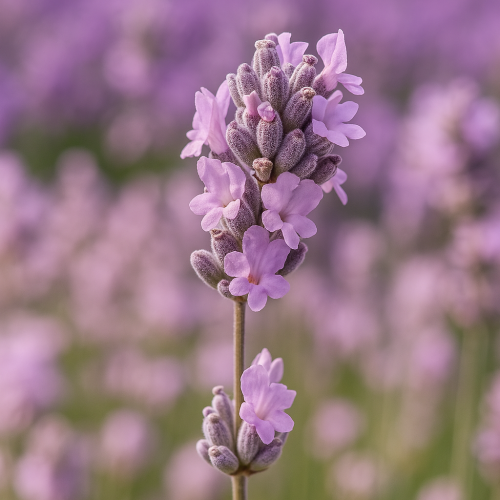
Lavandula angustifolia ‘Hidcote Pink’ is a cultivated variety of true lavender, part of the Lamiaceae family. Unlike the more commonly known purple-flowered cultivars, Hidcote Pink produces soft blush-pink flower spikes, making it visually striking and energetically distinct. While its oil chemistry still mirrors the classic angustifolia profile, the aroma and presence of this variety are far subtler—refined, softened, and gentle on the senses.
This variety is a compact, woody perennial shrub, known for thriving in temperate climates with plenty of sun and well-drained soil. The Hidcote cultivars, in general, are prized for both garden beauty and aromatic yield, but pink-flowering lavenders are less commonly grown for distillation—making this limited U.S. batch particularly rare.
Botanical Name:
Lavandula angustifolia ‘Hidcote Pink’
Family:
Lamiaceae
Common Names:
Hidcote Pink Lavender, Pink Lavender, Blush Lavender
Plant Type:
Woody perennial shrub
Part Used for Distillation:
Flowering tops (pink blossoms and upper stems)
Physical Characteristics:
-
Height: Typically 18–24 inches, more compact than standard angustifolia
-
Leaves: Narrow, silver-green, linear leaves with a soft texture
-
Flowers: Pale pink to blush-colored, tightly packed on upright spikes
-
Stem: Square stems, typical of the mint family, upright and sturdy
-
Root System: Fibrous, thrives in rocky, well-drained soils
Native Habitat and Growth Conditions:
-
Region: Cultivated primarily in temperate gardens; this batch was grown and distilled in the United States
-
Soil: Prefers alkaline, sandy or rocky soil with excellent drainage
-
Sunlight: Full sun exposure is essential for oil development
-
Climate: Thrives in dry, temperate conditions with low humidity
-
Flowering Season: Late spring to early summer
-
Harvest & Distillation Window: Flowers are typically harvested June through early July, when esters and monoterpenols are at their peak
Energetic Botanical Signature
Hidcote Pink grows close to the ground, compact and gentle—its pale flowers whispering rather than shouting. Unlike taller, more assertive cultivars, this plant invites stillness and grace. It embodies the archetype of the quiet healer: present, grounded, and deeply restorative. Its soft color and scent mirror its energetics—comfort without sedation, clarity without stimulation, and strength through stillness.
This is a plant that anchors without pulling, and soothes without numbing—medicine for the tender-hearted and energetically sensitive.