Personal Use
Hyssop Essential Oil – Chemotype 1,8-Cineole (France)
Hyssopus officinalis ct. 1,8-cineole
Hyssopus officinalis ct. 1,8-cineole
This oil opens with sharp clarity and sacred breath. Stillpoint’s Hyssop ct. 1,8-cineole is a high-altitude clarifier—bright, bracing, and immediately expansive in the chest and head. With nearly 50% 1,8-cineole, it’s a direct line to your lungs, your breath, your awareness.
But this isn’t the same vibe as Eucalyptus or Ravintsara. Hyssop carries a complex herbal backbone—crisp green notes with a slightly sweet and piney undercurrent. It's medicinal, yes, but also reverent. It feels like walking into an ancient stone chapel where fresh herbs were just laid at the altar.
The energetic hit is unmistakable: opening, sanctifying, centering. A breath of focus when your thoughts are tangled or the world feels cluttered.
Distilled from flowering tops grown in the dry hills of France, this oil offers a vibrational bridge between clearing and grounding. While the cineole leads the charge, supporting sinuses and breath, there’s a quiet earthiness underneath that keeps it anchored and spiritually aligned.
Hyssop ct. 1,8-cineole is a powerful respiratory and immune ally—but with more depth and nuance than your typical cineole-rich oils. While it shares the expectorant and mucolytic properties of Eucalyptus, this Hyssop chemotype brings in a slightly softer, more refined profile—perfect for those needing strong support without being overwhelmed.
Respiratory Support
-
High in 1,8-cineole (47.61%), making it a potent mucolytic and expectorant
-
Useful in treating congestion, sinus infections, bronchitis, and coughs
-
May support recovery from asthma or chronic respiratory tightness, especially when paired with conifers or Ravintsara
-
Ideal in steam blends, diffusers, or chest rubs
Immune System Activation
-
Gently stimulates immune response, especially in the early stages of illness
-
Antiviral and antimicrobial activity from both cineole and monoterpenes
-
May be useful in blends aimed at preventative care during cold/flu season
Mental Focus + Emotional Reset
-
Clears fog and sharpens mental focus—especially when under stress or exhaustion
-
Useful for those dealing with overwhelm, distraction, or energetic fragmentation
-
May support emotional resilience in individuals who feel “mentally congested”
Digestive Aid
-
Traditionally used to support digestion and gut clarity, especially when linked to emotional holding
-
Warming, moving, and cleansing in abdomi
Traditional Use
Hyssop has been revered for thousands of years as a purifier of body and spirit. Its name comes from the Hebrew ezov, a sacred cleansing herb mentioned in the Bible—used in rituals of protection, atonement, and renewal.
While the cineole chemotype is a modern identification, the therapeutic actions echo centuries of traditional use. In ancient Greece, Rome, the Middle East, and Europe, Hyssop was used to ward off illness, clear congested lungs, and protect against plague and “bad air.”
Traditional Herbal and Spiritual Applications:
-
Respiratory healing: Used in teas, steams, and herbal compresses for cough, bronchitis, and lung infection
-
Digestive support: Taken as an herbal bitter to stimulate appetite, ease bloating, and dispel gas
-
Sacred cleansing: Burned or bundled for energetic purification, especially in homes affected by grief or conflict
-
Protective herb: Hung in doorways or carried as a protective charm against negative energy or spiritual attack
-
Funeral rites & grief tending: Used in rituals to cleanse mourning spaces and help the spirit of the departed cross over
-
Bible and Temple Use: Referenced in Psalm 51—“Purge me with hyssop, and I shall be clean.” Often dipped in holy water and used to anoint or sprinkle sacred space.
This plant doesn’t just treat symptoms. It’s a spiritual antiseptic—used for clearing what lingers, both physical and unseen.
Botany
Hyssopus officinalis, commonly known as Hyssop, is a perennial evergreen shrub in the Lamiaceae (mint) family. While the standard chemotype leans toward a sweeter, camphoraceous profile, the 1,8-cineole chemotype tends to grow in higher altitudes and drier climates, like parts of southern France, where this batch originates. That shift in elevation and terrain gives us an oil that’s clearer, more direct—a mountain air version of an ancient plant.
Botanical Name: Hyssopus officinalis ct. 1,8-cineole
Family: Lamiaceae
Common Names: Hyssop, Holy Herb, Sacred Hyssop
Plant Type: Aromatic, woody perennial herb
Part Used for Distillation: Flowering tops
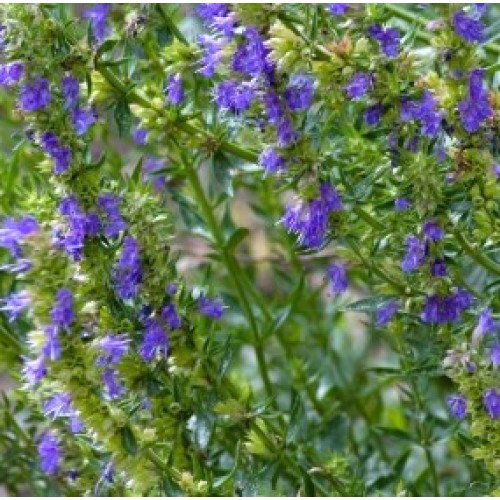
Growth Habit: Upright, branched shrub, 12–24 inches tall
Flowering Season: Summer (typically June–August in France)
Harvest Time for Distillation: Mid-summer, when flowers are fully open and cineole content is highest
Common Names: Hyssop, Holy Herb, Sacred Hyssop
Plant Type: Aromatic, woody perennial herb
Part Used for Distillation: Flowering tops
Growth Habit: Upright, branched shrub, 12–24 inches tall
Flowering Season: Summer (typically June–August in France)
Harvest Time for Distillation: Mid-summer, when flowers are fully open and cineole content is highest
Physical Characteristics:
-
Leaves: Narrow, dark green, lance-shaped; aromatic when crushed
-
Stems: Square and woody at the base—typical of the mint family
-
Flowers: Deep violet to blue (sometimes pink or white); highly attractive to bees and pollinators
-
Root System: Fibrous and spreading; helps stabilize rocky or dry soil
Native Habitat + Growth Conditions:
-
Native To: Southern Europe and parts of western Asia
-
Preferred Soil: Dry, well-drained, slightly alkaline soils; often grown in rocky or calcareous terrain
-
Sunlight: Full sun
-
Climate: Mediterranean; drought-tolerant once established
-
Ecological Notes: Supports pollinator populations and grows well alongside other medicinal plants like lavender, rosemary, and thyme
Energetic Botanical Signature
Hyssop’s upright posture, small blue flowers, and square stem reflect its clarity, structure, and spiritual focus. It grows in dry, windswept places, thriving not in lushness, but in restraint—a plant that teaches integrity, breath, and resilience.
Its flowering tops reach toward the heavens, while its leaves carry the signature bitterness of transformation. Hyssop is not here for indulgence—it’s here for truth-telling and energetic alignment. A boundary holder. A sacred purifier.