
Personal Use
Dry | Clearing | Ancient
Utah Juniper does not smell like lush forest.
It smells like survival.
Its aroma is dry, resinous, woody, sharp-green, and sun-baked, with a clean coniferous lift and a deeper desert-bone stillness underneath. This is not the wet, blue-green softness of a northern evergreen. This is high desert medicine — spare, strong, windswept, and honest as hell.
Utah Juniper feels like standing under a wide desert sky after everything unnecessary has been stripped away. It clears the air, clears the field, clears the head, and brings the body back into contact with what is solid, simple, and true.
This is an oil for energetic clutter. For heaviness. For spaces that feel stagnant, crowded, or spiritually dusty. For the moments when the body and mind need less noise and more ground.
There is something ancient and uncompromising about Utah Juniper. It does not coddle. It does not decorate the room. It purifies, steadies, protects, and reminds you that resilience does not always look soft. Sometimes resilience looks like a desert tree growing out of rock, still alive, still fragrant, still offering medicine.
Stillpoint’s Utah Juniper essential oil is distilled from the needles, berries, and twigs of Juniperus osteosperma, a hardy conifer native to the arid regions of the American Southwest. This tree grows where conditions are dry, exposed, and demanding, holding its aromatic medicine in evergreen foliage, resinous wood, and small berry-like cones.
This oil is for clearing. For grounding. For protection. For breath. For returning to yourself when the air around you feels too full of everyone else’s crap.
Therapeutic Applications
Respiratory Clearing + Breath Support
-
Utah Juniper’s fresh, dry, coniferous aroma makes it well suited for blends intended to support open, clear breathing.
-
Traditionally, juniper species have been used in aromatic preparations where the body feels congested, heavy, damp, or energetically crowded.
-
Useful in steam inhalation blends, chest oils, diffuser blends, and respiratory-support formulas when the goal is clarity, movement, and clean air.
-
Especially appropriate when the breath feels restricted by heaviness, emotional weight, stale indoor air, or seasonal sluggishness.
-
Blends beautifully with Eucalyptus, Rosemary, Black Spruce, Pine, Cedarwood, Frankincense, or Sweet Orange when the intention is clearer breath and steadier presence.
Purifying + Environmental Clearing
-
Utah Juniper is a natural fit for space-clearing, room sprays, diffuser blends, ritual oils, and formulas meant to freshen and purify the atmosphere.
-
Its dry, resinous, evergreen aroma helps cut through stale air, energetic heaviness, and that “too many people have been in this room with their feelings” situation.
-
Useful in cleansing blends for treatment rooms, meditation spaces, homes, studios, and thresholds.
-
Especially supportive when a space feels stagnant, dense, overused, emotionally loaded, or in need of reset.
-
Pairs well with Lemon, Frankincense, Cedarwood, Palo Santo, Black Spruce, Rosemary, Lavender, or Sweet Orange for clearing blends that feel clean without becoming harsh.
Grounding + Nervous System Steadiness
-
Utah Juniper may support the nervous system when someone feels scattered, porous, overwhelmed, or energetically untethered.
-
Its aroma is clearing without being frantic, grounding without being heavy, and protective without shutting the heart down.
-
Useful in blends for meditation, breathwork, bodywork, ceremony, or daily grounding rituals.
-
Especially helpful when stress has made the system feel noisy, vigilant, or filled with too much outside input.
-
This oil brings a “come back to the bones” quality — not soft comfort, but deep steadiness.
Muscular + Joint Comfort
-
Juniper oils have a long traditional association with movement, cleansing, and support for stiff, heavy, or overworked areas of the body.
-
Utah Juniper may be useful in massage blends for muscular tension, joint discomfort, and places that feel stuck, tired, or slow to move.
-
Its dry, warming-clearing nature makes it a good choice when the body feels heavy, congested, or burdened rather than hot and inflamed.
-
Blends well with Black Pepper, Ginger, Sweet Marjoram, Lavender, Copaiba, Plai, or Rosemary in low-dilution body oils.
-
This is not lush spa medicine. It is desert clearing medicine for the body — clean, direct, and practical.
Lymphatic + Fluid Movement Support
-
Utah Juniper may be useful in blends intended to support healthy fluid movement, especially when the body feels heavy, puffy, sluggish, or stagnant.
-
Juniper species are traditionally associated with cleansing, purification, and movement through the waters of the body.
-
Useful in massage oils for the legs, low back, hips, or areas where heaviness and sluggishness are part of the picture.
-
Pairs beautifully with Cypress, Grapefruit, Lemon, Rosemary, Cedarwood, or Ginger for blends focused on movement, lightness, and flow.
-
Use with respect and avoid overuse, especially with kidney concerns, pregnancy, or medically complex situations.
Energetic Protection + Boundary Support
-
Utah Juniper is one of those oils that feels like it knows where the perimeter is.
-
It may support energetic protection, boundary work, spiritual cleansing, and the release of what does not belong.
-
Useful when someone feels energetically slimed, invaded, foggy, drained, or too open to other people’s moods and projections.
-
This oil helps clear the field without making a big dramatic production out of it.
-
It says: this is my body, this is my breath, this is my space, and the rest can leave.
Utah Juniper is an oil of desert clarity.
It clears what is stale, steadies what is scattered, protects what is vulnerable, and brings the spirit back into clean relationship with the body, the breath, and the ground.
Traditional Use
Utah Juniper has long been part of the living medicine of the American Southwest. For Indigenous peoples of the region, Juniperus osteosperma was not just a tree in the landscape. It was medicine, material, smoke, shelter, fuel, food, ceremony, and protection.
This is desert medicine.
The needles, twigs, berries, bark, gum, wood, and smoke were used in different ways by different peoples, including the Navajo, Paiute, Havasupai, Yavapai, and other Indigenous communities of the Southwest. Traditional uses included preparations for stomach discomfort, coughs, colds, headaches, sore areas, cleansing, fumigation, postpartum care, hair and scalp care, wound covering, and ceremonial protection.
Utah Juniper grows in hard places. Dry places. Wind-stripped places. Places where the land does not hand out softness easily. And the traditional uses reflect that: this tree was used when the body, home, spirit, or community needed clearing, protection, endurance, and practical support.
It was not fancy medicine.
It was necessary medicine.
Coughs, Colds + Respiratory Clearing
-
Utah Juniper has traditional use among Indigenous peoples for coughs, colds, and respiratory discomfort. National Park Service material notes that American Indian tribes used juniper medicinally for stomach aches, coughs, and headaches. (
-
Paiute use includes inhaling fumes from burning twigs for headaches and colds, reflecting juniper’s role as a smoke and breath medicine.
-
The aromatic needles and twigs were valued for their strong volatile scent, which made the plant useful as incense, fumigant, and clearing smoke.
-
Traditionally, this was the kind of plant used when the air, breath, or body felt heavy, congested, or burdened.
-
Utah Juniper clears through the breath. It brings that dry, resinous, desert-air quality that helps the system feel less crowded.
Stomach Aches + Digestive Support
-
Utah Juniper was traditionally used for stomach aches and digestive discomfort in Indigenous medicine practices of the Southwest. The National Park Service specifically identifies stomach aches as one of the medicinal uses of juniper among American Indian tribes.
-
Juniper berries and plant preparations were used in different traditional contexts for internal complaints, though modern essential oil use is very different and should not be confused with drinking traditional plant teas or eating berries.
-
In energetic terms, this links Utah Juniper to clearing what is stagnant, not only in the air or space, but in the belly and body.
-
This is one of those places where we have to be precise: traditional use of the plant does not mean casual internal use of the essential oil.
-
The old use belongs to the whole plant and the people who knew how to work with it. The essential oil is concentrated and needs modern safety respect.
Headaches, Pain + Sore Areas
-
Traditional references document the use of Utah Juniper for headaches, pain, and sore areas. The Native American Ethnobotany database records Paiute use of fumes from burning twigs for headaches and colds, and a strong decoction of twigs as an antiseptic wash for sores.
-
Other ethnobotanical summaries note that Utah Juniper was used in treatments involving toothaches, stomach aches, coughs, colds, swellings, and headaches.
-
This supports Utah Juniper’s traditional association with clearing, cleansing, soothing, and supporting areas that feel burdened or uncomfortable.
-
In body oil or massage use, the essential oil belongs in low-dilution blends where the intention is movement, clearing, and comfort — not aggressive heat.
-
This is not “miracle pain oil” language. It is old desert plant use translated carefully into modern aromatic support.
Cleansing, Fumigation + Smoke Medicine
-
Utah Juniper’s aromatic and volatile compounds made it useful as incense and fumigant.
-
Smoke from juniper has been used traditionally for cleansing, protection, and ceremonial purposes across multiple Indigenous and folk contexts.
-
The Navajo used juniper in “War Dance medicine,” and Utah State University Extension also notes Navajo use of juniper rubbed on the hair for dandruff.
-
Juniper smoke carries a strong energetic signature: clearing the field, shifting the atmosphere, and marking sacred or protected space.
-
This is where the modern space-clearing use of Utah Juniper essential oil has real ancestral resonance — but again, with respect. We are not pretending a diffuser is the same thing as ceremony. We are recognizing the plant’s long relationship with purification and protection.
Hair, Scalp + Skin Cleansing
-
Traditional uses include hair and scalp care. Utah State University Extension notes Navajo use of juniper rubbed on the hair for dandruff, and Utah Valley University notes that an infusion of the plant has been used as a hair wash.
-
The Native American Ethnobotany database also records a strong decoction of Utah Juniper twigs used by Paiute people as an antiseptic wash for sores.
-
These uses point to juniper’s traditional role in cleansing the surface of the body, especially when something needed washing, clearing, or protective attention.
-
In modern aromatherapy, this does not mean applying the essential oil neat to the scalp or skin. It means the traditional plant use supports the broader theme of cleansing, purifying, and topical support when properly diluted.
Postpartum + Women’s Traditional Use
-
The Yavapai are recorded as giving women tea made from juniper leaves to calm contractions after birth, and fumigating them with smoke from leaves placed over hot coals.
-
This is an important traditional use, but it needs to be handled carefully.
-
We are naming the historical/ethnobotanical use of the plant. We are not recommending Utah Juniper essential oil for pregnancy, labor, postpartum, or internal use.
-
The modern essential oil is concentrated, and pregnancy/postpartum use should only be considered with appropriate professional guidance.
-
Still, energetically, this traditional use reinforces Utah Juniper’s connection to smoke, protection, transition, the body under pressure, and the threshold between vulnerability and strength.
Wounds, Gum + Protective Covering
-
Havasupai use included applying juniper gum as a protective covering over wounds, and using bark for practical purposes such as bedding and slow-match fire carrying.
-
This is a beautiful example of juniper as practical protection: not abstract, not decorative, but real material support.
-
Gum, bark, smoke, wood, and foliage all had roles.
-
The tree protected by being useful.
-
That is part of Utah Juniper’s medicine: it does not need to be glamorous. It endures, shelters, clears, covers, burns, scents, and supports.
Food, Berries + Daily Use
-
The berry-like cones of Utah Juniper were used as food by some Indigenous peoples, including the Havasupai, who ate the cones fresh and in cakes.
-
Dried berries have also been described as emergency food or seasoning, and in some contexts roasted and ground as a coffee substitute.
-
This places Utah Juniper not only in the medicine pouch, but in daily survival and nourishment.
-
Again, this is the whole plant and traditional food use — not internal use of essential oil.
Ceremony, Protection + Threshold Medicine
-
Utah Juniper carries a strong ceremonial and protective thread. Navajo use included “War Dance medicine,” and other sources describe juniper wood in ceremonial structures and its role in cultural practices.
-
The Navajo are also described as sweeping tracks with juniper boughs so death would not follow them, a powerful image of spiritual boundary and protection.
-
This is not casual folklore. This is threshold medicine.
-
Juniper marks the boundary between what follows and what does not. What enters and what stays out. What belongs in the field and what needs to leave.
-
Utah Juniper is protection with roots in the ground.
Utah Juniper is one of the great aromatic trees of the Southwest.
In traditional use, it was called on for coughs, colds, stomach aches, headaches, sore areas, cleansing, smoke medicine, hair and scalp care, postpartum practices, food, fuel, shelter, wound protection, ceremony, and spiritual boundary.
This is the medicine of a tree that knows how to live in exposed places.
It clears.
It protects.
It steadies.
It survives.
It protects.
It steadies.
It survives.
And sometimes, that is exactly the medicine we need.
Botany
Juniperus osteosperma, commonly known as Utah Juniper, is an evergreen conifer native to the arid and semi-arid regions of the American Southwest. A member of the Cupressaceae family, it grows as a shrub or small tree, often with multiple trunks, fibrous gray bark, stout branchlets, and a rounded, irregular crown shaped by wind, drought, sun, and time. Utah Valley University describes it as a monoecious shrub or small tree, usually 2–4 meters tall, sometimes taller, with gray, thin, fibrous bark that eventually shreds.
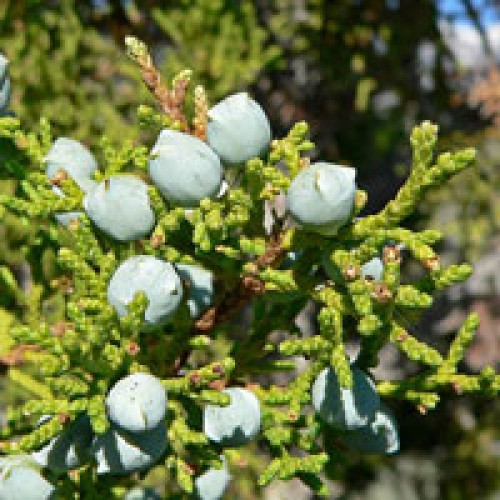
Stillpoint’s Utah Juniper essential oil is distilled from the needles, berries, and twigs of Juniperus osteosperma. Technically, the “berries” are not true berries. They are berry-like seed cones — small, rounded, resinous structures that mature slowly and carry the tree’s reproductive medicine. The National Park Service describes Utah Juniper as having short scale-like needles and berry-like scaled cones that mature to a bronze color with a bluish-white coating.
This tree grows where the land is dry, exposed, and demanding. It is commonly found with pinyon pine, sagebrush, desert scrub, rocky slopes, mesas, and high desert woodlands. In Great Basin National Park, Utah Juniper is described as one of the most abundant and widely scattered trees of the region, typically found between 3,000 and 8,000 feet.
This is not a tree of excess. This is a tree of endurance.
It survives through adaptation: small scale-like leaves to reduce water loss, aromatic resins to protect its tissues, deep relationship with dry soils and harsh exposure, and a slow, stubborn growth habit that lets it remain alive where softer things cannot.
Botanical Name: Juniperus osteosperma
Family: Cupressaceae
Common Names: Utah Juniper, Desert Juniper
Plant Type: Evergreen conifer; shrub to small tree
Part Used for Distillation: Needles, berry-like cones, and twigs
Growth Habit: Multi-trunked shrub or small tree with rounded, irregular crown; often shaped by drought, wind, and exposure
Flowering / Cone Season: Male pollen cones typically release pollen in early spring; seed cones mature slowly over an extended period
Harvest Time for Distillation: Needles, twigs, and berry-like cones may be gathered when aromatic and available, with timing depending on region, access, and responsible harvesting practices
Family: Cupressaceae
Common Names: Utah Juniper, Desert Juniper
Plant Type: Evergreen conifer; shrub to small tree
Part Used for Distillation: Needles, berry-like cones, and twigs
Growth Habit: Multi-trunked shrub or small tree with rounded, irregular crown; often shaped by drought, wind, and exposure
Flowering / Cone Season: Male pollen cones typically release pollen in early spring; seed cones mature slowly over an extended period
Harvest Time for Distillation: Needles, twigs, and berry-like cones may be gathered when aromatic and available, with timing depending on region, access, and responsible harvesting practices
Physical Characteristics
Leaves:
-
Short, scale-like evergreen leaves, usually yellow-green to gray-green
-
Young growth may show sharper, awl-like juvenile leaves
-
Aromatic when crushed
-
Adapted to conserve moisture in dry, exposed climates
Twigs + Branchlets:
-
Stout, aromatic branchlets
-
Often dense, irregular, and wind-shaped
-
Carry both foliage and small cones
-
Hold the dry, resinous aromatic character of the tree
Bark:
-
Gray to ashy-gray
-
Thin, fibrous, and shredding with age
-
Gives the tree an old, weathered, desert-survivor appearance
Cones / “Berries”:
-
Berry-like seed cones, not true botanical berries
-
Rounded, resinous, and often bluish, bronze, or brownish with a pale waxy coating when mature
-
Usually contain one seed, occasionally more
-
Mature slowly, often over more than one season
Roots:
-
Adapted to dry, rocky, low-moisture environments
-
Help anchor the tree in poor soils, slopes, mesas, and exposed high desert terrain
-
Reflect the tree’s ability to hold ground in difficult places
Native Habitat + Growth Conditions
Native To:
-
Southwestern and western United States, including Utah, Arizona, Nevada, New Mexico, Colorado, parts of California, Wyoming, Idaho, and surrounding regions
Preferred Soil:
-
Dry, rocky, well-drained soils
-
Often found in poor, alkaline, sandy, gravelly, or shallow soils where many other trees struggle
Sunlight:
-
Full sun to open exposure
-
Built for wide sky, direct light, and harsh conditions
Climate:
-
Arid to semi-arid climates
-
High desert, pinyon-juniper woodland, sagebrush country, rocky slopes, mesas, and dry foothills
-
Tolerates drought, temperature extremes, wind, and poor soil
Ecological Notes:
-
Utah Juniper is a foundational species in pinyon-juniper woodlands.
-
It provides shelter, food, nesting sites, and habitat for birds, mammals, insects, and other desert life.
-
Its berry-like cones are eaten by birds and small mammals, helping disperse the seeds.
-
The tree stabilizes dry landscapes and participates in the larger ecology of desert survival.
Energetic Botanical Signature
Utah Juniper grows where life has to mean it.
Dry slopes. Stone. Wind. Thin soil. Long heat. Cold nights. Open sky.
It does not have the softness of a lush forest tree because it was not shaped by lushness. It was shaped by exposure.
This is the medicine of endurance without performance.
Utah Juniper teaches that protection does not always look like armor. Sometimes protection looks like conserving what matters. Small leaves. Resinous tissues. Slow growth. Deep relationship with the land. A body built not for display, but for survival.
Its leaves are scaled down to what is necessary. Its bark shreds and weathers. Its branches twist with the conditions instead of pretending the conditions are not happening.
This is a tree that does not waste life force trying to look untouched.
The berry-like cones carry another layer of medicine. They are small, resinous, concentrated, and slow to mature — reminders that not all growth is fast, visible, or dramatic. Some things ripen in hard places. Some medicine takes time.
This is the plant teaching:
-
Stay rooted in difficult places.
-
Keep what is essential.
-
Let the rest dry away.
-
Protect your field without closing your heart.
-
Do not confuse softness with weakness or survival with failure.
Utah Juniper carries the signature of clearing, protection, resilience, and desert truth.
It clears what is stale.
It steadies what is scattered.
It protects what is vulnerable.
It reminds the body and spirit how to survive without becoming dead inside.
It steadies what is scattered.
It protects what is vulnerable.
It reminds the body and spirit how to survive without becoming dead inside.
This is not soft green comfort.
This is high desert clarity — ancient, dry, protective, and alive.
