
Personal Use
It is known for its unique relationship to the heart, and its ability to slow a rapid heartbeat. I've had great results with this oil in this capacity. It can also help alleviate the symptoms of shock and trauma. For sever PTSD and trauma combine with Laurel leaf essental oil, Melissa and Orange Essential Oil.
It's a strong sedative- Great for sleep assiatance and is great in a massage oil. Put it in a bath to help alleviate insomnia and reduce tension. In a cream, it's a beautiful moisturizing agent and is generally good in skin care blends. You only need a drop or two in 1 oz (30 ml) of carrier, and one drop in your bath is plenty. Great for reducing anxiety
Traditional Use
Analgesic - provides pain relief
Anti-inflammatory - alleviates inflammation Antidepressant - can help to prevent and alleviate depression CNS sedative - calming to the central nervous system Cooling - cools area
Hypotensive - lowers blood pressure
Skin healing - supports the skin to heal
Tonic - strengthens and restores vitality
Botany
Cananga odorata, commonly known as ylang-ylang, is a tropical tree native to the rainforests of countries such as India, the Philippines, Malaysia, Indonesia, and parts of Australia. The tree is part of the Annonaceae family.
-
Size: The tree can grow up to 20 meters (about 60 feet) tall. It has a grey, furrowed trunk that can reach a diameter of about 50 cm (approximately 20 inches).
-
Leaves: Its leaves are evergreen, elongated, and glossy, with a pointed tip and broad base. They usually grow directly across from each other in an alternate pattern.
-
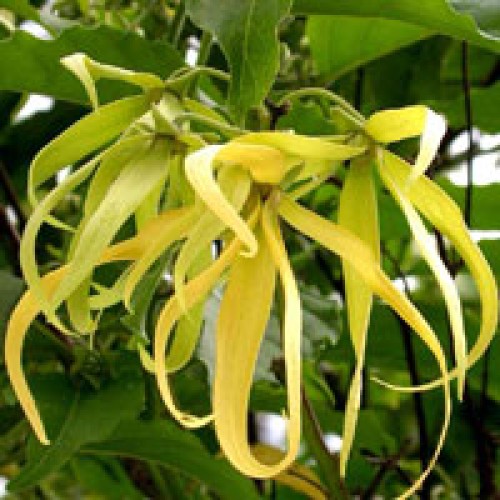
Flowers: The flowers of Cananga odorata are drooping, long-stalked, with six narrow, greenish-yellow (sometimes pink) petals, like a starfish. They exude a powerful and unique scent, which is most intense in the early morning. The flowers are the source of ylang-ylang essential oil.
-
Fruit: The fruit is a black, oval drupe that contains several seeds.
The tree requires a hot, humid, and tropical climate to thrive, ideally with an evenly distributed annual rainfall. The tree begins to flower each year after its fifth year. The flowers are handpicked for the extraction of ylang-ylang essential oil.
