
Personal Use
(Hippophae rhamnoides, Pulp CO₂ Extract)
Sea Buckthorn Pulp CO₂ is solar medicine in liquid form—dense, vibrant, and unapologetically orange. Pressed from the pulp of the fruit (excluding the seed), this CO₂ extract carries the plant’s most nourishing, restorative essence. It's thick, rich, and packed with naturally occurring palmitoleic acid (Omega-7)—a rare fatty acid also found in human skin that supports deep regeneration, especially after damage, depletion, or trauma.
This extract is not your everyday carrier. It’s targeted, potent, and vibrationally active. While we love and carry the full-spectrum berry extract and the lighter seed oil, this pulp-only version offers a direct line to the fruit’s solar intelligence. It’s for skin that’s been through something—or for spirits needing to recover from energetic burnout.
Stillpoint’s Sea Buckthorn Pulp CO₂ was supercritically extracted from organically grown berries, stabilized with a trace of rosemary antioxidant for long-term integrity.
Therapeutic Applications
Sea Buckthorn Pulp CO₂ is a deeply reparative extract with a long history of use in clinical, cosmetic, and traditional medicine—particularly for tissue regeneration, skin trauma, and mucosal recovery. Rich in palmitoleic acid (Omega-7), carotenoids, tocopherols, and phytosterols, it acts like first aid for the skin barrier, with added antioxidant and anti-inflammatory support.
Skin Trauma + Regeneration
This extract may assist in accelerating tissue repair following burns, abrasions, radiation damage, laser treatments, and scarring. Its rare fatty acid profile mimics the lipids found in skin and mucosa, helping to replenish and rebuild compromised areas.
Post-Sun + Radiation Support
Traditionally used for its ability to support UV-damaged tissue, Sea Buckthorn Pulp CO₂ is particularly well-suited for after-sun formulas, radiation recovery, and post-inflammatory hyperpigmentation.
Anti-Inflammatory + Barrier Rebuilding
Its synergy of carotenoids, sterols, and unsaturated fatty acids offers a powerful anti-inflammatory action while restoring moisture and lipid balance—making it helpful for eczema, rosacea, and chronic dryness.
Antioxidant + Cellular Protection
Carotenoids and tocopherols provide antioxidant protection, helping to neutralize oxidative stress and environmental damage. This makes it ideal for mature, stressed, or devitalized skin.
Internal + Mucosal Healing (Traditional Use)
In Eastern European traditions, the pulp oil was also taken internally for ulcers and mucosal inflammation (note: Stillpoint's oil is for external use only). The same principles may support external healing of delicate tissues such as lips, nostrils, or other vulnerable areas.
Traditional Use
Sea Buckthorn (Hippophae rhamnoides) has been used for centuries across Eastern Europe, Russia, Mongolia, and Tibet for its regenerative, nutritive, and protective properties. While the whole plant—leaves, berries, seeds—has its place in folk medicine, the fruit pulp in particular was valued for skin trauma, digestive recovery, and burn care.
In Siberian and Russian traditional medicine, the pulp oil was applied topically to burns, ulcers, frostbite, and wounds, as well as to support recovery from radiation therapy and sun damage. Internally, it was often taken as a tonic for gastric ulcers, mucosal inflammation, and nutrient depletion, especially during long winters.
In Tibetan and Mongolian systems, Sea Buckthorn fruit was viewed as a rejuvenating and strengthening plant, capable of restoring vitality and building “fire” in the body. It was often prescribed to patients recovering from illness, injury, or deep fatigue.
Even in contemporary herbal traditions, the pulp oil continues to be used for:
-
Skin barrier repair after dermatological procedures
-
Anti-aging and elasticity support
-
Recovery from burns, radiation, and trauma
-
Nutrient-dense skin nourishment for depleted or sun-exposed tissue
This CO₂ extract of the pulp alone captures that legacy—concentrated, focused, and intentionally designed for restoration.
Botany
Sea Buckthorn (Hippophae rhamnoides) is a resilient deciduous shrub native to Europe and Central Asia, especially in windswept coastal regions, high-altitude steppes, and nutrient-poor soils. It belongs to the Elaeagnaceae family, a lesser-known but hardy botanical lineage marked by adaptive brilliance and deep ecological intelligence.
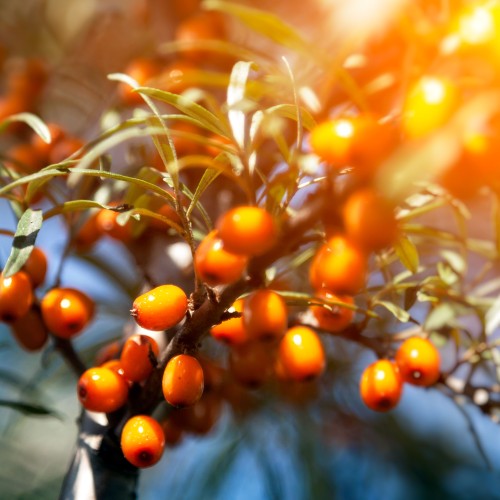
Unlike other oil-rich plants, Sea Buckthorn produces its therapeutic bounty not from seeds alone, but from its vivid orange fruit pulp, which is densely packed with Omega-7, carotenoids, and cell-regenerative compounds. The plant’s extreme growing conditions—and the harshness it survives—are mirrored in its medicine. This is a species that doesn’t just survive adversity; it transmutes it.
Botanical Name: Hippophae rhamnoides
Family: Elaeagnaceae
Common Names: Sea Buckthorn, Sandthorn, Siberian Pineapple
Plant Type: Deciduous, fruiting shrub
Part Used for CO₂ Extraction: Fruit pulp (dried), excluding the seeds
Growth Habit: Hardy, fast-growing shrub, 2–6 meters tall, with long, spiny branches
Flowering Season: Spring
Harvest Time for CO₂ Extraction: Late summer to early fall, when carotenoid content peaks
Physical Characteristics:
Family: Elaeagnaceae
Common Names: Sea Buckthorn, Sandthorn, Siberian Pineapple
Plant Type: Deciduous, fruiting shrub
Part Used for CO₂ Extraction: Fruit pulp (dried), excluding the seeds
Growth Habit: Hardy, fast-growing shrub, 2–6 meters tall, with long, spiny branches
Flowering Season: Spring
Harvest Time for CO₂ Extraction: Late summer to early fall, when carotenoid content peaks
Physical Characteristics:
-
Leaves: Narrow, silvery-green, slightly leathery
-
Stems: Thorny and woody with silvery bark
-
Flowers: Tiny and yellow-green; dioecious plant (separate male and female)
-
Fruits: Bright orange, oil-rich berries with sour, medicinal pulp
Native Habitat + Growth Conditions:
-
Native To: Europe and Central Asia
-
Preferred Soil: Sandy, loose, and low-nutrient
-
Sunlight: Full sun
-
Climate: Cold-hardy, drought-tolerant, and salt-resistant
-
Ecological Notes: Pioneering species for land regeneration; nitrogen-fixer; stabilizes degraded soils
Energetic Botanical Signature
Sea Buckthorn is a master of thresholds—thriving not in lush, fertile valleys but on the edge of what seems impossible. It grows in poor, rocky soil. It anchors into windblown cliffs, salt-exposed beaches, and high-altitude plains where other plants falter. And yet, its fruits are bursting with life—dense with nourishment, antioxidants, and the signature orange-gold glow of the sun itself.
The plant’s sharp thorns are no accident—they teach boundaries and protection, forming a living shield around its nutrient-dense core. Its silver-green leaves shimmer like armor, reflecting heat and harshness. Its root system digs deep and spreads wide, stabilizing disturbed land, holding soil in place where erosion threatens to strip it bare. It gives structure to chaos—literally and energetically.
This is not a soft plant, but it is a kind one. It does not coddle—it restores. Its energetic message is:
“You’ve been through the fire. Let’s rebuild—cell by cell, breath by breath, light by light.”
