
Every order ships USPS Priority — $10.95 flat-rate USPS Priority shipping on all US orders, no minimum. Free shipping on domestic orders over $299.
Welcome to Stillpoint. Subscribe to our newsletter for sale details and new-product news · One discount code per order · Every order is hand-poured, packed with care in ceremony, and shipped as we receive it.

Santolina Essential Oil | Skin Support, Boundaries, Protection

Santolina chamaecyparissus L.

  • Santolina Essential Oil | Skin Support, Boundaries, Protection

Average Rating: (see reviews)

$10.00 Ex Tax: $10.00

Essential Facts

  • Latin Name: Santolina chamaecyparissus L.
  • Country of Origin: British Indian Ocean Territory
  • Botanical Family: Asteraceae
  • Plant Parts: Flowering tops
  • Note Classification: Top/Middle
  • Cultivation Method: Organically Grown
  • Method of Extraction: Steam or Hydro Distillation
  • Extraction Date: September 2025
  • Approx. Shelf Life: 6 years
  • Chemical Family: Ketones, Monoterpenes, Oxides
  • Aroma: Camphoraceous, Fresh, Green
  • Energetic Applications: 4th Chakra - unconditional love, 6th Chakra - perspective, Clarity, Expansive, Purifying, Uplifting
  • Therapeutic Properties: Anti-arthritic, Anti-inflammatory, Anti-septic, Anti-spasmodic, Carminative, Cephalic, Decongestant, Insect repellent
Notes & Use

Personal Use

Santolina essential oil has a strong, dry, and camphoraceous aroma with notes of bitter herb, dry grass, and faint floral undertones. It is distinctly sharp, penetrating, and slightly medicinal—more aligned with the Artemisia family than with true Lavender, despite its common name “Lavender Cotton.”

Stillpoint’s Santolina essential oil is steam distilled from the flowering tops of Santolina chamaecyparissus grown in the Mediterranean region. This low-growing, silver-leaved shrub thrives in dry, alkaline soils and is known for its high content of monoterpenes and sesquiterpenes, which contribute to its broad-spectrum antimicrobial and antiparasitic activity.

Antimicrobial + Antifungal
Santolina essential oil has been shown to possess antimicrobial and antifungal properties, making it a potential ally in topical preparations for skin imbalances, including minor wounds, fungal infections, and microbial overgrowth. Useful in formulations targeting athlete’s foot, ringworm, or scalp issues.

Insect-Repelling + Antiparasitic
Traditionally used for its insect-repelling qualities, Santolina may support external applications to deter lice, mites, or other external parasites. It may also assist in promoting hygiene and repelling unwanted pests when diffused in enclosed environments.

Mild Anti-Inflammatory Support
The oil’s composition includes compounds that may offer mild anti-inflammatory effects. When diluted and applied topically, it may help support localized relief for bites, irritated skin, or areas of minor inflammation.

Energetic Use – Subtle Boundary Support
Clinically, it is not known as a nervous system oil, but anecdotal use suggests that Santolina may assist with energetic clearing and subtle boundary protection when used in low dilutions in inhalation or diffuser blends.

Traditional Use

Santolina (Santolina chamaecyparissus), also known as Lavender Cotton, has been used in traditional Mediterranean folk medicine for both physical and protective purposes. Its bitter, aromatic character made it a staple in gardens and homes—valued for its ability to ward off pests, support skin healing, and purify the environment.

Skin and Wound Support:
In folk applications, Santolina was used topically as a poultice or infusion to soothe minor wounds, insect bites, and inflamed or irritated skin. The flowering tops were steeped in oil or vinegar to draw out impurities and accelerate tissue repair in cuts, scrapes, and rashes.

Antiparasitic and Vermifuge Use:
Santolina was traditionally regarded as a vermifuge and antiparasitic, with internal preparations (now considered outdated and potentially unsafe) used to expel intestinal parasites. Topically, crushed leaves or essential oil-infused preparations were applied to repel lice and mites.

Insect Repellent + Garden Protector:
The plant was often grown at the edges of gardens to deter insects and protect crops. Its dried flowers and leaves were placed in linen drawers or burned as a fumigant to repel moths and insects from indoor spaces.

Energetic + Ritual Use:
Though not widely documented in formal spiritual traditions, Santolina was sometimes included in protection bundles or burned with other herbs to cleanse homes of negative energy and guard personal space. Its strong scent and bitter nature were believed to create a boundary between the physical and the unseen.

Botany

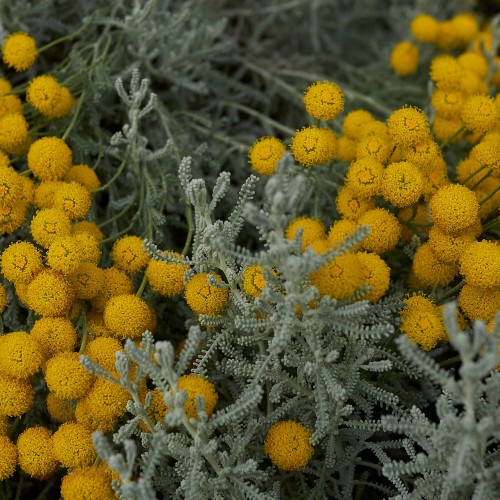
Santolina chamaecyparissus, commonly known as Santolina or Lavender Cotton, is a small, aromatic evergreen shrub belonging to the Asteraceae (daisy) family. Despite its common name, it is not related to true lavender. The name “Lavender Cotton” comes from its finely divided silver-gray foliage and compact, rounded habit, which visually resembles lavender and cotton plants.

Native to the western and central Mediterranean region, Santolina thrives in hot, dry environments with poor, well-drained soils. It is highly drought-tolerant and often used in xeriscaping, traditional herb gardens, and as a natural insect-repelling border plant.

Botanical Name: Santolina chamaecyparissus
Family: Asteraceae
Common Names: Santolina, Lavender Cotton, Cotton Lavender
Plant Type: Evergreen aromatic shrub
Part Used for Distillation: Flowering tops
Growth Habit: Compact, woody shrub reaching 30–60 cm in height and width
Flowering Season: Late spring to midsummer
Harvest Time for Distillation: When flower heads are fully formed and aromatic compounds are at their peak
Physical Characteristics:
  • Leaves: Fine, feathery, silver-gray, highly aromatic, and woolly in texture
  • Stems: Woody at the base, becoming more flexible and green toward the tips
  • Flowers: Button-like, bright yellow, forming dense globular clusters
  • Roots: Shallow and fibrous, adapted for dry, rocky conditions
Native Habitat + Growth Conditions:
  • Native To: Western and central Mediterranean (France, Italy, Spain, North Africa)
  • Preferred Soil: Poor, alkaline, well-drained soils—especially sandy or rocky terrain
  • Sunlight: Full sun
  • Climate: Hot, dry, Mediterranean; highly drought-resistant once established
  • Ecological Notes: Deters pests naturally; often used in companion planting and herb gardens to protect neighboring species

Energetic Botanical Signature
Santolina grows low and wide, forming a protective ring around the soil it anchors. Its silver foliage reflects the sun, shielding it from excess heat, while its dense growth habit naturally creates boundaries. The bright yellow flowers rise like tiny sentinels—watchful, alert, and precise.

This is a plant of containment and protection. Its shape, scent, and chemistry all speak to discernment—what to keep, what to release, what to guard. It offers clarity through structure and defense through subtle strength
Energetics

Energetic Properties

Santolina is boundary medicine. Its energy is firm, not forceful—bringing definition where things have become too porous, too chaotic, or too entangled. This is not an oil for emotional processing or catharsis—it’s for restoring structure. It helps to filter out what doesn’t belong and strengthens the energetic field so you can reclaim your own space, physically and psychically.

Where emotional noise drowns out inner clarity, Santolina brings containment. When energetic boundaries have been breached, it supports the process of re-sealing and reclaiming.
It’s especially useful for healers, empaths, or anyone who works in close contact with others and needs to maintain energetic sovereignty.

Energetic Themes:
  • Reinforcing energetic boundaries after emotional entanglement or psychic drain
  • Clearing residual energetic debris from physical or shared spaces
  • Supporting self-containment after oversharing or energetic overextension
  • Creating internal stillness when overstimulation leads to mental fragmentation
  • Holding space for quiet, neutrality, and energetic “reset”

Spiritual Use:
Santolina may be used in diffuser or topical blends to prepare for boundary-setting rituals, space clearing, or energetic protection work. Its dry, neutral scent and clear energetic profile make it a strong support during meditation, energy healing sessions, or after deep interpersonal exchanges. It is especially useful for solo integration work, shielding practices, and grounding after exposure to collective emotional fields.

Traditional & Folklore

Santolina, though less commonly highlighted in modern herbal texts, held a valued place in traditional Mediterranean folk medicine and rural life. Known for its strong scent and insect-repelling qualities, it was often planted along garden borders, used in home protection practices, and applied in basic first aid.

Folk Medicine in Mediterranean Regions:
In regions of southern France, Italy, and Spain, Santolina was infused into oils, vinegars, and poultices to address skin irritations, bites, and minor wounds. It was used as a topical remedy for its astringent and antimicrobial effects and occasionally brewed into simple teas for internal parasites or digestive complaints—though this practice has since fallen out of favor due to safety concerns with essential oil constituents.

Insect Repellent + Protective Use:
Santolina was widely used as a natural insect deterrent. Dried flowers and leaves were placed in closets, trunks, and bedding to repel moths and pests. In some rural traditions, it was also used as a boundary plant—not only for physical protection in gardens but also as a symbolic barrier against unwanted energies or influences in the home.

Ceremonial and Spiritual Use:
Though not as prevalent in formal ceremonial systems, Santolina was sometimes burned with other herbs during home-cleansing rituals or used in protective sachets to create energetic separation after conflict or illness. Its bitter, dry nature aligned it with practices meant to “dry out” stagnation, reset the field, and fortify boundaries.
Chemistry

Chemical Components

Santolina essential oil contains a distinctive composition of monoterpenes, sesquiterpenes, and ketones, which contribute to its strong aromatic profile and therapeutic applications. Its chemistry reflects the plant’s natural defense system—protective, clarifying, and energetically firm.

Key Chemical Families Typically Present in Santolina:
  • Monoterpenes (e.g., α-pinene, β-pinene, limonene) – Support respiratory clarity, diffusion, and immune modulation; also contribute to the oil’s insect-repellent effects
  • Sesquiterpenes (e.g., β-caryophyllene, germacrene D) – Anti-inflammatory, skin-supportive, and energetically grounding
  • Ketones (primarily camphor) – Known for mucolytic, analgesic, and antiparasitic properties; bring sharpness and structure to blends
  • Oxides (such as 1,8-cineole in small amounts) – Offer respiratory-clearing and mentally clarifying properties
  • Esters and Lactones (in trace amounts) – May provide additional calming, antispasmodic, or skin-soothing actions

Therapeutic Implications of the Chemistry:
  • Supports respiratory health, particularly where mucous congestion and microbial load are present
  • Effective in blends for minor skin concerns, microbial imbalances, or fungal overgrowth
  • Useful in insect-repellent formulations and topical parasite-clearing preparations
  • Balances sharp clarity with subtle grounding—making it suitable for energetic boundary support and diffuser use in enclosed spaces
  • Best used at low dilutions due to the presence of ketones and the oil’s strong aromatic intensity


Recipes & Blends

Recipes & Blends

1. Topical Antifungal Foot Serum
Supports fungal imbalances in feet and nails, particularly in moist or enclosed environments.
Ingredients:
  • 10 mL jojoba oil (Simmondsia chinensis)
  • 2 drops Santolina (Santolina chamaecyparissus)
  • 2 drops Tea Tree (Melaleuca alternifolia)
  • 1 drop Palmarosa (Cymbopogon martinii)
Apply 1–2x daily to affected area for up to 10 days. Always patch test first. Not for use on broken skin.

2. Bug Repellent + Skin Calming Lotion
A gentle yet effective repellent blend that also soothes minor irritations.
Ingredients:
  • 1 oz unscented lotion or aloe vera gel
  • 3 drops Santolina
  • 2 drops Lemongrass (Cymbopogon citratus)
  • 2 drops Lavender (Lavandula angustifolia)
  • Optional: 1 drop Patchouli (Pogostemon cablin) for longer-lasting scent
Apply to exposed skin before going outdoors. Reapply every 2–3 hours as needed.

3. Energetic Boundary Protection Inhaler
Supports energetic containment and resets the field after emotional overwhelm.
Ingredients (for one blank inhaler):
  • 4 drops Santolina
  • 2 drops Frankincense (Boswellia carterii)
  • 2 drops Black Spruce (Picea mariana)
  • 1 drop Cedarwood (Cedrus atlantica)
Inhale deeply when needing to center or clear external energetic noise.

4. Space Clearing Diffuser Blend
For energetic purification of a space after conflict, illness, or overstimulation.
Ingredients (for diffuser):
  • 3 drops Santolina
  • 3 drops Ravintsara (Cinnamomum camphora ct. 1,8-cineole)
  • 2 drops Rosemary (Salvia rosmarinus ct. cineole)
  • Optional: 1 drop Clary Sage (Salvia sclarea) for emotional clarity
Diffuse for 30–60 minutes in a well-ventilated space. Not for use around infants or pets in enclosed areas.


Safety Etc.

Safety Information

Santolina essential oil (Santolina chamaecyparissus) is a potent oil and should be used in low dilutions (0.5–2%) for topical applications. It contains ketones (notably camphor), which may present a risk of neurotoxicity if overused or improperly applied.
  • Not for use during pregnancy or breastfeeding.
  • Avoid use with infants, young children, and the elderly.
  • Do not apply near the face of children under 5 years old.
  • Do not ingest.
  • Always perform a patch test before applying topically.
  • Use caution around pets, especially cats and small animals.
Due to its strong aroma and chemical profile, Santolina is best used short-term and in targeted applications.

Reviews (1)

Write a review

Note: HTML is not translated!
    Bad           Good
Powered By OpenCart
Stillpoint Aromatics © 2026