
Every order ships USPS Priority — $10.95 flat-rate USPS Priority shipping on all US orders, no minimum. Free shipping on domestic orders over $299.
Welcome to Stillpoint. Subscribe to our newsletter for sale details and new-product news · One discount code per order · Every order is hand-poured, packed with care in ceremony, and shipped as we receive it.

Rosemary Antioxidant CO₂ Extract 14% | Natural Oil Stabilizer + Skin Protector

Salvia rosmarinus/Helianthus annuus

  • Rosemary Antioxidant CO₂ Extract 14% | Natural Oil Stabilizer + Skin Protector

Average Rating: (see reviews)

$15.00 Ex Tax: $15.00

Essential Facts

  • Latin Name: Salvia rosmarinus/Helianthus annuus
  • Country of Origin: Cuba
  • Botanical Family: Lamiaceae
  • Plant Parts: Leaves
  • Note Classification: Top/Middle
  • Cultivation Method: Organically Grown
  • Method of Extraction: CO2 Total Extraction
  • Extraction Date: May 2025
  • Approx. Shelf Life: 7 Years
  • Aroma: Cool, Fresh, Green, Slightly citrus, Soft, Woody
  • Energetic Applications: 3rd Chakra - personal power, 5th Chakra - speaking truth, 7th Chakra - higher information, Clarity, Grounding, Protective, Purifying, Transformative
  • Therapeutic Properties: Anti-fungal, Anti-inflammatory, Anti-microbial, Anti-oxidant, Cephalic, Cicatrisant, Immune support, Liver supporter, Nervine, Strengthening
Notes & Use

Suggested Uses

3rd Chakra – personal power (supports clarity of purpose and energetic boundaries)

5th Chakra – speaking truth (clears static, especially when thoughts or words feel tangled)

Protective

Purifying

Clarity

Energizing

Grounding

Transformative

Personal Use

This isn’t the rosemary you diffuse for focus or toss into the soup pot. She’s quieter. Earthier. Less about the scent itself and more about what she does behind the scenes—holding space, guarding what’s precious, and refusing to let life unravel too soon.

Rosemary Antioxidant CO₂ 14% has a subtle, resinous aroma with grounding herbal undertones and just a faint trace of the bright, camphoraceous top notes found in the essential oil. That’s because this isn’t a typical aromatic extract—it’s the plant’s deeper medicine, drawn from the fat-soluble antioxidants that live in her resinous heart.

She doesn’t shout. She protects.

Standardized in sunflower oil, this extract carries the grounded sweetness of Helianthus with the evergreen strength of Rosmarinus. It doesn’t perfume your space—it holds the container. It doesn’t steal the show—it extends it. Her presence isn’t loud, but it is steady. And sacred.


This is rosemary’s quiet power—stability, longevity, and protection without fanfare.


Therapeutic Applications

This extract isn’t designed to clear your sinuses or stimulate your focus—it’s here to preserve. To protect. To stabilize. Rosemary Antioxidant CO₂ at 14% is standardized in sunflower oil to ensure consistent performance across formulations, offering reliable oxidative protection for blends, skincare, and lipid-based products.
This is the guardian at the gate—working quietly in the background to prevent breakdown and decay.

Here’s what she may support:

1. Oxidative Protection for Lipid-Based Formulas
Rich in carnosic acid and carnosol, this CO₂ is one of the most effective natural antioxidants for extending shelf life. It slows the oxidation process in carrier oils, butters, balms, and serums—especially those with fragile fatty acids like rosehip, pomegranate, or borage.

2. Shelf-Life Extension for DIY + Professional Blends
Just 0.1–0.3% in most formulations can significantly extend the life of your products. Whether you’re a home alchemist or a professional formulator, this extract safeguards your investment and your clients’ trust.

3. Skin Support via Lipid Preservation
While not a direct skincare active, this extract plays a key role in preserving the efficacy of antioxidant-rich oils. It helps maintain the therapeutic integrity of skin-loving ingredients—keeping them potent, stable, and effective longer.

4. Vibrational Shield for Blends with Sacred Purpose
In energetic work, she holds the boundary. Energetically, this CO₂ offers a stabilizing field—protecting a blend’s frequency from degradation over time. She maintains intention, shields resonance, and prevents spiritual "oxidation."

5. Eco-Friendly, Non-Synthetic Alternative to Tocopherols
For those who prefer plant-based solutions over synthetic Vitamin E or preservatives, Rosemary Antioxidant 14% is a cleaner, vibrationally aligned choice. No compromise, no shortcuts.


Traditional Use

Before she was known as an antioxidant powerhouse in natural skincare and formulation, Rosemary (Salvia rosmarinus) was prized as a multi-system tonic. Traditional medical systems across the Mediterranean, Middle East, and Europe saw her not only as a memory herb, but as a full-body protector—warming, clearing, and invigorating.

Preservative + Wound Medicine
In early European herbalism, rosemary was infused in oils and salves to help preserve them from spoilage and support wound healing. The leaves were often steeped in wine or vinegar and applied to bruises, minor cuts, and swollen joints to reduce inflammation and infection.

Liver + Gallbladder Support
In both traditional European and Middle Eastern medicine, rosemary was used as a bitter tonic to stimulate bile flow and strengthen liver function. Decoctions of the leaves were given for sluggish digestion, poor appetite, and what was once called “liver melancholy”—a fog of body and mind.

Circulatory + Nervous System Stimulant
Known for her invigorating nature, rosemary was used to move blood, dispel coldness, and enliven the spirit. Herbalists reached for her when there was fatigue, poor concentration, or “damp stagnation” in the limbs or mind. Compresses and baths were prepared to awaken sluggish systems.

Hair + Scalp Health
Traditional use of rosemary water or oil on the scalp to stimulate hair growth and prevent thinning has persisted for centuries. In Mediterranean cultures, women steeped rosemary branches in water to rinse their hair and encourage thickness, shine, and vitality.

Respiratory + Immune Strengthening
Though more warming and stimulating than soothing, rosemary was included in steam inhalations and chest rubs to open breathing, break up congestion, and protect against colds. She was believed to protect not just the lungs—but the whole household.

Botany

Salvia rosmarinus—commonly known as Rosemary—is a perennial, evergreen shrub in the Lamiaceae family. Once grouped under the genus Rosmarinus officinalis, she has since been reclassified as a Salvia species, more accurately reflecting her lineage within the vast sage family. She grows wild and cultivated along the sun-drenched hillsides of the Mediterranean, thriving in rocky, dry soils that challenge weaker plants to survive.

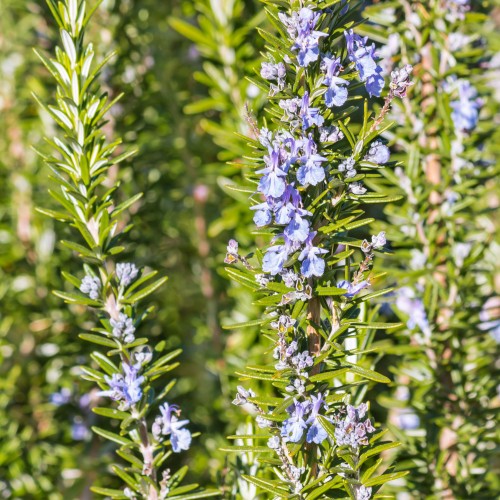
Her upright, needle-like leaves are rich in volatile oils and antioxidants, exuding a sharp, herbaceous, and slightly resinous aroma that carries both clarity and strength. In late spring through summer, she blooms in small, pale blue to violet flowers, attracting bees, pollinators, and medicine makers alike. Rosemary doesn’t just grow—she claims her space with confidence and an unshakable sense of purpose.

Botanical Name: Salvia rosmarinus (formerly Rosmarinus officinalis)
Family: Lamiaceae
Common Names: Rosemary, Sea Dew
Plant Type: Woody perennial evergreen shrub
Part Used for Extraction: Leaves and flowering tops
Growth Habit: Upright, bushy; reaches 3–6 feet in height
Flowering Season: Late spring to summer (varies by climate)
Harvest Time for CO₂ Extraction: Typically at peak bloom for maximum antioxidant yield

Physical Characteristics:
  • Leaves: Needle-like, dark green on top with silvery undersides; strongly aromatic
  • Stems: Woody, branching; grayish-brown with age
  • Flowers: Small, two-lipped blooms in shades of blue, violet, or white
  • Roots: Deep and spreading; capable of anchoring into rocky, poor soils
Native Habitat + Growth Conditions:
  • Native To: Mediterranean basin, especially coastal regions of southern Europe and northern Africa
  • Preferred Soil: Well-drained, rocky or sandy soils; low fertility
  • Sunlight: Full sun
  • Climate: Mediterranean—hot, dry summers and mild, wet winters
  • Ecological Notes: Drought-resistant, pollinator-friendly, and often grown as both a culinary and medicinal hedge plant

Energetic Botanical Signature
Rosemary is not gentle, and she doesn’t pretend to be. She is clarity in a world of noise. Her leaves point upward like blades, cutting through mental fog and emotional heaviness. She speaks the language of discipline, alertness, and protection—and she offers herself not as a salve, but as a call to action.

She teaches us to focus, to remember, to return to center when we’ve scattered ourselves too thin. Her bitter, resinous natureawakens what’s stagnant. Her rooted strength anchors what’s anxious. And her history as both medicine and memory calls us to honor what we’ve forgotten in ourselves.

This is the plant that says: Wake up. Remember. Protect what matters.
Energetics

Energetic Properties

You won’t smell her walking into the room, but you’ll feel her. She’s not the kind of rosemary that calls attention to herself. This version lives at the threshold—where oxidation tries to creep in, where breakdown threatens vitality, where the soul of your blend could fade if not protected.

This Rosemary doesn’t cleanse with scent. She protects with presence. She is the keeper of integrity—molecular and energetic. Infused in sunflower oil, she brings solar steadiness to rosemary’s sharp wisdom, anchoring her fiery clarity in something rooted, gentle, and enduring.

She speaks in the language of boundaries. Of quiet, intentional preservation. Of holding sacred what’s already alive and making sure it stays that way.

Energetic Qualities
  • Stabilizes energy fields and prevents spiritual “leakage” in blends
  • Protects vibrational coherence over time—especially in delicate or heart-centered formulas
  • Anchors the energy of preservation and protection in a blend, without scent interference
  • Supports energetic shielding for empaths, healers, and energy workers
  • Strengthens the auric field subtly, making it ideal for wear during depletion or recovery
Chakra Associations
  • 3rd Chakra (Solar Plexus – personal power): Helps maintain energetic integrity and resilience
  • 4th Chakra (Heart – unconditional love): Protects the subtle field of heart-centered formulas
  • 7th Chakra (Crown – higher information): Keeps spiritual information stable in blends used for meditation or ritual
Spiritual Use
Because she is not used aromatically, this extract is best woven into carrier oils, serums, and body formulas where she acts as the vibrational anchor—quietly keeping the medicine stable. She’s especially potent when used in:
  • Heart-based blends meant to stay fresh without essential oil interference
  • Ritual oils that need to hold frequency over time
  • Anointing or energetic shielding oils for those who feel energetically porous or vulnerable
This is a plant who says:
“Your light is sacred. Let me guard it.”

Traditional & Folklore

Rosemary (Rosmarinus officinalis, now classified as Salvia rosmarinus) has stood as a sacred herb for thousands of years—woven into the rituals, medicine, and magic of countless cultures. She was burned for purification, carried for remembrance, steeped for strength, and honored as a protector of both body and spirit.

Ancient Greece + Rome
Rosemary was sacred to Aphrodite and often used in ceremonies of love, death, and transition. Students in ancient Greece would tuck sprigs behind their ears to sharpen memory, while Roman soldiers rubbed it into their skin before battle to fortify courage. Brides carried rosemary as a symbol of fidelity and remembrance.

Egyptian + Mediterranean Traditions
Though not native to Egypt, rosemary found her way into funerary rites and temple offerings as a purifying and protective herb. Across the Mediterranean, she was burned in sickrooms to cleanse air and dispel bad spirits, or bundled and worn to ward off the “evil eye.”

Medieval European Herbalism
During plague times, rosemary was included in vinegar infusions and strewn on floors for protection. She was believed to drive away negative energies, bring mental clarity, and fortify the heart. Folk medicine saw her as a tonic for the nerves, blood, and memory—a sacred plant for “quickening the spirit.”

Magical + Protective Uses
Rosemary was often planted near the entrance of homes to protect against ill intent. In folk magic, she was used in love spells, memory charms, and energetic boundaries. Burned as incense, rosemary was believed to banish grief and restore clarity to the grieving or the haunted.

Cultural Symbolism
Throughout history, rosemary has symbolized memory, truth, and loyalty. “There’s rosemary, that’s for remembrance,” Shakespeare wrote through Ophelia. Whether tucked into a warrior’s cloak or a widow’s pocket, rosemary has always been more than a herb. She’s been a sentinel of the soul.
Chemistry

Chemical Components

This 14% Rosemary Antioxidant CO₂ extract is standardized in Helianthus annuus (Sunflower) oil, offering a gentler potency than the 25% version while retaining significant antioxidant and stabilizing power. She’s not here for scent—she’s here for structure. The kind of quiet molecular structure that keeps your blends from going rancid, keeps your sacred formulas potent, and protects your delicate plant allies from degradation.

Rich in diterpenes like carnosic acid and carnosol, this extract brings potent lipid stabilization without altering the aroma or intention of your final product. She’s ideal in skincare, body oils, and lipid-heavy formulations that need to endure—especially when you're working with sensitive carriers like Rosehip, Hemp, Borage, or Evening Primrose.

Key Chemical Families + Compounds
Diterpenes
  • Carnosic Acid, Carnosol, Rosmanol
  • Properties: Strong antioxidant, anti-rancidity, cell-protective, stabilizing
These are fat-soluble compounds that directly inhibit lipid peroxidation, giving your serums, balms, and butters more resilience over time—without altering their energetic vibration.
Phenolic Acids
  • Rosmarinic Acid, Caffeic Acid (trace amounts)
  • Properties: Antioxidant, mild anti-inflammatory, water-soluble free radical scavenger
These support the antioxidant effect even in emulsified or water-inclusive formulas, contributing to overall cellular defense.
Monoterpenes (minor)
  • α-Pinene, Camphene, Limonene
  • Properties: Mildly antimicrobial, circulation-boosting, refreshing in trace presence
They are not dominant here, but their inclusion gently echoes rosemary’s broader spectrum.
Sesquiterpenes + Alcohols (trace)
  • β-Caryophyllene, Borneol, Verbenone (variable)
  • Properties: Immune support, anti-inflammatory, skin resilience
Present in small amounts—these compounds don’t overpower, but add layered therapeutic nuance to the extract.

Therapeutic Implications of the Chemistry

Oxidative Defense + Formula Stability
This extract’s primary use is to prevent oxidation in lipid-rich formulas. Her diterpenes inhibit rancidity, extending the shelf life of delicate oils without changing their aroma, feel, or intention. This makes her a silent guardian of your skincare and an essential in natural preservation systems.

Skin Nourishment Support
While not a direct skin treatment, the extract helps maintain the integrity of nourishing ingredients in your formulas—allowing rosehip, pomegranate, and other sensitive oils to stay therapeutically active longer.

Vibrational Integrity in Ritual Blends
If you’re working with sacred blends designed for energy work or long-term use, she holds the vibrational field steady—preserving the energetic imprint and intention behind the blend.
Recipes & Blends

Recipes & Blends

Oxidative Support Serum Base
To extend shelf life of delicate oils like Rosehip, Evening Primrose, or Sea Buckthorn
  • 3 drops Rosemary Antioxidant CO₂ 14% (in Helianthus annuus)
  • 1 oz Rosa rubiginosa (Rosehip Seed Oil)
  • Optional: 2 drops Tocopherol (Vitamin E)
Use: Add to any carrier oil prone to oxidation. Shake gently. Use within 3–6 months.
Why it works: Carnosic acid and carnosol act as natural stabilizers, preventing rancidity and protecting therapeutic properties.

Herbal Balm Preservation Boost
To preserve herbal-infused salves and balms (like calendula, comfrey, or St. John’s Wort)
  • 5 drops Rosemary Antioxidant CO₂ 14%
  • Add to 2 oz total balm base at the final stage (just before pouring into jars)
Use: Mix thoroughly into balm once removed from heat and slightly cooled.
Why it works: Prevents lipid degradation in balms and butters—extending freshness without interfering with scent or vibration.

“Energetic Shield” Anointing Oil
For emotional burnout, energetic overload, or protection during healing work
  • 3 drops Rosemary Antioxidant CO₂ 14%
  • 2 drops Cedrus atlantica (Cedarwood Atlas)
  • 1 drop Boswellia carterii (Frankincense)
  • 1 oz Simmondsia chinensis (Jojoba Oil)
Use: Anoint pulse points, heart center, and lower back when feeling drained or overly open.
Affirmation: “I hold my energy sacred. I allow only what aligns with truth.”

“Preserve the Light” Ritual Oil
For grief rituals, energetic grounding, or intention to stabilize sacred space
  • 2 drops Rosemary Antioxidant CO₂ 14%
  • 2 drops Myrtus communis (Myrtle)
  • 2 drops Lavandula stoechas (Lavender Spike)
  • 1 oz Olea europaea (Olive Oil)
Use: Apply to temples, heart, and soles of feet before ceremony or journaling.
Affirmation: “I protect what matters. I let go of what is no longer mine to carry.”
Safety Etc.

Safety Information

Rosemary Antioxidant CO₂ 14% (standardized in Helianthus annuus) is generally regarded as safe for topical use when properly diluted. However, due to its potency and fat-soluble nature, it should be used mindfully and not in the same way as essential oils.
  • Dilution:
    Recommended at 0.1–0.3% in carrier oils, balms, or oil-based serums. A little goes a long way in protecting against oxidation.
  • Not for Diffusion or Inhalation:
    This extract is not suitable for diffusing or direct inhalation. It is not volatile and is intended for topical and formulation use only.
  • Internal Use:
    Not recommended for ingestion. While carnosic acid is used in food and supplement industries, internal use of this extract should only occur under professional supervision and with food-grade certification.
  • Pregnancy & Breastfeeding:
    No known contraindications at proper topical dilutions. However, due to the concentration of phenolic compounds, use under guidance is advised during pregnancy.
  • Children:
    Suitable for use in products for children when used within recommended dilutions and not applied directly to mucous membranes or broken skin.
  • Skin Sensitivity:
    Rare, but possible. Always patch test before use in leave-on products, especially for those with nut or seed sensitivities (due to the sunflower oil base).
  • Storage:
    Store in a cool, dark place. Best kept refrigerated and nitrogen-capped to extend shelf life and preserve antioxidant potency.

Reviews (0)

Write a review

Note: HTML is not translated!
    Bad           Good
Powered By OpenCart
Stillpoint Aromatics © 2026