Personal Use
Pimento Berry Essential Oil (Pimenta dioica)
Warm | Spicy | Protective
Pimento Berry comes in warm, spicy, sweet, and penetrating — like clove, cinnamon, nutmeg, and black pepper all met in a dark little berry and decided to become one hell of a fire medicine.
Its aroma is rich, hot, sweet-spicy, and deeply comforting, with that unmistakable allspice warmth that feels both kitchen-medicinal and old-world protective. It has depth. It has bite. It has presence. This is an oil that brings heat, circulation, digestion, and energetic strength into the room.
Pimento Berry is the essential oil distilled from the dried berries of Pimenta dioica, the evergreen tree commonly known as Allspice. The name “allspice” comes from the berry’s aroma, which reminded Europeans of several spices at once — clove, cinnamon, nutmeg, and pepper.
This is an oil for coldness. For sluggishness. For digestive heaviness. For sore, tired muscles. For the places where the body needs warmth, movement, and stronger protection.
Pimento Berry is powerful, though. This is not an oil to casually throw into everything because it smells delicious. Its chemistry is rich in phenolic compounds, especially eugenol, which gives it much of its warming, analgesic, antimicrobial-oriented, and spicy character — but also brings real skin-safety considerations.
Stillpoint’s Pimento Berry essential oil is a deep warming ally for carefully formulated blends where the body needs heat, strength, digestive fire, and protective aromatic support.
This oil is for warmth. For digestion. For circulation. For protective fire. For the body and spirit when the inner hearth needs to be lit again.
Therapeutic Applications
Digestive Support + Belly Warmth
-
Pimento Berry has a long traditional association with digestion, appetite, gas, bloating, and cold digestive patterns.
-
Its warm, spicy aroma may support abdominal massage blends when digestion feels slow, heavy, tense, or chilled.
-
Useful in very low dilution with oils such as Ginger, Cardamom, Sweet Orange, Coriander Seed, or Fennel when the belly needs warmth and movement.
-
Best used sparingly; this is a strong oil and does not need a heavy hand to be effective.
Muscular Support + Warming Relief
-
Pimento Berry may be useful in massage blends for sore muscles, stiffness, cold tissue, and overworked areas.
-
Its warming, spicy character makes it appropriate when discomfort feels stagnant, contracted, chilled, or slow to loosen.
-
Useful in body oils, balms, liniments, and recovery blends where deep warmth is desired.
-
Because of its skin-irritation potential, it should be used at very low dilution and balanced with skin-supportive oils.
Circulatory Warmth
-
Pimento Berry is strongly warming and may support blends for cold hands, cold feet, sluggish tissue, and winter body care.
-
It brings a sense of heat and movement to formulas designed for cold, tired, or under-circulated areas.
-
Combines well with Black Pepper, Ginger, Juniper Berry, Rosemary, or Sweet Marjoram in carefully diluted warming blends.
-
This is fire medicine, so precision matters.
Immune-Season + Cleansing Support
-
Pimento Berry’s phenolic chemistry gives it a strong antimicrobial-oriented aromatic profile.
-
It may be useful in diffuser blends, room sprays, and immune-season formulas when used in very small amounts.
-
Its aroma brings warmth, protection, and a strong spice note to cold-season blends.
-
Use carefully in diffusion because phenol-rich oils can become overwhelming quickly, especially around children, elders, pets, or sensitive lungs.
Oral + Dental Traditional Associations
-
Because Pimento Berry contains eugenol, it has a traditional aromatic link with dental and oral-care support, similar to Clove.
-
It may appear in professionally formulated oral-care blends where warming, cleansing, and discomfort-supportive qualities are desired.
-
Direct oral use is not recommended without professional training and proper formulation.
-
This is not a “drop it on your gums” oil. That is how chaos gets invited to dinner.
Emotional Warmth + Energetic Protection
-
Energetically, Pimento Berry brings warmth, courage, protection, and inner fire.
-
It may support states of emotional coldness, depletion, fear, sluggishness, or lack of motivation.
-
Its spicy warmth can help restore a sense of vitality when the spirit feels dull, chilled, or underpowered.
-
This oil has a strong protective quality — not soft, not airy, but warm, spicy, rooted, and direct.
General Therapeutic Personality
-
Pimento Berry is best understood as a warming, spicy, digestive, muscular, circulatory, cleansing, and protective oil.
-
Its strongest therapeutic lanes are digestive warmth, muscular support, cold tissue, immune-season blends, and energetic fire.
-
It is powerful and useful, but it demands respect in dilution.
Pimento Berry is hearth fire in a berry — warm, spicy, protective, and deeply alive.
Traditional Use
Digestive Warmth | Pain Relief | Protective Spice Medicine
-
Pimento Berry, also known as Allspice, comes from the dried unripe berries of Pimenta dioica, an evergreen tree native to the Caribbean, Central America, and parts of Mexico.
-
The name “allspice” came from the berry’s aroma, which reminded Europeans of clove, cinnamon, nutmeg, and pepper all in one.
-
Traditionally, Pimento Berry has been used as both food and medicine — a warming spice for the belly, the blood, the muscles, the mouth, and the spirit.
-
This is old kitchen medicine: practical, hot, protective, and deeply useful when the body feels cold, slow, tense, or depleted.
Digestive Support + Belly Warmth
-
Pimento Berry has a long history of traditional use for indigestion, gas, bloating, sluggish digestion, low appetite, and abdominal discomfort.
-
The berries were used in foods, teas, decoctions, bitters, and warming preparations to stimulate digestive fire and help the body move what had become cold, heavy, or stuck.
-
This is one of Pimento Berry’s oldest lanes: warm the belly, wake the appetite, and support the body’s ability to digest and assimilate.
Muscular Aches + Body Pain
-
Pimento Berry has traditionally been used in warming preparations for sore muscles, aching joints, stiffness, and body discomfort.
-
Infused oils, poultices, baths, and topical rubs were used where pain felt cold, contracted, stagnant, or slow to loosen.
-
Pimento Berry belongs to the same old herbal logic as Clove, Ginger, Black Pepper, and Cinnamon: heat moves what cold holds still.
Oral + Dental Traditional Use
-
Because of its warm, clove-like aromatic chemistry, Pimento Berry has a traditional relationship with toothache, gum discomfort, mouth freshness, and oral cleansing.
-
This belongs to the traditional use of the whole spice and properly prepared remedies — not casual essential oil use directly in the mouth.
-
The mouth is delicate territory, and Pimento Berry is strong medicine.
Cold-Season + Respiratory Warmth
-
Pimento Berry has been used in cold-season preparations where warmth, circulation, sweating, and comfort were needed.
-
It was used in warming teas, spiced syrups, chest rubs, steam-style preparations, and cold-weather tonics when the body felt chilled, achy, and slow.
-
Its medicine here is hearth medicine: bring heat back to the system.
Food, Preservation + Kitchen Medicine
-
Pimento Berry has deep roots in Caribbean and Central American foodways, especially Jamaican cooking, where allspice became central to jerk seasoning, stews, marinades, sauces, pickles, and preserved foods.
-
In traditional foodways, spices were never only flavor.
-
They helped digestion, preservation, warmth, circulation, and resilience.
-
The kitchen was the medicine cabinet.
-
Honestly, it still is when we stop acting fancy.
Emotional + Energetic Benefits
-
Traditionally, warming spices like Pimento Berry were used when the body and spirit needed heat, courage, protection, and comfort.
-
Energetically, Pimento Berry speaks to emotional coldness, depletion, fear, sluggishness, low vitality, and the need for protective fire.
-
It belongs to the old category of spice medicine: warm the belly, warm the blood, warm the spirit, and help the person come back into life.
-
Pimento Berry is old fire medicine — warming, protective, digestive, cleansing, and direct.
-
It belongs to the kitchen, the medicine chest, the winter tonic, the warming rub, and the moment when the body says: bring the fire back.
Botany
Pimenta dioica, commonly known as Pimento Berry or Allspice, is an evergreen tree in the Myrtaceae family, the same aromatic family that includes Clove, Bay Rum, Eucalyptus, Tea Tree, Myrtle, and Niaouli. Native to the Caribbean, southern Mexico, and Central America, this tree is especially associated with Jamaica, where Allspice became deeply woven into food, medicine, culture, and trade.
The essential oil is steam distilled from the dried, unripe berries of the tree. These berries are harvested while still green, then dried until they become dark brown, wrinkled, and intensely aromatic. That drying process concentrates the berry’s warm, sweet-spicy character — the famous allspice aroma that smells like clove, cinnamon, nutmeg, and pepper all somehow living inside one little fruit.
Botanical Profile
-
Botanical Name: Pimenta dioica
-
Family: Myrtaceae
-
Common Names: Pimento Berry, Allspice, Jamaica Pepper, Pimento, Myrtle Pepper
-
Plant Type: Evergreen aromatic tree
-
Part Used for Distillation: Dried unripe berries
-
Growth Habit: Upright evergreen tree with a dense canopy, aromatic leaves, smooth bark, and clusters of small berries
-
Height: Commonly 20–40 feet tall in cultivation, though it can grow taller in ideal tropical conditions
-
Flowering Season: Varies by region; small white flowers are generally produced before berry development in warm tropical climates
-
Harvest Time for Distillation: Berries are harvested while still green and unripe, then dried before distillation
Physical Characteristics
-
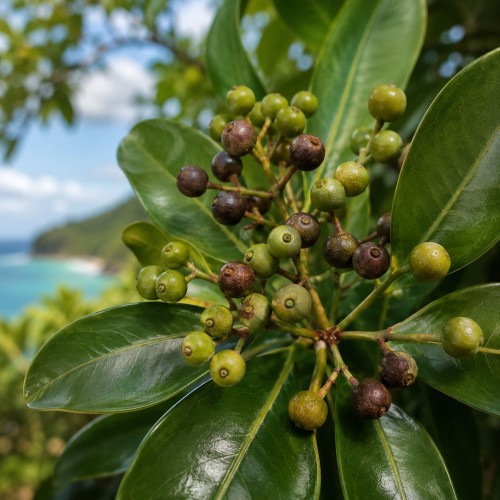
Leaves: Glossy, leathery, oval to oblong leaves; aromatic when crushed, with a warm clove-like scent
-
Bark: Smooth, pale gray to brownish bark; the tree has a clean, upright form
-
Flowers: Small, white to cream-colored flowers arranged in clusters
-
Fruits: Small round berries that grow in clusters; green when harvested, then dried until dark brown and wrinkled
-
Aroma: Warm, sweet-spicy, clove-like, peppery, woody, and deeply aromatic
-
Overall Form: Strong, upright, tropical, aromatic, and generous — a tree that concentrates great heat and protection into very small berries
Native Habitat + Growth Conditions
-
Native To: Caribbean region, southern Mexico, and Central America; strongly associated with Jamaica
-
Preferred Habitat: Warm tropical forests, cultivated plantations, and humid lowland regions
-
Preferred Soil: Well-drained, fertile soil with consistent moisture
-
Sunlight: Full sun to partial sun
-
Climate: Tropical to subtropical climates with warmth, humidity, and protection from frost
-
Water Needs: Moderate moisture; prefers humidity and does not tolerate prolonged cold
-
Ecological Notes: Pimento Berry trees support pollinators through their flowers and produce aromatic fruits that became an important spice crop, especially in Jamaican agriculture and trade
Energetic Botanical Signature
Pimento Berry teaches through concentrated fire held in a small fruit. The tree itself is evergreen, steady, tropical, and aromatic, but the real force gathers in the berries — tiny, dark, wrinkled, potent little heat-carriers that hold the scent of several spices at once. That is the doctrine: great medicine does not always need a large vessel. Sometimes the fire is carried in something small, dense, and unmistakable.
Its evergreen nature speaks to endurance and protection. Its glossy aromatic leaves speak to vitality and warmth. Its berries speak to digestion, circulation, courage, and inner hearth. Pimento Berry teaches that warmth is structure, protection can be fragrant, and the body sometimes needs spice to remember life. This is a plant that says: gather your fire, keep it close, and let warmth return from the center outward.