
Personal Use
Lavender 'Melissa' (Lavandula angustifolia 'Melissa') offers a tender, nuanced twist on classic lavender. The aroma is unmistakably soft and floral, but with a sweet citrus overtone—like lavender kissed by lemon balm. It opens with bright, gentle clarity, then deepens into a creamy, calming heart with almost honeyed undertones.
This batch is steam-distilled from flowering tops grown in the Pacific Northwest region of the United States, where cool nights and long summer days encourage high ester production and aromatic complexity. The oil is especially rich in linalyl acetate and linalool, with a sweet citrus nuance that sets it apart from more camphoraceous lavenders.
Energetically, Lavender 'Melissa' moves with grace. It doesn't push—it invites. It’s the kind of oil that loosens tension with warmth, rather than force. It brings soft focus to a scattered mind and quiet reassurance to a restless heart.
Clinically, this oil’s chemistry makes it ideal for stress-related conditions, skin irritation, and nervous system support. It’s well-tolerated by children and the elderly and shines in blends for anxiety, grief, insomnia, and skin inflammation.
Therapeutic Applications
Lavender 'Melissa' is a uniquely gentle, high-elevation varietal of Lavandula angustifolia, and this particular batch was distilled exclusively for Stillpoint, with intention, timing, and energetic care. The resulting oil is a sweet, citrus-laced version of lavender—ideal for sensitive systems, emotional trauma, and skin that needs to be both soothed and held.
Nervous System Support
Exceptionally calming to the parasympathetic nervous system. High levels of linalyl acetate and linalool support emotional regulation, nervous exhaustion, and overthinking without sedation. Especially helpful for those recovering from stress-related burnout, anxiety, or hypervigilance.
Exceptionally calming to the parasympathetic nervous system. High levels of linalyl acetate and linalool support emotional regulation, nervous exhaustion, and overthinking without sedation. Especially helpful for those recovering from stress-related burnout, anxiety, or hypervigilance.
Emotional Healing & Sleep
Used in blends for insomnia, grief, and nighttime rumination. Lavender 'Melissa' works gently but deeply to relax the mind, soften heartache, and invite emotional release. It brings peace without disconnect.
Used in blends for insomnia, grief, and nighttime rumination. Lavender 'Melissa' works gently but deeply to relax the mind, soften heartache, and invite emotional release. It brings peace without disconnect.
Skin Soothing & Repair
A potent skin ally for irritation, inflammation, or sensitivity. This variety is gentle enough for eczema, sunburn, diaper rash, and post-procedure care. Linalool supports tissue repair while esters reduce inflammation and calm reactivity.
A potent skin ally for irritation, inflammation, or sensitivity. This variety is gentle enough for eczema, sunburn, diaper rash, and post-procedure care. Linalool supports tissue repair while esters reduce inflammation and calm reactivity.
Pain & Tension Relief
Helpful for muscle tension, tension headaches, menstrual cramping, and nervous system-linked pain. May be used in compresses, massage blends, or bath rituals to ease both physical and emotional holding patterns.
Helpful for muscle tension, tension headaches, menstrual cramping, and nervous system-linked pain. May be used in compresses, massage blends, or bath rituals to ease both physical and emotional holding patterns.
Respiratory Ease
Mildly antispasmodic and mucolytic. Can support relaxation of the breath and ease tightness in the chest—especially when breathing feels constricted by anxiety or grief.
Mildly antispasmodic and mucolytic. Can support relaxation of the breath and ease tightness in the chest—especially when breathing feels constricted by anxiety or grief.
Traditional Use
Lavandula angustifolia has been revered for centuries across Europe, the Mediterranean, and the Middle East as a remedy for the body, mind, and environment. While the 'Melissa' cultivar is a more recent development, it carries the full herbal lineage of true lavender—gently detoxifying, emotionally stabilizing, and widely respected for its role in folk healing.
Herbal Medicine + Topical Care
Lavender was traditionally applied in poultices, infused oils, or steeped in teas to ease headaches, burns, insect bites, and wounds. It was used to clean cuts, speed healing, and reduce inflammation long before modern antiseptics. The plant’s astringent and vulnerary properties made it a go-to in first-aid and skin-care preparations across Europe.
Lavender was traditionally applied in poultices, infused oils, or steeped in teas to ease headaches, burns, insect bites, and wounds. It was used to clean cuts, speed healing, and reduce inflammation long before modern antiseptics. The plant’s astringent and vulnerary properties made it a go-to in first-aid and skin-care preparations across Europe.
Culinary & Digestive Support
In small amounts, lavender flowers were added to honey, wine, or tea for digestive support—particularly in cases of indigestion linked to nervous tension. Its carminative and antispasmodic qualities were used to ease bloating, gas, and stomach upset, especially in children or the elderly.
In small amounts, lavender flowers were added to honey, wine, or tea for digestive support—particularly in cases of indigestion linked to nervous tension. Its carminative and antispasmodic qualities were used to ease bloating, gas, and stomach upset, especially in children or the elderly.
Household + Hygiene
Lavender was bundled into sachets, burned as incense, and added to bathwater for centuries to purify the air, calm the spirit, and repel pests. In ancient Rome, the name “lavandula” itself came from lavare—to wash. It was commonly added to laundry, bedding, and personal hygiene rituals to cleanse both body and space.
Lavender was bundled into sachets, burned as incense, and added to bathwater for centuries to purify the air, calm the spirit, and repel pests. In ancient Rome, the name “lavandula” itself came from lavare—to wash. It was commonly added to laundry, bedding, and personal hygiene rituals to cleanse both body and space.
Traditional European Systems
In both folk and monastic traditions, lavender was used to “cool the head and quiet the heart.” Herbalists like Hildegard of Bingen recommended it for melancholy, heart palpitations, and emotional agitation. It was a staple in gardens maintained by midwives, monks, and healers throughout medieval Europe.
In both folk and monastic traditions, lavender was used to “cool the head and quiet the heart.” Herbalists like Hildegard of Bingen recommended it for melancholy, heart palpitations, and emotional agitation. It was a staple in gardens maintained by midwives, monks, and healers throughout medieval Europe.
Modern Herbal Continuity
The Lavender 'Melissa' cultivar, while relatively modern, is deeply aligned with these historical uses—especially where emotional healing, sensitive skin, or tender nervous systems are involved. Its sweeter, citrus-tinged profile makes it especially beloved in formulations for children, elders, and anyone walking through grief or tenderness.
The Lavender 'Melissa' cultivar, while relatively modern, is deeply aligned with these historical uses—especially where emotional healing, sensitive skin, or tender nervous systems are involved. Its sweeter, citrus-tinged profile makes it especially beloved in formulations for children, elders, and anyone walking through grief or tenderness.
Botany
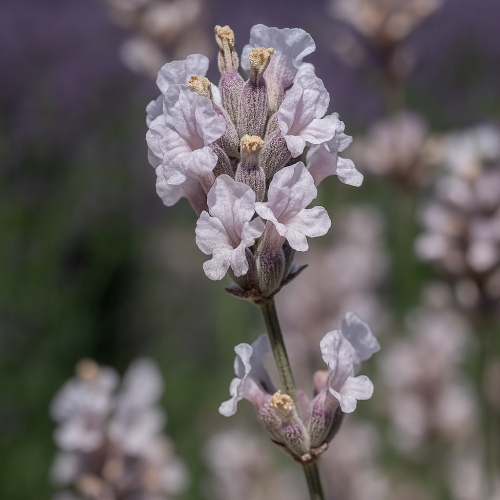
Lavandula angustifolia ‘Melissa’ is a perennial shrub in the Lamiaceae family, known for its soft pink blossoms, compact growth habit, and high essential oil content. Unlike the deep purple flowers of classic English lavender, ‘Melissa’ produces delicate, pale pink to white blooms—visually expressing the gentle sweetness it carries in scent and chemistry.
This cultivar was developed in the Pacific Northwest by Andy Van Hevelingen and named after his wife, Melissa. Bred for both beauty and performance, it retains the therapeutic potency of traditional L. angustifolia while offering a softer aromatic expression—slightly citrusy, slightly honeyed, always calming.
‘Melissa’ thrives in dry, well-drained soil and full sun, with silvery-green foliage that resists drought and returns year after year with minimal care. It’s favored in cottage gardens and artisan distillations alike for its graceful structure, high ester content, and gentle energy.
Botanical Name: Lavandula angustifolia ‘Melissa’
Family: Lamiaceae
Common Names: Melissa Lavender, Lavender ‘Melissa’
Plant Type: Perennial evergreen shrub
Part Used for Distillation: Flowering tops
Growth Habit: Compact, bushy, rounded shape; grows 18–24 inches tall
Flowering Season: Early to mid-summer
Harvest Time for Distillation: During full bloom, when ester content is highest
Family: Lamiaceae
Common Names: Melissa Lavender, Lavender ‘Melissa’
Plant Type: Perennial evergreen shrub
Part Used for Distillation: Flowering tops
Growth Habit: Compact, bushy, rounded shape; grows 18–24 inches tall
Flowering Season: Early to mid-summer
Harvest Time for Distillation: During full bloom, when ester content is highest
Physical Characteristics:
-
Leaves: Narrow, gray-green, and highly aromatic; arranged opposite on square stems
-
Stems: Woody at the base, soft and square in shape
-
Flowers: Pale pink to white, forming dense terminal spikes on long stalks
-
Roots: Fibrous, shallow root system adapted to dry soils
Native Habitat + Growth Conditions:
-
Native To: Cultivar developed in the United States from traditional European L. angustifolia stock
-
Preferred Soil: Sandy, well-drained, low fertility
-
Sunlight: Full sun
-
Climate: Mediterranean and temperate; drought-tolerant once established
-
Ecological Notes: Attracts pollinators, deer-resistant, low water needs
Energetic Botanical Signature
Lavender ‘Melissa’ is a quiet force—one that doesn’t demand attention but gently shifts the field around her. Her soft pink blossoms aren’t here to dazzle. They’re here to soothe, to remind, to invite you back to your own tenderness. She doesn’t carry the bold medicine of camphorous lavender. Instead, she offers an inner unwinding—like a sigh after the tears come, or the stillness right before sleep.
Her form is compact, grounded, and low to the earth—a plant that listens more than it speaks. But when she does speak, it’s in the language of comfort and permission: permission to rest, to soften, to be exactly where you are. The silver-green of her foliage speaks of cooling and clarity. The narrow spikes of her bloom, pale and pointed, show us a path upward—but only when we’re ready.
She’s especially attuned to those in transition:
-
Children learning to navigate big emotions.
-
Elders longing for peace in the body.
-
Grievers walking back into the world one breath at a time.
-
Survivors reclaiming safety in the nervous system.
Lavender ‘Melissa’ doesn’t chase healing—she creates the space for it to happen.
Her message is clear and uncluttered:
“Come home. You are safe now. Let the quiet mend you.”
Her message is clear and uncluttered:
“Come home. You are safe now. Let the quiet mend you.”
