
Every order ships USPS Priority — $10.95 flat-rate USPS Priority shipping on all US orders, no minimum. Free shipping on domestic orders over $299.
Welcome to Stillpoint. Subscribe to our newsletter for sale details and new-product news · One discount code per order · Every order is hand-poured, packed with care in ceremony, and shipped as we receive it.

Hyssop Essential Oil ct. 1,8-cineole | Sacred Purification & Respiratory Clarity

Hyssop officinalis ct 1,8 cineole

  • Hyssop Essential Oil ct. 1,8-cineole | Sacred Purification & Respiratory Clarity

Average Rating: (see reviews)

$10.00 Ex Tax: $10.00
GC/MS Report
Current: Winter 2012

GC/MS Report

Batch: hyscin2012 (Winter 2012)
Distilled: Fall 2012

Gas Chromatography Analysis (%)

Monoterpenes

β-pinene 13.78
d-limonene 4.76
α-pinene 3.56
cis-β-ocimene 3.54
sabinene 3.01
trans-β-ocimene 2.99
β-myrcene 2.29
γ-terpinene 0.67
α-terpinene 0.30
terpinolene 0.27
α-thuyene 0.25
camphene 0.09
pinadiene 0.06
α-phellandrene 0.04

Monoterpenols

α-terpineol 2.76
terpinen-4-ol 0.65
linalol 0.48
trans-thuyanol 0.15

Sesquiterpenes

germacrene D 1.03
β-bourbonene 0.22
bicyclogermacrene 0.20
β-caryophyllene 0.18

Esters

perillyl acetate 4.02

Aliphatic Aldehydes

myrtenal 0.18

Ketones

pinocamphone 2.01
isopinocamphone 1.42
pinocarvone 1.04

Oxides

1,8-cineole 48.27
2,3-dehydro-1,8-cineole 0.09

Ethers

methyl myrtenol 0.49

Essential Facts

  • Latin Name: Hyssop officinalis ct 1,8 cineole
  • Country of Origin: Austria
  • Botanical Family: Lamiaceae
  • Plant Parts: Flowering plant/herb
  • Note Classification: Middle
  • Cultivation Method: Distiller is Certified Organic
  • Method of Extraction: Steam or Hydro Distillation
  • Extraction Date: August 2025
  • Approx. Shelf Life: 6 years
  • Chemical Family: Oxides
  • Batch: hysscin
  • Aroma: Camphoraceous, Cool, Medicinal, Strong
  • Energetic Applications: 3rd Chakra - personal power, 4th Chakra - unconditional love, 5th Chakra - speaking truth, 7th Chakra - higher information, Clarity, Energizing, Protective, Purifying, Uplifting
Notes & Use

Personal Use

Hyssop Essential Oil – Chemotype 1,8-Cineole (France)
Hyssopus officinalis ct. 1,8-cineole

This oil opens with sharp clarity and sacred breath. Stillpoint’s Hyssop ct. 1,8-cineole is a high-altitude clarifier—bright, bracing, and immediately expansive in the chest and head. With nearly 50% 1,8-cineole, it’s a direct line to your lungs, your breath, your awareness.
But this isn’t the same vibe as Eucalyptus or Ravintsara. Hyssop carries a complex herbal backbone—crisp green notes with a slightly sweet and piney undercurrent. It's medicinal, yes, but also reverent. It feels like walking into an ancient stone chapel where fresh herbs were just laid at the altar.

The energetic hit is unmistakable: opening, sanctifying, centering. A breath of focus when your thoughts are tangled or the world feels cluttered.

Distilled from flowering tops grown in the dry hills of France, this oil offers a vibrational bridge between clearing and grounding. While the cineole leads the charge, supporting sinuses and breath, there’s a quiet earthiness underneath that keeps it anchored and spiritually aligned.
Hyssop ct. 1,8-cineole is a powerful respiratory and immune ally—but with more depth and nuance than your typical cineole-rich oils. While it shares the expectorant and mucolytic properties of Eucalyptus, this Hyssop chemotype brings in a slightly softer, more refined profile—perfect for those needing strong support without being overwhelmed.

Respiratory Support
  • High in 1,8-cineole (47.61%), making it a potent mucolytic and expectorant
  • Useful in treating congestion, sinus infections, bronchitis, and coughs
  • May support recovery from asthma or chronic respiratory tightness, especially when paired with conifers or Ravintsara
  • Ideal in steam blends, diffusers, or chest rubs

Immune System Activation
  • Gently stimulates immune response, especially in the early stages of illness
  • Antiviral and antimicrobial activity from both cineole and monoterpenes
  • May be useful in blends aimed at preventative care during cold/flu season

Mental Focus + Emotional Reset
  • Clears fog and sharpens mental focus—especially when under stress or exhaustion
  • Useful for those dealing with overwhelm, distraction, or energetic fragmentation
  • May support emotional resilience in individuals who feel “mentally congested”

Digestive Aid
  • Traditionally used to support digestion and gut clarity, especially when linked to emotional holding
  • Warming, moving, and cleansing in abdomi


Traditional Use

Hyssop has been revered for thousands of years as a purifier of body and spirit. Its name comes from the Hebrew ezov, a sacred cleansing herb mentioned in the Bible—used in rituals of protection, atonement, and renewal.

While the cineole chemotype is a modern identification, the therapeutic actions echo centuries of traditional use. In ancient Greece, Rome, the Middle East, and Europe, Hyssop was used to ward off illness, clear congested lungs, and protect against plague and “bad air.”

Traditional Herbal and Spiritual Applications:
  • Respiratory healing: Used in teas, steams, and herbal compresses for cough, bronchitis, and lung infection
  • Digestive support: Taken as an herbal bitter to stimulate appetite, ease bloating, and dispel gas
  • Sacred cleansing: Burned or bundled for energetic purification, especially in homes affected by grief or conflict
  • Protective herb: Hung in doorways or carried as a protective charm against negative energy or spiritual attack
  • Funeral rites & grief tending: Used in rituals to cleanse mourning spaces and help the spirit of the departed cross over
  • Bible and Temple Use: Referenced in Psalm 51—“Purge me with hyssop, and I shall be clean.” Often dipped in holy water and used to anoint or sprinkle sacred space.

This plant doesn’t just treat symptoms. It’s a spiritual antiseptic—used for clearing what lingers, both physical and unseen.


Botany

Hyssopus officinalis, commonly known as Hyssop, is a perennial evergreen shrub in the Lamiaceae (mint) family. While the standard chemotype leans toward a sweeter, camphoraceous profile, the 1,8-cineole chemotype tends to grow in higher altitudes and drier climates, like parts of southern France, where this batch originates. That shift in elevation and terrain gives us an oil that’s clearer, more direct—a mountain air version of an ancient plant.

Botanical Name: Hyssopus officinalis ct. 1,8-cineole
Family: Lamiaceae
Common Names: Hyssop, Holy Herb, Sacred Hyssop
Plant Type: Aromatic, woody perennial herb
Part Used for Distillation: Flowering tops
Growth Habit: Upright, branched shrub, 12–24 inches tall
Flowering Season: Summer (typically June–August in France)
Harvest Time for Distillation: Mid-summer, when flowers are fully open and cineole content is highest

Physical Characteristics:
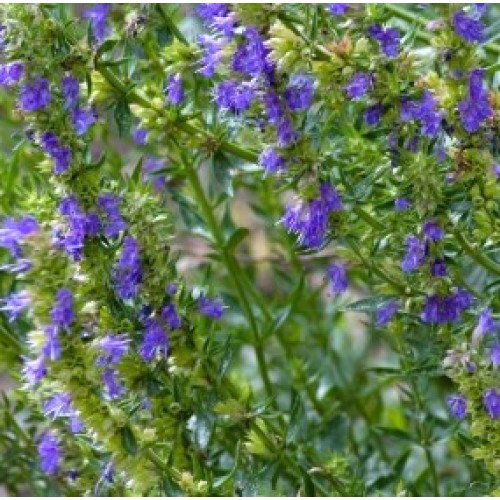
  • Leaves: Narrow, dark green, lance-shaped; aromatic when crushed
  • Stems: Square and woody at the base—typical of the mint family
  • Flowers: Deep violet to blue (sometimes pink or white); highly attractive to bees and pollinators
  • Root System: Fibrous and spreading; helps stabilize rocky or dry soil

Native Habitat + Growth Conditions:
  • Native To: Southern Europe and parts of western Asia
  • Preferred Soil: Dry, well-drained, slightly alkaline soils; often grown in rocky or calcareous terrain
  • Sunlight: Full sun
  • Climate: Mediterranean; drought-tolerant once established
  • Ecological Notes: Supports pollinator populations and grows well alongside other medicinal plants like lavender, rosemary, and thyme

Energetic Botanical Signature
Hyssop’s upright posture, small blue flowers, and square stem reflect its clarity, structure, and spiritual focus. It grows in dry, windswept places, thriving not in lushness, but in restraint—a plant that teaches integrity, breath, and resilience.

Its flowering tops reach toward the heavens, while its leaves carry the signature bitterness of transformation. Hyssop is not here for indulgence—it’s here for truth-telling and energetic alignment. A boundary holder. A sacred purifier.

Energetics

Energetic Properties

Hyssop ct. 1,8-cineole is an energetic purifier for the soul’s cluttered corners. It doesn’t just move air—it moves energy. This oil is for when the mind won’t stop spinning, when grief gets stuck in the chest, or when the room feels thick with unspoken pain.

Energetically, this Hyssop is more priest than nurse—a sacred companion that invites you to come clean. It helps release guilt, internal chaos, and inherited emotional debris. The kind of spiritual grime that doesn’t respond to talking, only to deep breath and sacred space.

Energetic Themes:
  • Purifies the subtle body after emotional or psychic exposure
  • Clears grief, guilt, or internalized shame that has settled in the chest
  • Supports a return to truth, integrity, and breath
  • Anchors the soul after spiritual work, especially when the field feels thin or porous
  • Helps clear ancestral or karmic residue held in the lungs and solar plexus
  • Resets boundaries after codependency, overextension, or empathic overload

Spiritual Use:
  • Use in rituals of release, purification, and realignment
  • Ideal for breathwork, post-shadow work, or after intense dream states
  • Blend into auric sprays, anointing oils, or incense for clearing sacred space or energetic debris
  • May support the integration of truth and the release of self-judgment

Hyssop doesn’t coddle—but it does hold space for release. It calls the breath back. It clears the slate. It makes room for what’s real.

Traditional & Folklore

Hyssop has been called the “holy herb” for thousands of years—and with good reason. In nearly every culture where it grows, Hyssop is known not just as a plant, but as a purifier of the sacred and profane. It was used to cleanse temples, protect homes, and tend to the spirit after death or illness. It’s a plant of thresholds—between sickness and health, sorrow and peace, shadow and light.

Biblical & Hebrew Traditions
Hyssop appears multiple times in the Bible, most notably in Psalm 51:
“Purge me with hyssop, and I shall be clean.”

It was used to sprinkle holy water in temple rituals and during the Passover as part of protective rites. Hyssop was believed to remove sin, spiritual residue, and psychic contamination.

European Folk Medicine
In medieval Europe, Hyssop was used to:
  • Ward off the plague and other infectious diseases
  • Cleanse homes after death or illness
  • Support grief rituals, funerals, and post-trauma recoveries
  • Burn as incense or hang in doorways to protect against “evil spirits” or energetic intrusion
It was also believed to sharpen vision—both literal and spiritual—and was sometimes used in potions and washes for seers and prophets.

Arabic and Mediterranean Healing
Traditional Arab and Greek herbalists used Hyssop as a:
  • Lung tonic and remedy for deep, wet coughs
  • Digestive cleanser after heavy meals or emotional upset
  • Anointing oil for the chest and heart when working with grief, illness, or ancestral clearing

Hyssop was never just a kitchen herb or a cough remedy. It was a bridge back to integrity—a way to feel clean again, emotionally, spiritually, and physically.
Chemistry

Chemical Components

This chemotype of Hyssopus officinalis is dominated by 1,8-cineole—making it structurally similar to oils like Eucalyptus or Ravintsara, but with a wider aromatic dimension. It blends the sharp breath-opening power of cineole with warming monoterpenes and quiet stabilizers, creating an oil that is both stimulating and centering.

Primary Constituents (from your GC/MS):
  • 1,8-Cineole (47.61%)
    Powerful expectorant, mucolytic, antiviral
    Clears breath, mind, and energetic congestion
  • β-Pinene (8.29%)
    Anti-inflammatory, bronchodilator, supportive of immune response
    Energetically opens stuck thinking and tight structures
  • α-Pinene (7.78%)
    Airway opener, antibacterial, gently grounding
    Brings in energetic focus and alert calm
  • Limonene (6.43%)
    Mood-brightening, antispasmodic, supports digestion and immune response
    Brings light to heaviness—emotional and physical
  • γ-Terpinene (4.74%)
    Antioxidant, calming to skin and tissue
    Adds a soft roundness to the sharper top notes
  • β-Myrcene (2.45%)
    Relaxing, mildly analgesic, harmonizing with other oils
    Helps anchor the energy back into the body

Therapeutic Implications of This Chemistry:
  • Potent respiratory support without the harshness of camphor-rich oils
  • Excellent for clearing brain fog, stagnation, or grief-held breath
  • Gently antiviral and antimicrobial, suitable for immune blends
  • Supports mental clarity while staying emotionally accessible
  • Well-suited for ceremonial work, cleansing rituals, and subtle field repair

This is not the kind of oil you grab when you want a nap. It’s for when you want to be awake, clear, and aligned. A plant ally that says: Let’s clear the air, inside and out.
Recipes & Blends

Recipes & Blends

1. Sacred Lung Steam
For stuck breath, grief in the chest, or congestion that won’t move
  • 3 drops Hyssop ct. 1,8-cineole
  • 2 drops Ravintsara (Cinnamomum camphora ct. cineole)
  • 1 drop Ginger (CO₂ extract or essential oil)
Use: Add to a bowl of hot water, cover head with towel, and breathe deeply for 5–7 minutes. Best used when emotional heaviness is also part of the symptom picture.

2. Cineole Clarity Chest Rub
For tight lungs, wheezing, or to prevent incoming illness
  • 4 drops Hyssop ct. 1,8-cineole
  • 3 drops Fragonia
  • 3 drops Black Spruce
  • 1 oz carrier oil (Jojoba or Arnica-infused oil work well)
Use: Massage into chest and upper back, especially at night or before exposure to crowds. Can also be used during immune-compromised states.

Energetic + Emotional Blends
3. Energetic Reset Mist
When you feel clouded, emotionally contaminated, or scattered after exposure
  • 4 drops Hyssop ct. 1,8-cineole
  • 3 drops Palo Santo (Bursera graveolens)
  • 2 drops Frankincense (Boswellia carterii)
  • 2 oz distilled water + splash of high-proof alcohol or Solubol
Use: Mist around body or space. Use before or after client work, breathwork sessions, or ritual. Clears energetic debris and invites sacred clarity back in.

4. Ritual Anointing Oil for Spiritual Cleansing
For release rituals, grief tending, or energetic recalibration
  • 3 drops Hyssop ct. 1,8-cineole
  • 2 drops Myrrh (Commiphora myrrha)
  • 2 drops Cypress (Cupressus sempervirens)
  • 1 drop Tulsi (Ocimum sanctum)
  • 10 mL Jojoba or other sacred carrier
Use: Apply to sternum, temples, or soles of the feet during meditation, ceremony, or emotional integration work. Especially powerful during grief rituals, boundary reset work, or post-shadow work reflection.
Safety Etc.

Safety Information

Hyssop ct. 1,8-cineole is a potent and clarifying oil that must be used with respect. While this chemotype lacks the neurotoxic compounds found in Hyssopus officinalis ct. pinocamphone, it still contains constituents that require mindful application—especially for sensitive individuals or those with compromised respiratory systems.
  • Do Not Confuse with Neurotoxic Chemotypes: This cineole chemotype does not contain significant pinocamphone or iso-pinocamphone (which are present in ct. pinocamphone and are known for neurotoxicity).
  • Dermal Use: Safe when properly diluted (1–3%) but may cause irritation in sensitive skin. Avoid use on damaged or broken skin.
  • Not for Use During Pregnancy or Breastfeeding: Due to its strong action and high 1,8-cineole content, it should be avoided during pregnancy and nursing.
  • Children: Not recommended for use on or around infants or young children under 10 years of age.
  • Contraindications: Use with caution in individuals with asthma or other chronic respiratory issues—can be too stimulating.
  • Internal Use: Not for internal use.
  • Photosensitivity: Not phototoxic.


Related Products

Frankincense frereana Essential Oil

Frankincense frereana Essential Oil

..

$15.00 Ex Tax: $15.00

Reviews (1)

Write a review

Note: HTML is not translated!
    Bad           Good
Powered By OpenCart
Stillpoint Aromatics © 2026