
Personal Use
This is not your light, floral distillate—it’s something far more substantial. Stillpoint’s Helichrysum italicum CO₂ Total Extract is a thick, pasty semi-solid concentrate, not a pourable oil. It holds the full signature of the plant: not just its volatile top notes, but its heavier resins, waxes, and lipid-soluble compounds that don’t survive steam distillation.
Aromatically, it opens with warm straw, dried immortelle blossoms, and hints of sun-baked herbs, anchored by soft notes of resin, honey, and curry leaf. The scent is dry, grounded, and complex—less airy than the essential oil, and far more embodied. It doesn’t float. It settles.
This extract smells like healing in motion—like fascia unwinding, old bruises softening, and warmth returning to long-neglected places. You can almost smell the circulatory movement.
Its rich chemistry—italidiones, sesquiterpenes, and esters—translates directly through the nose: deeply anti-inflammatory, cicatrisant, and microcirculatory in profile. The aroma reflects its clinical power: steady, layered, and restorative.
This is not perfume. This is plant medicine in its most complete aromatic form.
Therapeutic Applications
Helichrysum italicum CO₂ Total Extract is one of the most therapeutically potent forms of Helichrysum available, with a composition that goes far beyond the steam-distilled essential oil. This CO₂ extract contains not only the volatile oils but also heavier constituents like waxes, resins, flavonoids, and lipid-soluble compounds—making it particularly valuable for inflammatory, vascular, and tissue-repair applications.
Here’s what it may support:
1. Wound Healing + Scar Tissue Remodeling
Rich in italidiones and diketones, Helichrysum CO₂ is known for its cicatrisant (wound-healing) properties. It may assist in cellular regeneration, reduce scar formation, and improve the appearance and function of existing scar tissue. Topical use may support skin recovery after trauma, burns, surgery, or acne-related lesions.
2. Microcirculatory + Vascular Support
One of its most studied applications is in microcirculation. The extract may reduce bruising, edema, and capillary fragility, and is often used in post-operative or sports recovery formulations. Its ability to support blood and lymph flow without stimulating heat makes it appropriate for fragile or congested tissues.
3. Anti-inflammatory + Musculoskeletal Use
Due to its combination of sesquiterpenes, esters, and non-volatile waxes, Helichrysum CO₂ may offer targeted relief for joint inflammation, muscle tension, and soft tissue pain—especially when inflammation is chronic or trauma-related. It's particularly useful in blends for arthritis, overuse injuries, or neuropathic-type discomfort.
4. Skin Integrity + Inflammatory Skin Conditions
This extract is highly compatible with the skin’s lipid matrix. It may soothe eczema, dermatitis, and reactive skin states without suppressing function. Its gentle anti-inflammatory nature and regenerative action make it suitable for barrier repair and sensitive skin blends, especially in lipid-based carriers.
5. Post-Surgical and Aesthetic Recovery
Frequently used by clinicians and holistic practitioners for post-surgical support, Helichrysum CO₂ may help prevent hematoma formation, reduce bruising, and improve tissue elasticity during the healing process. It's often included in high-end dermatological and aesthetic aftercare formulas.
Traditional Use
Helichrysum italicum, also known as Immortelle or Curry Plant, has a long-standing reputation in Mediterranean folk medicine for treating wounds, bruises, and inflammatory skin conditions. Traditionally used as a poultice, maceration, or herbal infusion, the flowers and aerial parts were applied to bruises, burns, infections, and respiratory ailments. Its use spans across Corsica, Sardinia, Italy, and parts of the Balkans, where it was regarded as a plant of regeneration and preservation.
Wound + Trauma Care
In traditional Corsican and Sardinian practices, the fresh or dried flowers were infused in fat or oil and applied to cuts, bruises, sprains, and contusions. It was valued for its ability to stop bleeding, reduce swelling, and minimize scarring. This use correlates with modern findings on its anti-hematoma and vascular-supportive effects.
Anti-inflammatory Herb
Helichrysum has been historically used as an anti-inflammatory tonic for muscle and joint pain, rheumatism, and neuralgia. Infusions or decoctions of the flowering tops were applied topically or taken internally to reduce systemic inflammation and promote tissue recovery after injury or exertion.
Liver + Digestive Support
In southern Italian and Greek folk medicine, Helichrysum was used to stimulate liver function, support bile secretion, and relieve abdominal discomfort. Decoctions of the plant were taken to support detoxification, particularly after illness, heavy meals, or alcohol consumption.
Skin and Allergy Support
The plant was traditionally applied to eczema, dermatitis, and allergic rashes, particularly where the skin was red, irritated, or inflamed. Inhalations or infused washes were used to relieve sinus congestion, cough, and sore throat, especially when symptoms were heat-aggravated.
Symbolic and Protective Use
While not central in magical traditions, Helichrysum has been regarded in rural communities as a plant of preservation, longevity, and protection—often dried and hung in homes or carried in bundles to ward off illness. Its bright yellow flowers, which never fade, earned it the name “Immortelle” (the immortal one), symbolizing vitality and endurance.
Botany
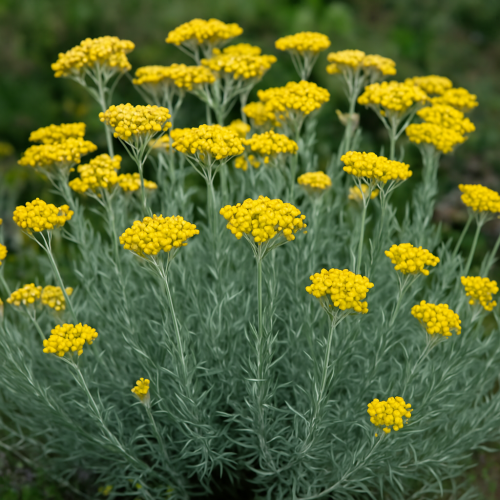
Helichrysum italicum, commonly referred to as Immortelle, Everlasting, or Curry Plant, is a small perennial shrub in the Asteraceae family, native to the Mediterranean basin. It thrives in rocky, dry soils, often found growing wild along coastal cliffs, sun-drenched hillsides, and degraded lands from Corsica and Sardinia to Croatia and Greece.
Though delicate in appearance, this plant is incredibly resilient—capable of surviving heat, drought, and poor soil conditions with minimal resources. Its resilience mirrors its function: Helichrysum doesn’t just heal the surface; it supports repair from the roots.
Botanical Name: Helichrysum italicum
Family: Asteraceae
Common Names: Immortelle, Everlasting, Curry Plant
Plant Type: Perennial subshrub
Part Used for Extraction: Flowering tops
Growth Habit: Compact, bushy growth up to 60 cm; woody base with soft, silver-gray foliage
Flowering Season: Late spring through summer (May–August)
Extraction Month for CO₂: Typically harvested and extracted during peak flowering in June–July
Family: Asteraceae
Common Names: Immortelle, Everlasting, Curry Plant
Plant Type: Perennial subshrub
Part Used for Extraction: Flowering tops
Growth Habit: Compact, bushy growth up to 60 cm; woody base with soft, silver-gray foliage
Flowering Season: Late spring through summer (May–August)
Extraction Month for CO₂: Typically harvested and extracted during peak flowering in June–July
Physical Characteristics
-
Leaves: Narrow, linear, silver-gray with fine hairs; aromatic with a curry-like scent
-
Stems: Woody at base, soft and green near tips
-
Flowers: Clusters of small, bright yellow, papery blooms that retain color and structure even when dried
-
Root System: Fibrous, drought-tolerant
Native Habitat + Growing Conditions
-
Native To: Mediterranean coastal regions (Italy, France, Corsica, Croatia, Greece)
-
Soil Needs: Well-drained, sandy or rocky soils—thrives in poor soil with full sun
-
Climate: Hot, dry summers; mild winters
-
Ecological Notes: Drought-adapted; attracts pollinators; often part of ecological restoration due to its tolerance for degraded soils
Energetic Botanical Signature
Helichrysum italicum doesn’t push. It penetrates. Quietly, steadily, it gets beneath the scar, beneath the shock, beneath what’s been held for too long—and begins the work of release and repair. This isn’t a “feel better fast” plant. It’s a plant that meets the wound with wisdom.
Helichrysum italicum doesn’t push. It penetrates. Quietly, steadily, it gets beneath the scar, beneath the shock, beneath what’s been held for too long—and begins the work of release and repair. This isn’t a “feel better fast” plant. It’s a plant that meets the wound with wisdom.
Its flowers never wilt—they hold their shape and color even when dried. And that’s the key to its medicine: it holds form when everything else breaks down. It teaches the body and psyche how to re-pattern, how to find structure again after trauma, grief, or rupture.
Growing out of the harshest soils with only sun and stone for company, Helichrysum is about survival—but not just physical survival. It’s about metabolizing what was too much to hold in the moment and making it livable. It doesn’t erase the wound. It helps it move.
The bush grows low to the ground but produces vibrant yellow blooms that seem to defy death. There’s no waste here—just precision. It says: You don’t have to forget. You just don’t have to carry all of it in the same way.
This is the plant of cellular memory, shock release, and soul-level repair—an ally when the wound has gone quiet but never really healed.
