Every order ships USPS Priority — $10.95 flat-rate USPS Priority shipping on all US orders, no minimum. Free shipping on domestic orders over $299.
Welcome to Stillpoint. Subscribe to our newsletter for sale details and new-product news · One discount code per order · Every order is hand-poured, packed with care in ceremony, and shipped as we receive it.

Fresh Root Ginger Essential Oil | Digestion, Warmth + Movement

Zingiber officinale

  • Fresh Root Ginger Essential Oil | Digestion, Warmth + Movement

Average Rating: (see reviews)

$10.00 Ex Tax: $10.00
GC/MS Report
Current: Not Provided

GC/MS Report

Batch: gin2016 (Not Provided)
Distilled: Fall 2016

Gas Chromatography Analysis (%)

Monoterpenes

camphene 10.99
β-phellandrene 5.23
α-pinene + α-thujene 4.55
d-limonene 1.85
β-myrcene 1.20
β-pinene 0.65
terpinolene 0.29
para-cymene 0.23
α-phellandrene 0.20
tricyclene 0.12
δ-3-carene 0.05

Monoterpenols

geraniol 0.80
α-terpineol 0.70
nerol 0.43
linalol 0.39
terpinen-4-ol 0.18
borneol 0.09

Sesquiterpenols

sesquiphellandrol isomer 0.74
sesquiterpenol Mw=220 0.46
trans-nerolidol 0.43
β-eudesmol 0.31
zingiberol 0.30
elemol 0.21
α-Eudesmol 0.10

Sesquiterpenes

α-zingiberene 27.30
β-sesquiphellandrene 12.02
α-bisabolene 5.58
α-curcumene 4.93
E-α-farnesene 4.23
β-curcumene 1.43
germacrene D 1.23
other sesquiterpenes 0.96
β-elemene 0.94
β-caryophyllene 0.54
E-β-farnesene 0.50
germacrene B 0.43
Epi-bicyclosesquiphellandrene 0.42
α-copaene 0.33
γ-selinene 0.32
δ-cadinene 0.29
bergamotene isomer 0.29
γ-curcumene 0.20

Aliphatic Aldehydes

geranial 3.21
neral 1.83
citronellal 0.02

Ketones

zingerone 0.22
zingiberenone 0.10

Oxides

1,8-cineole 3.64

Essential Facts

  • Latin Name: Zingiber officinale
  • Country of Origin: Bahrain
  • Botanical Family: Zingiberaceae
  • Plant Parts: Rhizome
  • Note Classification: Middle/Base
  • Cultivation Method: Wild Harvested
  • Method of Extraction: Steam or Hydro Distillation
  • Extraction Date: January 2026
  • Approx. Shelf Life: 6 - 7 years
  • Chemical Family: Sesquiterpenes
  • Batch: ginfresh
  • Aroma: Exotic, Spicy, Warm
  • Energetic Applications: 1st Chakra - survival and support, 2nd Chakra - relationships, creation energy, 3rd Chakra - personal power, 4th Chakra - unconditional love, 5th Chakra - speaking truth, Balancing, Energizing, Protective, Purifying
  • Therapeutic Properties: Analgesic, Anti-bacterial, Anti-emetic, Anti-inflammatory, Anti-microbial, Anti-oxidant, Anti-spasmodic, Anti-viral, Carminative, Hypotensive, Mucolytic, Tonic, Warming
Notes & Use

Personal Use

Fresh Root Ginger Essential Oil (Zingiber officinale)
Warm | Bright | Mobilizing

Fresh Root Ginger doesn’t lumber in like old dried spice. It sparks. It moves. It wakes the body with warmth, brightness, and that unmistakable zing that says: something is about to shift.

Its aroma is fresh, spicy, warm, slightly lemony, and alive — less dense than dried ginger, more radiant, more fluid, more immediate. It has the familiar ginger heat, but with a cleaner, greener edge, like freshly sliced rhizome releasing its medicine into the air.

This is an oil for movement. For digestion. For circulation. For the places in the body and spirit where things have gotten cold, stuck, sluggish, or heavy.

Fresh Root Ginger brings heat without being brutal. It warms the belly, stirs the blood, awakens the senses, and helps move what has been sitting too long — physically, emotionally, and energetically.

Stillpoint’s Fresh Root Ginger essential oil is steam distilled from the fresh rhizome of Zingiber officinale, a tropical perennial plant long valued in traditional medicine systems for digestive support, warmth, circulation, nausea, vitality, and restoring movement to the body.

This oil is for rekindling. For motion. For thawing what has gone cold. For getting the body, belly, and spirit moving again.


Therapeutic Applications
Digestive Support + Belly Warmth
  • Fresh Root Ginger has a long history of traditional use for digestive discomfort, nausea, sluggish digestion, gas, bloating, and lack of appetite.
  • Its warm, spicy aroma may support digestive ease, especially when the belly feels cold, tense, heavy, or slow.
  • Useful in properly diluted abdominal massage blends when the digestive system needs warmth and movement.
  • Especially appropriate when digestion is affected by stress, travel, fatigue, emotional holding, or nervous system tension.
Nausea + Motion Support
  • Ginger is one of the classic plant allies traditionally used for nausea, queasiness, motion discomfort, and unsettled stomach.
  • Fresh Root Ginger’s brighter aromatic profile makes it especially useful in inhalation blends, travel blends, and aroma sticks when the stomach feels unsettled.
  • Its aroma may help bring a sense of steadiness when nausea is connected to motion, travel, anxiety, or digestive upset..
Circulation + Coldness
  • Fresh Root Ginger is warming and mobilizing, making it useful in blends for cold hands, cold feet, sluggish tissue, and general lack of warmth.
  • It may support a sense of improved movement and vitality in the body, especially when someone feels cold, tired, stagnant, or physically depleted.
  • Useful in massage oils, foot rubs, winter body blends, and pre-movement preparations.
  • This is not frantic stimulation. It is warmth with direction.
Muscular Support + Stiffness
  • Fresh Root Ginger may be useful in massage blends for sore muscles, stiffness, tension, and areas that feel cold or slow to loosen.
  • Its warming action makes it especially appropriate when discomfort feels stagnant, contracted, or related to coldness rather than acute heat.
  • Useful in localized massage blends for the low back, shoulders, neck, hips, legs, and feet.
  • It helps bring circulation, sensation, and movement back into the tissue.
Emotional Warmth + Energetic Movement
  • Fresh Root Ginger may support emotional states marked by hesitation, depletion, low motivation, fear, or feeling “frozen.”
  • Energetically, it brings warmth back to the belly and courage back to the body.
  • It is especially helpful when someone feels stuck between knowing what needs to happen and actually having the fire to move.
Fresh Root Ginger does not scream, “Get your life together.” It says, “Start here. Warm the center. Take the next step.”
This is an oil that moves what has gone stagnant. Belly, blood, body, spirit.

Traditional Use

Fresh Ginger has been used for thousands of years across traditional medicine systems, especially in Ayurveda, Traditional Chinese Medicine, Southeast Asian medicine, and household folk medicine. The rhizome of Zingiber officinale was valued as food, spice, warming medicine, digestive support, nausea support, and a plant ally for cold, damp, sluggish, or stagnant conditions.

Fresh Ginger and dried Ginger have overlapping medicine, but they are not exactly the same. Fresh Ginger is often experienced as brighter, juicier, more moving, and more dispersing, while dried Ginger is generally hotter, deeper, and more inwardly warming. For this profile, we are focusing on the fresh rhizome — the living, aromatic, zesty root that wakes up the belly and gets things moving.

Digestive Fire + Stomach Comfort
Fresh Ginger has long been used to support digestion, appetite, and stomach comfort.
Traditional uses include:
  • Sluggish digestion
  • Gas and bloating
  • Nausea
  • Queasiness
  • Coldness in the belly
  • Loss of appetite
  • Heavy or slow digestion
  • Digestive discomfort connected to cold, damp, or stagnant conditions
In Ayurveda, Ginger is famous as a digestive fire plant — used to awaken agni, the inner digestive flame. In Chinese medicine, fresh ginger is traditionally used to warm the middle, harmonize the stomach, and help redirect rebellious stomach qi when nausea or vomiting is present. Modern reviews also note ginger’s long-standing traditional use for nausea, vomiting, and gastrointestinal discomfort. 

This is the plant people reached for when the belly needed warmth, movement, and intelligence.

Nausea, Travel + Motion Discomfort
Ginger is one of the most well-known traditional plants for nausea and vomiting.

Traditional uses include:
  • Motion sickness
  • Travel queasiness
  • Morning sickness
  • General nausea
  • Vomiting
  • Unsettled stomach
  • Nervous stomach
  • Post-illness queasiness
The fresh rhizome was chewed, brewed into tea, added to food, made into syrups, or prepared in traditional formulas when the stomach felt unsettled. Ginger has been used as a broad-spectrum antiemetic in traditional medicine systems for more than 2,000 years, and modern reviews continue to examine its role in nausea and vomiting support. 

Fresh Ginger is practical medicine. It belongs in kitchens, travel bags, sickrooms, and anywhere someone says, “My stomach feels weird.”

Colds, Chills + Damp Conditions
Fresh Ginger has traditionally been used when the body felt chilled, cold, damp, congested, or stuck at the surface.

Traditional uses include:
  • Early-stage chills
  • Cold-type discomfort
  • Damp heaviness
  • Mild respiratory congestion
  • Sore throat
  • Coughs
  • Feeling cold after exposure
  • Needing to sweat or warm the body
In many traditions, fresh Ginger tea was used to warm the body, support sweating, comfort the throat, and help the body move through cold, damp, or stagnant conditions. A review on ginger notes long traditional use for concerns such as colds, nausea, arthritis, migraines, and other ailments, while another review notes Southeast Asian traditional use for digestive problems, sore throats, coughs, and fevers. 

Fresh Ginger does not feel like heavy fire. It feels like kindling catching.


Circulation + Coldness
Fresh Ginger has been traditionally used to bring warmth and movement to the body.

Traditional uses include:
  • Cold hands and feet
  • Poor peripheral warmth
  • Stagnant-feeling tissue
  • General chilliness
  • Low vitality
  • Cold, tense muscles
  • Winter body support
As a food and medicine, Ginger has long been used to warm the body from the inside out. In topical and aromatic traditions, its essential oil continues that same energetic lane — bringing heat, movement, and circulation to areas that feel cold, contracted, or slow.

This is not reckless stimulation. It is intelligent warmth.

Muscles, Joints + Body Aches
Ginger has traditionally been used for discomfort in the muscles and joints, especially where coldness, stiffness, dampness, or stagnation are part of the pattern.

Traditional uses include:
  • Sore muscles
  • Stiff joints
  • Rheumatic discomfort
  • Aches connected to cold or damp weather
  • Tension from overwork
  • Body heaviness
  • General pain patterns connected to stagnation
The rhizome was used internally as food, tea, and traditional medicine, and externally in poultices, compresses, oils, or warming preparations depending on the culture and context.

Ginger has been studied extensively for inflammatory and musculoskeletal concerns, but the traditional message is much older and simpler: when the body is cold, stiff, and stuck, Ginger brings warmth and movement.

Women’s Traditional Use
Fresh Ginger has also been used traditionally in women’s health contexts, especially where coldness, cramping, nausea, or digestive discomfort were involved.

Traditional uses include:
  • Menstrual discomfort
  • Cold-type pelvic tension
  • Nausea during pregnancy
  • Postpartum warming foods and teas in some traditions
  • Digestive support during hormonal shifts
This does not mean essential oil use is automatically appropriate during pregnancy — that belongs in the safety section. But as a plant, Ginger has a long traditional place in pregnancy nausea, postpartum warming foods, and menstrual support across various cultures.

The thread is warmth, movement, and comfort where the body feels cold, clenched, or unsettled.

Everyday Kitchen Medicine
One of the most beautiful things about Ginger is that it never belonged only to healers. It belonged to households.

Fresh Ginger was used in:
  • Teas
  • Soups
  • Broths
  • Pickles
  • Syrups
  • Decoctions
  • Compresses
  • Foods
  • Digestive formulas
  • Warming remedies
It is one of those plants that lives at the intersection of food and medicine. Ordinary, yes — but ordinary in the holy way. The kind of ordinary that keeps people alive.

Fresh Ginger is practical fire medicine. It warms the belly, settles nausea, moves cold and dampness, supports circulation, and helps the body shift out of stagnation.

It is not fancy. It is not fragile. It is the root you turn to when the body says: I need warmth. I need movement. I need help coming back online.

Botany

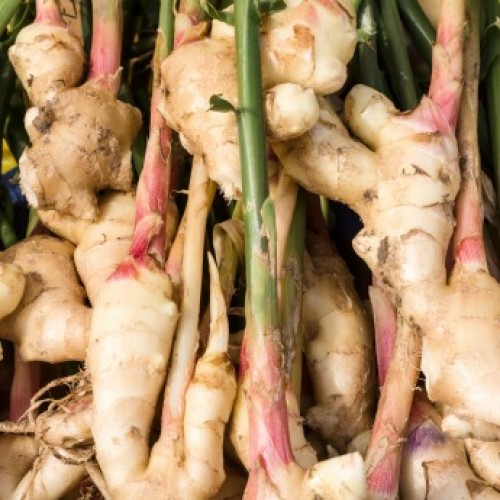
Zingiber officinale, commonly known as Ginger, is a tropical perennial plant in the Zingiberaceae family. It is grown for its aromatic rhizome — the thick, knobby underground stem most people casually call “ginger root.”

Fresh Root Ginger essential oil is steam distilled from the fresh rhizome. That matters, because fresh rhizome distillation often gives the oil a brighter, juicier, more lemony-spicy aroma than oil distilled from dried ginger. It still carries Ginger’s warmth, but with more lift, movement, and living spark.

Botanical Profile
  • Botanical Name: Zingiber officinale
  • Family: Zingiberaceae
  • Common Names: Ginger, Fresh Ginger, Ginger Root, Fresh Root Ginger
  • Plant Type: Tropical herbaceous perennial
  • Part Used for Distillation: Fresh rhizome
  • Growth Habit: Upright leafy shoots emerging from underground rhizomes
  • Height: Usually around 2–4 feet tall, depending on growing conditions
  • Flowering Season: Varies by climate; flowers appear from separate stalks when conditions are favorable
  • Harvest Time for Distillation: Rhizomes are harvested when aromatic compounds are well developed; fresh rhizomes are distilled before drying
Physical Characteristics
  • Rhizome: Thick, knobby, branching underground stem with pale yellow flesh and a strong spicy-aromatic scent
  • Leaves: Long, narrow, lance-shaped green leaves arranged alternately along upright stems
  • Stems: Reed-like leafy shoots rising from the rhizome
  • Flowers: Cone-like flower spikes with pale yellow, greenish, or purple-marked flowers depending on variety and growing conditions
  • Roots: Fine roots emerge from the rhizome and anchor the plant into warm, moist soil
  • Aroma: Fresh, spicy, warm, slightly lemony, bright, and penetrating when the rhizome is cut or crushed
Native Habitat + Growth Conditions
  • Native To: Southeast Asia, with long cultivation throughout India, China, tropical Asia, Africa, the Caribbean, and other warm regions
  • Preferred Soil: Rich, loose, well-drained soil with good moisture and organic matter
  • Sunlight: Partial shade to filtered sun; can tolerate more sun in humid climates with enough moisture
  • Climate: Warm, humid tropical to subtropical climates
  • Water Needs: Consistent moisture, but not waterlogged soil
  • Ecological Notes: Ginger spreads through rhizomes and is widely grown as a cultivated medicinal and culinary plant rather than as a wild forest species in most modern settings
Energetic Botanical Signature
Ginger teaches through the rhizome.

This plant does not put its main medicine in a tall trunk, a delicate flower, or a showy fruit. It stores its fire underground, in the swollen, branching rhizome — hidden in the dark, close to the earth, gathering heat, moisture, and life force beneath the surface.
That is the doctrine.

Ginger’s medicine is not flashy. It is subterranean fire. The kind of warmth that begins below the visible world and then rises through the whole system. It starts in the belly. It starts in the root. It starts in the place where digestion, courage, instinct, and movement all meet.

The rhizome itself is a map of movement: branching, spreading, pushing outward, creating new growth from what is stored below. Ginger does not ask the body to leap before it is ready. It warms the center first. Then movement becomes possible.

Fresh Root Ginger carries that teaching with more brightness and immediacy than dried ginger. It has the spark of living tissue — juicy, aromatic, awake. It knows how to move cold, stir stagnation, and bring warmth back without burying the spirit under heaviness.

This is a plant that teaches: Your fire does not have to be loud to be real. Warm the center. Trust the next movement. Let life begin again from the root.
Energetics

Energetic Properties

Inner Fire • Momentum • Emotional Thawing

Fresh Root Ginger is an oil of movement.

It does not sit quietly in the corner waiting for life to become easier. It enters the body like warmth returning after a long cold spell — not as a blast furnace, but as that first real heat that reminds you: oh right, I’m still alive in here.

Energetically, Fresh Root Ginger speaks to the places where the system has gone cold, stagnant, hesitant, or afraid to move. It is for the belly that tightens when life feels uncertain. The feet that don’t want to take the next step. The spirit that knows something needs to shift but can’t quite find the spark.

This oil brings heat to the center.

Not performance heat. Not “push through until you collapse” heat. Real heat. Body heat. Belly heat. The kind of warmth that helps movement become possible again.

Fresh Root Ginger is especially helpful when fear, grief, stress, fatigue, or emotional overwhelm has created a freeze response in the body. It helps thaw the field gently enough that the body does not feel attacked, but clearly enough that stagnation starts to loosen.

It says:
Start where you are.
Warm the center.
Move one breath, one step, one choice at a time.

Energetic Themes:
  • Rekindling inner fire after depletion, fear, grief, or emotional shutdown
  • Supporting movement through hesitation, stagnation, and emotional freeze
  • Warming the belly when stress or anxiety has tightened the digestive center
  • Helping restore motivation, courage, and forward motion
  • Supporting the release of cold, damp, heavy, or stuck emotional patterns
  • Bringing vitality back into the body after fatigue or burnout
  • Encouraging embodied confidence without harshness or force
  • Helping someone digest not only food, but experience, emotion, and change
  • Supporting transitions when the next step feels intimidating but necessary
  • Reconnecting the body to instinct, appetite, desire, and life force
Chakra Connections:
Root Chakra
  • Fresh Root Ginger supports the root chakra through warmth, embodiment, and physical vitality.
  • When the root chakra is imbalanced, the body may feel unsafe, cold, frozen, tired, or disconnected from the ground. Fresh Root Ginger helps bring energy back down into the body and then outward into movement.
  • It is especially useful when fear has created stagnation — when the body is technically present, but the life force feels like it is hiding in the basement with the lights off.
Fresh Root Ginger says:
I am here.
I have warmth.
I can move from this place.

Sacral Chakra
  • Fresh Root Ginger has a strong relationship with the sacral chakra because it supports flow, appetite, pleasure, emotional movement, and creative vitality.
  • The sacral chakra can become tight or stagnant when shame, grief, fear, exhaustion, or old emotional patterns interrupt our ability to feel and move freely. Ginger helps bring warmth back into that fluid center.
  • This is not fake cheerfulness. It is not “just be positive” nonsense. It is the slow return of warmth to the waters.
  • Fresh Root Ginger helps the sacral field remember that movement is safe, desire is not dangerous, and life does not have to stay frozen just because something hurt.
Solar Plexus Chakra
  • This is one of Fresh Root Ginger’s strongest energetic centers.
  • The solar plexus governs will, digestion, confidence, direction, and personal fire. When this center is depleted, we may feel hesitant, collapsed, indecisive, unmotivated, or afraid to act.
  • Fresh Root Ginger warms the solar plexus without bullying it. It supports courage that begins in the belly — not the loud, performative kind of courage, but the embodied kind that says, “I can take the next step.”
  • It helps transform stuckness into motion.
  • Not all at once. Not by force. But through heat, breath, and choice.
Spiritual Use:
  • Useful before rituals focused on movement, courage, release, or new beginnings
  • Supportive in solar plexus work when confidence, action, and direction are needed
  • Helpful in sacral chakra blends for emotional thawing, creativity, and restored flow
  • Useful in root chakra work when fear has created freeze, coldness, or disconnection from the body
  • Supportive before movement practices, breathwork, dance, journaling, or body-based ritual
  • Helpful when someone is processing grief or stress that has settled into the belly
  • Useful in blends for reclaiming appetite — for food, for life, for desire, for forward motion
  • Supportive when the spirit feels stuck between “I know” and “I can’t move yet”
Energetic Cautions:
  • Fresh Root Ginger is warming and mobilizing, so it may feel like too much when someone is already overheated, inflamed, agitated, angry, or energetically overstimulated.
  • This does not mean the oil is harsh. It means the timing matters.
  • If the system is already fiery, irritated, or emotionally explosive, Ginger may need to be used lightly or balanced with cooling, soothing, or grounding oils.
Fresh Root Ginger is best when there is coldness, stagnation, hesitation, collapse, or sluggishness. It is less ideal when the field is already running hot and looking for a fight.

This oil is not here to shove you forward. It is here to warm the place where movement begins.

Fresh Root Ginger is belly fire. Root fire. Life-force fire.

It helps the body remember that stuck is not the same as dead. Frozen is not forever. Cold places can thaw. Movement can begin again.

Affirmation
I warm the center of myself and trust the next movement. My body knows how to thaw, my spirit knows how to rise, and my fire returns one breath at a time.

Traditional & Folklore

Ginger is one of the old fire roots.

Long before it became something people casually toss into tea, stir-fry, cookies, juice shots, and wellness trends, Ginger was a treasured rhizome carried across trade routes, written into ancient medical systems, guarded by merchants, and woven into household magic.

It belongs to the folklore of warmth, protection, vitality, digestion, love, prosperity, and movement. Not delicate magic. Not floating-around-in-a-white-dress magic. Ginger is practical magic — the kind that lives in kitchens, sickrooms, markets, traveling pouches, wedding foods, winter remedies, and the hands of people who knew that fire could be medicine.

Ginger has been used as a spice and remedy since ancient times, with deep roots in Asian, Indian, Arabic, Greek, Roman, and later European traditions. Ancient writers such as Dioscorides and Pliny discussed ginger as a valuable imported spice, and it became an important trade item moving from India and Asia into the Mediterranean world. 

Fire Root + Life Force
In traditional Chinese medicine and broader East Asian symbolism, Ginger is strongly associated with warmth, yang energy, movement, and vitality. It was understood as a plant that could help counter cold, damp, heavy, sluggish states — not only physically, but energetically. 

That is the folklore thread:
Ginger brings the fire back.
Not wildfire.
Not destruction.
Not drama.

Ginger is hearth fire. Belly fire. Circulation fire. The kind of flame that keeps the house warm and the body alive.
Energetically, it became a plant of reanimation — used when the body or spirit felt too cold, too slow, too collapsed, too damp, too stuck.

Kitchen Magic + Household Protection
Ginger has always lived close to ordinary people. That is part of its power.
It was not only reserved for temples or kings. It became part of the kitchen, and the kitchen has always been one of the oldest altars.

Across folk practices, Ginger has been associated with:
  • Protection
  • Prosperity
  • Warmth
  • Courage
  • Love
  • Vitality
  • Success
  • Energetic movement
  • Breaking stagnation
  • Strengthening intention
Its heat made it a natural ally for “warming up” a spell, a body, a relationship, a room, or a decision. Ginger was used when something needed momentum — when life needed to stop sitting there like cold soup.

This is root magic with an apron on. Sacred, useful, and not interested in pretending it’s above daily life.

Trade, Wealth + Desire
Ginger was once an expensive and highly valued trade spice. It moved from India and Asia through Arab trade routes into the Mediterranean and Europe, where it became prized in kitchens, apothecaries, and elite households. Historical sources describe ginger as an important article of trade, and later medieval Europe valued it highly enough that it became associated with wealth, access, and status. 

That gives Ginger a prosperity thread.

Not because it magically rains coins from the ceiling. Because it was valuable. Desired. Carried across distance. Worth protecting. Worth trading.

And of course, where there is heat, spice, value, and desire, humans are going to make aphrodisiac lore out of it. Arab traders helped spread claims that Ginger was an aphrodisiac, and the idea persisted for centuries in European imagination. 

Whether we take that literally or symbolically, the folklore makes sense.
Ginger warms the belly.
Ginger moves the blood.
Ginger wakes appetite.
And appetite is not just about food. It is about wanting life again.

Ancient Medicine + Universal Remedy
In Ayurveda, Ginger has been honored as one of the great household medicines and is often described in traditional language as a broad, warming remedy for digestion, respiratory concerns, circulation, and vitality. Some Ayurvedic sources call it vishwabheshaja, often translated as “universal medicine.” 

That title tells us something about Ginger’s folkloric place: it was trusted.
Not rare.
Not fragile.
Not exotic for the sake of being exotic.
Trusted.

The plant you reach for when the belly is off, the body is chilled, the spirit is sluggish, the breath is heavy, or someone you love needs comfort from the inside out.

That is sacred in the most human way.

Greek + Roman Awareness
Ginger was known in the ancient Mediterranean world, though it was imported rather than native. Greek and Roman writers recognized it as a valuable spice and medicine from distant lands. Dioscorides and Pliny both wrote about ginger, placing it within the ancient materia medica and trade imagination of the Mediterranean world.

This matters because Ginger’s mythology in Greece and Rome was not the same as laurel, myrtle, olive, or rose. It did not grow in their sacred groves.

Its power came partly from distance.

It arrived as a heated root from elsewhere — mysterious, valuable, warming, and potent. A spice that carried the energy of faraway lands, trade winds, caravans, ships, and the human hunger for medicine, flavor, and transformation.

Love, Courage + Momentum
In folk magic traditions, Ginger is often treated as an accelerator. It heats things up. It moves them faster. It strengthens intention.
That makes energetic sense.

Ginger is not passive. It does not sit around waiting for permission from your fear.

It is traditionally associated with:
  • Courage
  • Passion
  • Confidence
  • Action
  • Sensual warmth
  • Prosperity
  • Protection
  • Breaking inertia
  • Moving stuck energy
This is the root for “I need to move now.”
Not recklessly.
Not chaotically.
But with heat.

Ginger says: choose the direction, then give it fire.

The Folklore Medicine
  • Ginger’s folklore is the story of fire carried in the root.
  • It is the medicine of kitchens and trade routes, healers and grandmothers, travelers and lovers, cold mornings and uneasy stomachs, courage spells and winter teas.
  • It warms what has gone cold.
  • It stirs what has gone stagnant.
  • It protects the belly fire.
  • It helps the spirit remember appetite — for food, for love, for movement, for life.
Fresh Root Ginger carries that ancient story with a brighter spark. It is not the heavy, dried spice of the deep winter cupboard. It is living rhizome fire — juicy, sharp, warm, and ready to move.

This is the root that says: thaw the body, wake the belly, and stop waiting for the perfect moment to begin.
Chemistry

Chemical Components

Fresh Root Ginger essential oil has a lively, complex chemistry that explains why it feels warm, bright, spicy, and mobilizing all at once.

It is not simply “hot.” It has lift, movement, citrus-like sparkle, and deeper root warmth underneath.

Ginger essential oil is typically rich in sesquiterpene hydrocarbons, especially compounds such as zingiberene, β-sesquiphellandrene, ar-curcumene, β-bisabolene, and related constituents.

Fresh rhizome oils may also contain brighter monoterpenes and oxygenated monoterpenes, including limonene, camphene, β-phellandrene, citral components, and 1,8-cineole, depending on origin, cultivar, harvest, and distillation.

Ginger oil shows significant compositional diversity, but the sesquiterpene backbone is one of its defining features. 

That’s the chemistry of Ginger’s gift: warmth with movement. Fire with direction. Root medicine that does not just sit there — it
gets things going.

Main Chemical Families:

Sesquiterpenes
Fresh Root Ginger essential oil is strongly shaped by sesquiterpene hydrocarbons, especially zingiberene, β-sesquiphellandrene, ar-curcumene, β-bisabolene, and related compounds. These constituents help give Ginger its warm, spicy, rooty, softly woody base. 
  • Support Ginger’s deeper warmth and staying power
  • Give the aroma its rooty, spicy, rounded body
  • Help explain Ginger’s traditional use for muscular stiffness, coldness, digestive sluggishness, and body aches
  • Bring grounding to what could otherwise be a sharp, fleeting spicy note
  • Contribute to the oil’s usefulness in warming massage blends and belly blends
Energetically, the sesquiterpenes are the deep heat under the spark. They hold the fire in the root so it does not fly all over the room.

Zingiberene
Zingiberene is one of the signature constituents of Ginger essential oil and is often one of the major components. In one review, fresh ginger oil was described with zingiberene at 23.5%, along with α-farnesene, β-sesquiphellandrene, and ar-curcumene as other major constituents. 
  • Gives Ginger its unmistakable spicy-root identity
  • Supports the warm, digestive, moving character of the oil
  • Helps anchor the aroma beneath the brighter fresh notes
  • Contributes to Ginger’s deep, body-centered presence
This is the molecule that reminds you Ginger is not just sparkle. It is root fire.

β-Sesquiphellandrene, ar-Curcumene + β-Bisabolene
These sesquiterpene constituents contribute to Ginger’s warmth, spicy depth, and rooty complexity.
  • β-Sesquiphellandrene contributes to the warm, spicy, woody-root aspect
  • ar-Curcumene adds dry, warm, slightly earthy spice
  • β-Bisabolene contributes softness, warmth, and aromatic roundness
Together, these constituents help explain why Fresh Root Ginger can feel both bright and deep. It can wake the body up without becoming thin or frantic.

Monoterpenes
Fresh Ginger oil may contain monoterpenes such as camphene, limonene, β-phellandrene, α-pinene, and related compounds, depending on the oil. These lighter molecules give fresh Ginger some of its sparkle, lift, and quicker movement. (PubMed Central)
  • Add brightness and diffusion to the aroma
  • Support the fresh, lively, zesty quality of fresh rhizome distillation
  • Help the oil feel more moving and less heavy than some dried Ginger oils
  • Contribute to respiratory, circulatory, and general clearing impressions
  • Bring the “zing” in Ginger’s zing
Energetically, the monoterpenes are the spark at the edge of the root fire. They lift the heat and get it moving.

Oxygenated Monoterpenes + Citral Components
Some Fresh Ginger oils contain oxygenated monoterpenes and citral components such as neral and geranial, which can give the oil a lemony, fresh, bright edge. This is one of the reasons fresh rhizome Ginger often smells more juicy and alive than heavier dried Ginger oils. 
  • Add lemony brightness and freshness
  • Support the perception of clarity, movement, and lift
  • Help balance Ginger’s deeper spicy warmth
  • Make fresh Ginger especially useful when you want warmth without too much heaviness
This is the part of Fresh Root Ginger that feels like the rhizome was just sliced open — bright, aromatic, alive.

Fresh Rhizome vs. Dried Rhizome Chemistry
Fresh and dried Ginger oils overlap, but they do not smell or feel exactly the same. Drying can change the relative balance of constituents and shift the aromatic profile. A 2019 review notes that fresh ginger oil may contain major components such as zingiberene, α-farnesene, β-sesquiphellandrene, and ar-curcumene, while dried ginger oils may show different proportional patterns depending on drying method and source. 

Fresh Root Ginger tends to feel:
  • Brighter
  • Juicier
  • More lemony-spicy
  • More immediate
  • More dispersing
  • Less heavy than dried Ginger
Dried Ginger tends to feel:
  • Hotter
  • Deeper
  • Denser
  • More cooked-spice
  • More inwardly warming
Neither is “better.” They are different medicines. Fresh Root Ginger has more sparkle in the fire.

Therapeutic Implications of This Chemistry:
  • Digestive support:
    The warm, spicy sesquiterpene-rich profile supports Ginger’s traditional role in belly blends for sluggish digestion, gas, bloating, nausea, and coldness in the abdomen.
  • Nausea and queasiness support:
    Fresh Ginger’s aromatic brightness makes it useful in inhalation blends, travel blends, and aroma sticks when the stomach feels unsettled.
  • Circulatory warmth:
    The balance of deeper sesquiterpenes and lighter monoterpenes supports the oil’s warming, moving, and mobilizing nature.
  • Muscular support:
    Fresh Root Ginger is useful in massage blends for stiffness, soreness, cold muscles, and areas that need warmth and movement.
  • Respiratory and clearing impressions:
    The brighter monoterpene and oxygenated monoterpene aspects may support a feeling of clearer breath and movement through heaviness.
  • Emotional movement:
    Energetically, this chemistry helps move someone out of coldness, hesitation, fear-freeze, or emotional stagnation. It warms the center and reminds the body that forward motion is possible.
This chemistry does not bulldoze the body. It warms, stirs, and mobilizes.

Fresh Root Ginger is root fire with brightness — deep enough to warm the belly, lively enough to move stagnation, and sharp enough to remind the spirit that it is not done yet.
Recipes & Blends

Recipes & Blends

Belly Fire Blend
Physical Support | Digestive Warmth + Abdominal Comfort
  • Fresh Root Ginger Essential Oil (Zingiber officinale): 7 drops
  • Cardamom Essential Oil (Elettaria cardamomum): 8 drops
  • Coriander Seed Essential Oil (Coriandrum sativum): 7 drops
  • Sweet Orange Essential Oil (Citrus sinensis): 14 drops
  • Fennel Sweet Essential Oil (Foeniculum vulgare var. dulce): 4 drops
This blend is designed for abdominal massage when digestion feels cold, slow, tense, heavy, or unsettled.
  • Fresh Root Ginger brings warmth and movement to the belly
  • Cardamom supports digestive ease and comfort
  • Coriander Seed helps soften digestive tension
  • Sweet Orange brings brightness, warmth, and emotional ease
  • Sweet Fennel supports the traditional digestive lane without overpowering the blend
Dilute in a suitable carrier oil before applying to the abdomen. Massage gently in a clockwise direction. A 1–2% dilution is generally appropriate for adult topical use.

Warm the Body Blend
Physical Support | Circulation + Cold, Stiff Muscles
  • Fresh Root Ginger Essential Oil (Zingiber officinale): 8 drops
  • Black Pepper Essential Oil (Piper nigrum): 6 drops
  • Plai Essential Oil (Zingiber cassumunar): 8 drops
  • Juniper Berry Essential Oil (Juniperus communis): 7 drops
  • Sweet Marjoram Essential Oil (Origanum majorana): 11 drops
This blend is for cold, stiff, sore, or slow-to-warm muscles — the kind of body discomfort that feels stuck, contracted, or sluggish rather than hot and inflamed.
  • Fresh Root Ginger brings fresh warmth and movement
  • Black Pepper adds circulatory fire and vitality
  • Plai supports muscular comfort and ease
  • Juniper Berry helps move heaviness and stagnation
  • Sweet Marjoram softens tension and overholding
Dilute before topical use. Apply to areas such as the low back, shoulders, legs, feet, or other places where the body feels cold, tight, or slow to loosen. Use lower dilution for sensitive skin.

Courage in the Belly Blend
Energetic Support | Solar Plexus Fire + Forward Motion
  • Fresh Root Ginger Essential Oil (Zingiber officinale): 7 drops
  • Rosemary Essential Oil (Rosmarinus officinalis): 8 drops
  • Lemon Essential Oil (Citrus limon): 10 drops
  • Cedarwood Atlas Essential Oil (Cedrus atlantica): 7 drops
  • Jasmine Absolute (Jasminum grandiflorum or Jasminum sambac): 3 drops
  • Bergamot Essential Oil (Citrus bergamia): 5 drops
This blend is for the moment when you know something needs to move, but your courage is still hiding under the bed with snacks and a flashlight.
  • Fresh Root Ginger warms the solar plexus and restores momentum
  • Rosemary brings clarity and direction
  • Lemon cuts through heaviness and mental fog
  • Cedarwood Atlas grounds the will into the body
  • Jasmine reconnects courage with desire and life force
  • Bergamot brings lightness without floating away
Use before journaling, teaching, movement practice, ritual, or any grounded action that requires courage. Dilute before applying to the belly, solar plexus, feet, or pulse points. If using Bergamot that is not FCF/bergapten-free, avoid sun or UV exposure on the area of application after topical use.

Thaw the Frozen Places Blend
Energetic Support | Emotional Stagnation + Life Force Return
  • Fresh Root Ginger Essential Oil (Zingiber officinale): 6 drops
  • Black Spruce Essential Oil (Picea mariana): 9 drops
  • Vetiver Essential Oil (Chrysopogon zizanioides): 3 drops
  • Mugwort Essential Oil (Artemisia vulgaris): 2 drops
  • Geranium Essential Oil (Pelargonium graveolens): 8 drops
  • Mandarin Essential Oil (Citrus reticulata): 12 drops
This blend is for emotional coldness, shutdown, hesitation, and the places where the spirit feels frozen but not gone.
  • Fresh Root Ginger brings heat back to the center
  • Black Spruce supports endurance and energetic backbone
  • Vetiver anchors the body and nervous system
  • Mugwort helps move deeper symbolic material and old stuck patterns
  • Geranium supports emotional balance and heart-body reconnection
  • Mandarin brings gentle warmth, sweetness, and hope
Use in ritual body oil, grounding work, breath practice, or post-processing integration when the body needs warmth without being shoved. Dilute well before applying to the body. Use Mugwort conservatively and avoid during pregnancy.


Affirmation
I warm the center of myself and trust the next movement. My body knows how to thaw, my spirit knows how to rise, and my fire returns one breath at a time.
Safety Etc.

Safety Information


Fresh Root Ginger essential oil is generally considered safe when properly diluted, but it is warming and may irritate sensitive skin if used too strong.

Topical Use
  • Dilute before applying to the skin.
  • General adult dilution: 1–2%.
  • For sensitive skin: 0.5–1%.
  • For short-term localized use: up to 3% may be appropriate.
  • Avoid applying undiluted.
  • Avoid broken, irritated, inflamed, or freshly shaved skin.
  • Patch testing is recommended.
Skin Sensitivity
  • Ginger can feel warming on the skin.
  • Use lower dilution for sensitive individuals.
  • Discontinue use if redness, burning, itching, rash, or discomfort occurs.
Phototoxicity
  • Fresh Root Ginger essential oil is not known to be phototoxic.
Internal Use
  • Internal use is not recommended unless supervised by a qualified practitioner trained in aromatic medicine.
Pregnancy & Lactation
  • Use cautiously during pregnancy and lactation.
  • Avoid heavy or frequent use.
  • Use low dilution only.
  • For nausea during pregnancy, aromatic inhalation may be gentler than topical use, but professional guidance is best.
Pediatric Use
  • Use cautiously with children.
  • Avoid use with infants unless guided by a qualified practitioner.
  • Use very low dilution for children.
  • Avoid applying near the face, mouth, nose, eyes, or hands.
Medical Considerations
Use caution with:
  • Very sensitive skin
  • Heat-sensitive conditions
  • Active inflammation
  • Anticoagulant or blood-thinning medication
  • Bleeding disorders
  • Upcoming surgery
Pets
  • Use thoughtful care around animals.
  • Do not apply directly to pets unless guided by a qualified animal aromatherapy professional.
  • Use good ventilation if diffusing.
  • Allow animals to leave the room.
  • Keep bottles out of reach.
Storage
  • Store in a cool, dark place.
  • Keep away from heat, light, and oxygen.
  • Keep the cap tightly closed.
  • Keep out of reach of children and pets.
General Safety Summary
Fresh Root Ginger is warming, moving, and generally well tolerated when used properly. Use it diluted, use it moderately, and respect its heat. A little is usually enough.

References

  • Battaglia, Salvatore. The Complete Guide to Aromatherapy, 3rd ed., Vol. I: Foundations & Materia Medica. Black Pepper Creative, 2018.
  • Blumenthal, Mark, et al., editors. The Complete German Commission E Monographs: Therapeutic Guide to Herbal Medicines. American Botanical Council.
  • Bone, Kerry, and Simon Mills. Principles and Practice of Phytotherapy: Modern Herbal Medicine. Churchill Livingstone Elsevier.
  • Frawley, David, and Vasant Lad. The Yoga of Herbs: An Ayurvedic Guide to Herbal Medicine. Lotus Press.
  • Holmes, Peter. Aromatica: A Clinical Guide to Essential Oil Therapeutics, Volume 1 and Volume 2. Singing Dragon.
  • Lawless, Julia. The Encyclopedia of Essential Oils. Conari Press.
  • Mahboubi, Mohaddese. Zingiber officinale Rosc. Essential Oil, a Review on its Composition and Bioactivity. Clinical Phytoscience, 2019.
  • National Center for Complementary and Integrative Health. Ginger: Usefulness and Safety. National Institutes of Health.
  • Rhind, Jennifer Peace. Essential Oils: A Handbook for Aromatherapy Practice. Singing Dragon.
  • Rhind, Jennifer Peace. Fragrance and Wellbeing: Plant Aromatics and Their Influence on the Psyche. Singing Dragon.
  • Sharifi-Rad, Mehdi, et al. Plants of the Genus Zingiber as a Source of Bioactive Phytochemicals: From Tradition to Pharmacy. Molecules, 2017.
  • Tisserand, Robert, and Rodney Young. Essential Oil Safety: A Guide for Health Care Professionals. 2nd ed., Churchill Livingstone Elsevier, 2014.
  • Zhang, Shuang, et al. Essential Oils of Zingiber officinale: Chemical Composition, Biological Activities, and Potential Applications. Molecules, 2022.

Related Products

Clove Bud Essential Oil | Immune & Pain Support
Anise Star Essential Oil

Anise Star Essential Oil

Anise star essential oil is a fabulous oil to use for many digestive issues...

$10.00 Ex Tax: $10.00

Clove Bud Essential Oil -  Sedona Limited Reserve
Clove Bud CO2 Select Extract Organic

Clove Bud CO2 Select Extract Organic

..

$11.00 Ex Tax: $11.00

Reviews (10)

Write a review

Note: HTML is not translated!
    Bad           Good
Powered By OpenCart
Stillpoint Aromatics © 2026