
Personal Use
Bitter Fennel Essential Oil (Foeniculum vulgare var. vulgare)
There’s nothing subtle about Bitter Fennel—and that’s exactly its gift. Aromatically, it’s sharp, herbal-sweet, and licorice-like, but with an edge that cuts through stagnation. It’s less syrupy than Sweet Fennel and holds a drier, slightly more austere character—think discipline over indulgence.
Stillpoint’s Bitter Fennel oil hits the nose with clarity. There’s something ancient in it—an old-world herbaceousness that speaks to gut wisdom, energetic regulation, and internal boundaries. This isn’t a cozy comfort oil. It’s a truth-teller, a system mover, a reminder to clear out what no longer serves—physically, emotionally, and energetically.
Distilled from the seeds of the bitter fennel plant, this oil carries digestive and hormonal intelligence deep in its code. Traditionally used for bloating, fluid retention, and emotional congestion, it shows up best when clarity, flow, and fire are needed in equal measure.
Therapeutic Applications
Bitter Fennel is sharp, stimulating, and clearing—a true mover of systems. Traditionally used for digestive, endocrine, and lymphatic support, this oil brings structure where there’s slack, and flow where there’s stagnation.
Digestive Support
Used to relieve bloating, flatulence, intestinal cramping, and sluggish digestion. It works both directly on the gut and energetically on the solar plexus—strengthening internal processing of both food and emotion.
Lymphatic and Fluid Regulation
May support gentle detoxification and fluid balance, especially when used in massage blends or lymphatic compresses. Bitter fennel is known to assist with mild water retention and sluggish elimination.
Hormonal Support
While not as estrogenic as sweet fennel, bitter fennel still offers support for the reproductive system, especially during PMS, menstrual cramps, or periods of hormonal stagnation or irregularity. Use with discernment and not for extended periods.
Respiratory + Antispasmodic
Bitter fennel can also assist with spasmodic coughing, especially when linked to digestive or nervous system tension. Its antispasmodic actions make it a good addition to blends for abdominal massage or tension-related discomfort.
Energetic Cleanser
Though not typically highlighted for its energetic work, Bitter Fennel is a strong boundary oil. It helps cut cords, release guilt or obligation, and re-center the self after entanglement or overextension.
Traditional Use
Traditional Uses & Benefits
Bitter Fennel has a long and complex history—used across continents for everything from digestive aid to ritual purification. While its sweeter cousin often steals the spotlight, it’s Bitter Fennel that holds the deeper medicinal edge.
Ancient Cultures & Herbal Roots
In ancient Greece and Rome, fennel (known as marathron) was revered for strength and clarity. Warriors consumed it before battle, and it was associated with vision, purification, and power. It was also believed to help ward off evil spirits—possibly due to its strong aroma and clearing action.
Traditional European Herbalism
Bitter fennel was used in teas, poultices, and oil infusions for:
-
Bloating, gas, and indigestion
-
Water retention and lymphatic stagnation
-
Hormonal imbalances and menstrual regulation
-
Increasing milk flow in lactating women (though this use is controversial and outdated with essential oil due to potency)
It was often combined with other "carminative" herbs like anise, caraway, and peppermint in classic digestive formulas.
Ayurveda & Traditional Chinese Medicine
In Ayurveda, fennel is considered cooling and calming to the digestive fire, but still stimulating to agni (digestive strength). It’s used to ease flatulence, support liver function, and calm emotional heat linked to digestion.
In TCM, fennel (especially the seed) is used to warm the interior, disperse cold, and regulate Qi in the lower abdomen—especially when pain, stagnation, or cramps are involved.
Bitter Fennel is the plant that says: "Let’s get things moving—but let’s stay grounded." It has long been a friend to the gut, the breath, and the boundaries we forget we need.
Botany
Foeniculum vulgare var. vulgare, commonly known as Bitter Fennel, is a hardy perennial or biennial herb in the Apiaceae family. Closely related to Sweet Fennel, it is differentiated by its higher content of fenchone and a more pronounced bitter edge, both in flavor and energy.
This variety is native to the Mediterranean region but now grows widely across Europe, Asia, and parts of North America—especially in dry, coastal, or rocky soils where other crops may struggle. The plant produces small aromatic seeds, which are harvested and steam distilled to produce the essential oil.
Botanical Name: Foeniculum vulgare var. vulgare
Family: Apiaceae
Common Names: Bitter Fennel, Wild Fennel
Plant Type: Perennial or biennial herb
Part Used for Distillation: Seeds (sometimes called fruits)
Growth Habit: Upright, hollow-stemmed, branching 3–6 feet in height
Flowering Season: Midsummer to early autumn
Harvest Time for Distillation: Seeds are harvested in late summer to early fall, when aromatic compounds peak
Common Names: Bitter Fennel, Wild Fennel
Plant Type: Perennial or biennial herb
Part Used for Distillation: Seeds (sometimes called fruits)
Growth Habit: Upright, hollow-stemmed, branching 3–6 feet in height
Flowering Season: Midsummer to early autumn
Harvest Time for Distillation: Seeds are harvested in late summer to early fall, when aromatic compounds peak
Physical Characteristics:
-
Leaves: Feathery, bright green, threadlike; resemble dill
-
Stems: Tall, hollow, ridged
-
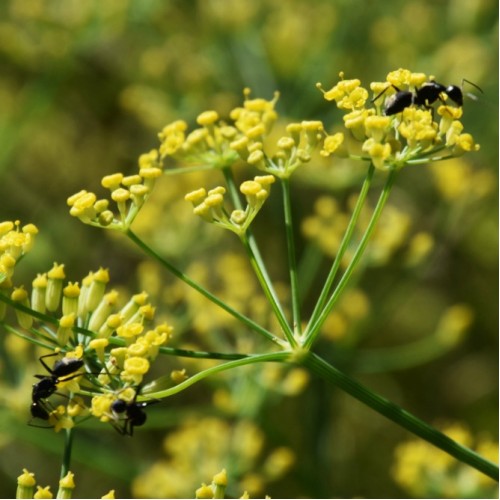
Flowers: Flat-topped umbels of tiny yellow flowers; pollinator friendly
-
Seeds: Oblong, ribbed, greenish to brown when mature; pungent and aromatic
-
Roots: Deep taproot; drought-resistant
Native Habitat + Growth Conditions:
-
Native To: Mediterranean basin
-
Preferred Soil: Well-drained, sandy or rocky soil with moderate nutrients
-
Sunlight: Full sun
-
Climate: Temperate to warm climates; drought-tolerant once established
-
Ecological Notes: Often grows wild along roadsides and dry fields; supports beneficial insects
Energetic Botanical Signature
Bitter Fennel stands tall and open, with its hollow stems and far-reaching umbels reflecting its role in clearing space and connecting inner systems. It grows in rough, dry places—bringing movement where there’s stuckness. Its root dives deep, anchoring it, while its flowering head stretches outward in full solar expression. That dual action—rooted and expansive—mirrors its physical and emotional medicine.
This is a plant that doesn't crowd or dominate—it creates space, both in the field and the body. It reminds the system how to move.
