
Personal Use
(Piper nigrum, CO₂ select extract)
This is not the dusty shaker from the back of your spice rack. Stillpoint’s Black Pepper CO₂ extract smells like fire just before it catches—warm, dry, and deeply aromatic with a soft, spicy edge that curls into the body rather than burns. It’s bold without being sharp. Clean without being sterile. And it stirs something deep in the blood—an old memory of movement, will, and trust in your own momentum.
Our Black Pepper CO₂ extract is obtained from dried peppercorns of Piper nigrum through select supercritical carbon dioxide extraction. The result is a true-to-plant representation: rich in monoterpenes, sesquiterpenes, and oxygenated compounds like caryophyllene oxide, which make this extract a powerful ally for both the physical and emotional body.
Where steam-distilled Black Pepper can feel one-dimensional, this CO₂ holds warmth, softness, and a slow-building strength. It doesn’t just stimulate—it grounds and stabilizes as it moves heat through the system.
Therapeutic Applications
Muscle + Joint Support
Black Pepper CO₂ is known for its circulatory stimulation and warming analgesic action. It may help ease muscle stiffness, joint pain, and cold-related tension—especially when applied in warming massage blends. Useful in formulas for arthritis, overexertion, or sluggish movement.
Digestive Support
Traditionally used to stimulate digestion, this extract supports peristalsis and may help relieve bloating, constipation, and loss of appetite. Its warming nature enlivens a sluggish gut—particularly when stagnation is tied to cold constitutions or emotional holding.
Immune + Respiratory Strength
With its monoterpenes and sesquiterpenes, Black Pepper CO₂ offers mild antimicrobial, expectorant, and antispasmodic effects. It may assist in clearing congestion and supporting immunity, particularly when included in warming, circulatory blends.
Circulatory Activation
Excellent for poor circulation, cold extremities, and post-illness recovery. This oil stimulates blood flow, especially when used topically in salves or massage oils focused on limbs, abdomen, or lower back.
Addiction + Withdrawal Support
Black Pepper has been studied for its ability to reduce nicotine cravings and support withdrawal processes—both physically and emotionally. The CO₂ extract is ideal for inhalation-based formulas aimed at craving reduction, emotional steadiness, and habit interruption.
Traditional Use
Black Pepper has been used for over 4,000 years in both culinary and medicinal traditions, revered for its ability to ignite internal fire, stimulate digestion, and protect the body from illness and cold. It has held a place not just as a seasoning—but as a medicine of movement, metabolism, and circulation.
Digestive Stimulant
In Ayurvedic and Unani medicine, Piper nigrum was used to kindle agni—the digestive fire—and help relieve symptoms of bloating, gas, constipation, and poor nutrient absorption. Black Pepper was often combined with other herbs to enhance bioavailability (such as with turmeric), a practice still supported today by modern research on piperine.
Circulatory + Warming Tonic
Black Pepper was traditionally applied in liniments, poultices, or infused oils to relieve cold limbs, sluggish blood flow, and muscular tension. It was used to warm the body, stimulate movement, and counteract the damp, heavy qualities of cold-weather illnesses or sedentary living.
Support for Respiratory Congestion
In traditional folk medicine, it was added to steams, teas, and smoke blends to clear phlegm, support bronchial strength, and alleviate wet coughs. Its warming, drying nature was especially helpful in kapha-dominant respiratory conditions.
Immune + Antimicrobial Use
Historically considered a protective herb, Black Pepper was included in spice blends and herbal formulations for its antimicrobial, antiviral, and preservative qualities. It was thought to “cut through” stagnation and defend against seasonal threats and digestive infections.
Energetic + Addiction Support
Though less emphasized in traditional records, Black Pepper has more recently been incorporated into addiction support protocols, especially for tobacco withdrawal, where its warming, steadying presence is used to ease cravings and support mental-emotional grounding.
Botany
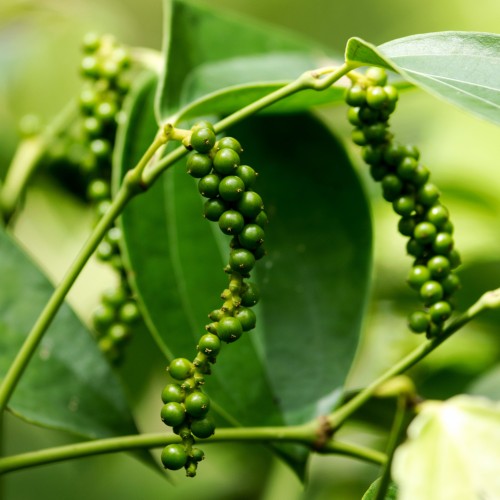
Piper nigrum is a perennial climbing vine in the Piperaceae family, native to the humid tropics of India and Sri Lanka. Today, it is cultivated in many tropical regions worldwide for its fruit—peppercorns—which are harvested at various stages of ripeness and processed into black, white, or green pepper depending on post-harvest treatment.
The black peppercorn is produced by harvesting the still-green, unripe fruit, then briefly boiling and drying it in the sun, which causes the outer skin to darken and wrinkle. These dried fruits are the raw material used in CO₂ extraction.
Botanical Name: Piper nigrum
Family: Piperaceae
Common Names: Black Pepper, Peppercorn Vine
Plant Type: Perennial tropical climbing vine
Part Used for Extraction: Dried unripe fruits (black peppercorns)
Growth Habit: Woody vine with aerial roots, often trained on trees or poles; grows up to 10–15 meters in height
Flowering Season: Varies by region; typically blooms and fruits multiple times annually in tropical climates
Harvest Time for CO₂ Extraction: When berries are still green and firm, just before full maturity
Family: Piperaceae
Common Names: Black Pepper, Peppercorn Vine
Plant Type: Perennial tropical climbing vine
Part Used for Extraction: Dried unripe fruits (black peppercorns)
Growth Habit: Woody vine with aerial roots, often trained on trees or poles; grows up to 10–15 meters in height
Flowering Season: Varies by region; typically blooms and fruits multiple times annually in tropical climates
Harvest Time for CO₂ Extraction: When berries are still green and firm, just before full maturity
Physical Characteristics:
-
Leaves: Heart-shaped, dark green, glossy, with pronounced veins
-
Stems: Long, climbing, and woody with aerial roots for support
-
Flowers: Tiny, pale green-white, arranged in pendulous spikes
-
Fruits: Small spherical berries that ripen from green to red, wrinkling to black when dried
Native Habitat + Growth Conditions:
-
Native To: Western Ghats of India and Sri Lanka
-
Preferred Soil: Rich, moist, well-drained loam
-
Sunlight: Partial shade to full sun
-
Climate: Warm, humid tropics with high rainfall
-
Ecological Notes: Grows best in symbiosis with support trees; long-lived vine, often producing for 20+ years
Energetic Botanical Signature
Black Pepper doesn’t flower in showy ways—it hides its power in the seeds, in the internal fire that forms under heat and pressure. Its fruits are small, round, dark, and wrinkled—holding a depth of heat and potency disproportionate to their size.
As a climbing vine, Piper nigrum reaches upward, seeking support, yet its medicine is rooted in downward motion—pulling energy into the gut, into the blood, into the will. It teaches how to contain power, not explode with it. Its energy is concentrated, catalytic, and direct—a teacher of action without aggression.
It brings heat where there is cold. It brings motion where there is stuckness. It clears the clutter and reminds you: You are allowed to want, to move, and to act.
