
Every order ships USPS Priority — $10.95 flat-rate USPS Priority shipping on all US orders, no minimum. Free shipping on domestic orders over $299.
Welcome to Stillpoint. Subscribe to our newsletter for sale details and new-product news · One discount code per order · Every order is hand-poured, packed with care in ceremony, and shipped as we receive it.

Bitter Fennel Essential Oil | Digestive & Energetic Clarity

Foeniculum vulgare Mill. ssp. vulgare var. vulgare

  • Bitter Fennel Essential Oil | Digestive & Energetic Clarity

Average Rating: (see reviews)

$9.00 Ex Tax: $9.00

GC/MS Report

Gas Chromatography Analysis (%)

Monoterpenes

d-limonene 32.09
α-phellandrene 8.93
α-pinene 3.86
para-cymene 2.54
myrcene 2.53
β-pinene 1.51
cis-β-ocimene 1.33
β-phellandrene 0.87
δ-3-carene 0.42
camphene 0.28
γ-terpinene 0.20
terpinolene 0.19
sabinene 0.13
trans-β-ocimene 0.13
α-thujene 0.09
allo-ocimene 0.05
α-terpinene 0.03
α-fenchene 0.03

Monoterpenols

terpinen-4-ol 0.08
α-terpineol 0.08
p-cymene-8-ol 0.05
cis-p-menth-2-en-1-ol 0.04
trans-p-menth-2-en-1-ol 0.02

Sesquiterpenes

germacrene D 0.06
α-copaene 0.03

Esters

Decenyl acetate 0.06
Sobrerol 8-acetate 0.04
exo-Fenchyl acetate 0.03
endo-Fenchyl acetate 0.02
Isopentyl 2-methyl butanoate 0.02

Aliphatic Aldehydes

para-Anis aldehyde 0.18
isoneral 0.02

Ketones

fenchone 16.52
camphor 0.21
carvone 0.01

Oxides

1,8-cineole 0.03

Ethers

trans-anethole 22.94
methyl chavicol 2.81
cis-anethole 0.08

Essential Facts

  • Latin Name: Foeniculum vulgare Mill. ssp. vulgare var. vulgare
  • Country of Origin: British Indian Ocean Territory
  • Botanical Family: Apiaceae
  • Plant Parts: Seeds
  • Note Classification: Middle
  • Cultivation Method: Organically Grown
  • Method of Extraction: Steam or Hydro Distillation
  • Extraction Date: August 2025
  • Approx. Shelf Life: 6 years
  • Chemical Family: Ethers, Ketones
  • Batch: bitfen
  • Aroma: Earthy, Exotic, Green, Strong, Sweet
  • Energetic Applications: 2nd Chakra - relationships, creation energy, 5th Chakra - speaking truth, 7th Chakra - higher information, Clarity, Energizing, Expansive, Meditative
  • Therapeutic Properties: Anti-septic, Anti-spasmodic, Carminative, Circulatory stimulant, Depurative, Digestive stimulant, Digestive tonic, Emmenagogic, Estrogenic, Lymph decongest, Stomachic
Notes & Use

Personal Use

Bitter Fennel Essential Oil (Foeniculum vulgare var. vulgare)
There’s nothing subtle about Bitter Fennel—and that’s exactly its gift. Aromatically, it’s sharp, herbal-sweet, and licorice-like, but with an edge that cuts through stagnation. It’s less syrupy than Sweet Fennel and holds a drier, slightly more austere character—think discipline over indulgence.

Stillpoint’s Bitter Fennel oil hits the nose with clarity. There’s something ancient in it—an old-world herbaceousness that speaks to gut wisdom, energetic regulation, and internal boundaries. This isn’t a cozy comfort oil. It’s a truth-teller, a system mover, a reminder to clear out what no longer serves—physically, emotionally, and energetically.

Distilled from the seeds of the bitter fennel plant, this oil carries digestive and hormonal intelligence deep in its code. Traditionally used for bloating, fluid retention, and emotional congestion, it shows up best when clarity, flow, and fire are needed in equal measure.

Therapeutic Applications
Bitter Fennel is sharp, stimulating, and clearing—a true mover of systems. Traditionally used for digestive, endocrine, and lymphatic support, this oil brings structure where there’s slack, and flow where there’s stagnation.

Digestive Support
Used to relieve bloating, flatulence, intestinal cramping, and sluggish digestion. It works both directly on the gut and energetically on the solar plexus—strengthening internal processing of both food and emotion.

Lymphatic and Fluid Regulation
May support gentle detoxification and fluid balance, especially when used in massage blends or lymphatic compresses. Bitter fennel is known to assist with mild water retention and sluggish elimination.

Hormonal Support
While not as estrogenic as sweet fennel, bitter fennel still offers support for the reproductive system, especially during PMS, menstrual cramps, or periods of hormonal stagnation or irregularity. Use with discernment and not for extended periods.

Respiratory + Antispasmodic
Bitter fennel can also assist with spasmodic coughing, especially when linked to digestive or nervous system tension. Its antispasmodic actions make it a good addition to blends for abdominal massage or tension-related discomfort.

Energetic Cleanser
Though not typically highlighted for its energetic work, Bitter Fennel is a strong boundary oil. It helps cut cords, release guilt or obligation, and re-center the self after entanglement or overextension.

Traditional Use

Traditional Uses & Benefits
Bitter Fennel has a long and complex history—used across continents for everything from digestive aid to ritual purification. While its sweeter cousin often steals the spotlight, it’s Bitter Fennel that holds the deeper medicinal edge.

Ancient Cultures & Herbal Roots
In ancient Greece and Rome, fennel (known as marathron) was revered for strength and clarity. Warriors consumed it before battle, and it was associated with vision, purification, and power. It was also believed to help ward off evil spirits—possibly due to its strong aroma and clearing action.

Traditional European Herbalism
Bitter fennel was used in teas, poultices, and oil infusions for:
  • Bloating, gas, and indigestion
  • Water retention and lymphatic stagnation
  • Hormonal imbalances and menstrual regulation
  • Increasing milk flow in lactating women (though this use is controversial and outdated with essential oil due to potency)
It was often combined with other "carminative" herbs like anise, caraway, and peppermint in classic digestive formulas.
Ayurveda & Traditional Chinese Medicine
In Ayurveda, fennel is considered cooling and calming to the digestive fire, but still stimulating to agni (digestive strength). It’s used to ease flatulence, support liver function, and calm emotional heat linked to digestion.

In TCM, fennel (especially the seed) is used to warm the interior, disperse cold, and regulate Qi in the lower abdomen—especially when pain, stagnation, or cramps are involved.

Bitter Fennel is the plant that says: "Let’s get things moving—but let’s stay grounded." It has long been a friend to the gut, the breath, and the boundaries we forget we need.

Botany

Foeniculum vulgare var. vulgare, commonly known as Bitter Fennel, is a hardy perennial or biennial herb in the Apiaceae family. Closely related to Sweet Fennel, it is differentiated by its higher content of fenchone and a more pronounced bitter edge, both in flavor and energy.

This variety is native to the Mediterranean region but now grows widely across Europe, Asia, and parts of North America—especially in dry, coastal, or rocky soils where other crops may struggle. The plant produces small aromatic seeds, which are harvested and steam distilled to produce the essential oil.

Botanical Name: Foeniculum vulgare var. vulgare
Family: Apiaceae
Common Names: Bitter Fennel, Wild Fennel
Plant Type: Perennial or biennial herb
Part Used for Distillation: Seeds (sometimes called fruits)
Growth Habit: Upright, hollow-stemmed, branching 3–6 feet in height
Flowering Season: Midsummer to early autumn
Harvest Time for Distillation: Seeds are harvested in late summer to early fall, when aromatic compounds peak

Physical Characteristics:
  • Leaves: Feathery, bright green, threadlike; resemble dill
  • Stems: Tall, hollow, ridged
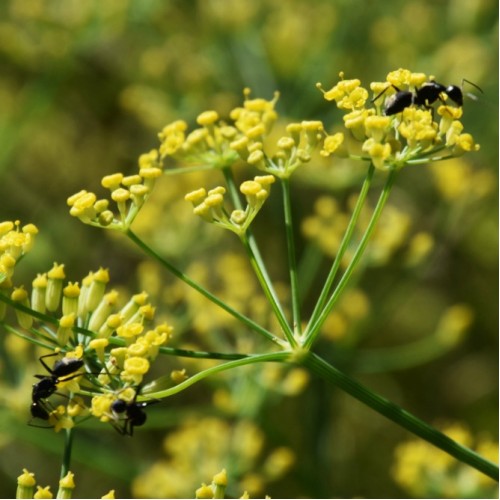
  • Flowers: Flat-topped umbels of tiny yellow flowers; pollinator friendly
  • Seeds: Oblong, ribbed, greenish to brown when mature; pungent and aromatic
  • Roots: Deep taproot; drought-resistant

Native Habitat + Growth Conditions:
  • Native To: Mediterranean basin
  • Preferred Soil: Well-drained, sandy or rocky soil with moderate nutrients
  • Sunlight: Full sun
  • Climate: Temperate to warm climates; drought-tolerant once established
  • Ecological Notes: Often grows wild along roadsides and dry fields; supports beneficial insects

Energetic Botanical Signature
Bitter Fennel stands tall and open, with its hollow stems and far-reaching umbels reflecting its role in clearing space and connecting inner systems. It grows in rough, dry places—bringing movement where there’s stuckness. Its root dives deep, anchoring it, while its flowering head stretches outward in full solar expression. That dual action—rooted and expansive—mirrors its physical and emotional medicine.

This is a plant that doesn't crowd or dominate—it creates space, both in the field and the body. It reminds the system how to move.


Energetics

Energetic Properties

Bitter Fennel is a truth oil—not the kind that coddles, but the kind that clears fog from your internal radar. It sharpens your intuition by cleaning up the interference—mental clutter, energetic entanglements, and emotional stagnation that clouds your gut instinct.

This is solar plexus medicine. It cuts through energetic bloating and psychic overconsumption the same way it clears gas from the belly. When you’ve been digesting too much—emotionally, physically, spiritually—Bitter Fennel helps you remember where your own center is.

Energetic Themes:
  • Clearing psychic and emotional congestion
  • Restoring the solar plexus (personal power, decision-making, clarity of will)
  • Reclaiming internal sovereignty after being “talked over” or energetically overridden
  • Supporting emotional digestion during times of grief, anger, or confusion
  • Cutting cords of obligation, especially from caretaking or old roles
  • Inviting clean movement forward—without drama, without delay

Spiritual Use:
Use Bitter Fennel in rituals or blends when you need to make a clean cut, speak your truth, or reconnect to your gut wisdom. Anoint the solar plexus before sessions where clarity and boundaries are needed. Blend it into energetic detox baths after overexposure to crowds, screen time, or emotional intensity.

This isn’t an oil that lingers. It shows up, does its work, and steps back—leaving behind a quieter, cleaner field where your own voice can be heard.


Traditional & Folklore

Fennel’s history runs deep. Though Sweet Fennel is more commonly referenced in culinary and modern herbalism, Bitter Fennel is the older, more medicinal ancestor—used by the ancients not for its sweetness, but for its power to protect, purge, and purify.

Ancient Greece + Rome
Fennel was associated with strength, vision, and discipline. The Greeks believed it was a gift from the gods—Prometheus supposedly smuggled fire to humanity in a fennel stalk. Roman warriors consumed fennel to stay lean and focused in battle. It was also planted around temples and used in purification rites.

Medieval Europe
During the Middle Ages, fennel was hung in doorways or stuffed into keyholes to ward off evil spirits, curses, and disease. It was considered a protective herb, often burned in ritual fires or carried for psychic shielding. Its seeds were chewed to aid digestion after feasting and to keep one “clear of malice.”

Folk Medicine Across Cultures
  • Used in digestive teas and tonics for gas, cramps, and sluggish gut motility
  • Believed to increase courage and inner clarity, especially when taken before conflict or hard decisions
  • In some traditions, the seeds were burned or scattered to break hexes, purify energy, or “cast out deceit”

Symbolic Themes
Bitter Fennel has long been a plant of clarity, protection, and purification. Not soft or maternal, but boundaried, intelligent, and purpose-driven. It calls the truth out of hiding, clears what’s bloated or dishonest, and returns you to the clean, sharp edge of your own knowing.
Chemistry

Chemical Components

Bitter Fennel essential oil is rich in phenylpropanoids, particularly trans-anethole, which gives the oil its licorice-like aroma and contributes to its digestive, carminative, and antispasmodic properties. It also contains monoterpenes and ketones in small amounts, which add dimension to its actions and highlight the need for mindful use.

Primary Constituents:
  • Trans-Anethole (Phenylpropanoid):
    • Sweet, anise-like aroma
    • Strong antispasmodic and carminative properties
    • Supports digestion, relieves cramps, and helps clear stagnation
    • Can be mildly estrogenic—use with caution and not for prolonged periods
  • Limonene (Monoterpene):
    • Adds digestive, mood-lifting, and mild antimicrobial activity
    • Supports liver detox and gentle circulatory stimulation
  • Fenchone (Ketone):
    • Bitter, herbaceous note
    • Digestive tonic; helps move stuck energy in the gut
    • Neurotoxic in high amounts—why dilution and short-term use are important
  • Alpha-pinene, Myrcene, and other trace terpenes:
    • Add to its anti-inflammatory and mild expectorant properties
    • Contribute to clarity and energetic clearing

Therapeutic Implications of This Chemistry:
  • Excellent for digestive blends targeting bloating, cramps, and gut stagnation
  • Can support fluid movement and detox when used in massage or lymphatic formulas
  • Not recommended for long-term daily use due to potential mild estrogenic effects and fenchone content
  • Ideal for short-term use, especially when paired with grounding or liver-supportive oils like Lemon, Juniper, or Rosemary ct. verbenone
Recipes & Blends

Recipes & Blends

1. Deep Digestive Flow Massage Oil
For bloating, cramping, and gut stagnation
  • 4 drops Bitter Fennel
  • 3 drops Cardamom (Elettaria cardamomum)
  • 2 drops Ginger CO₂
  • 1 oz carrier oil (Jojoba or Tamanu)
Use: Massage clockwise on the abdomen, especially after meals or when experiencing digestive discomfort.

2. Fluid Movement Lymph Tonic
For water retention and light detox support
  • 3 drops Bitter Fennel
  • 3 drops Juniper Berry (Juniperus communis)
  • 2 drops Lemon (Citrus limon)
  • 1 oz carrier oil
Use: Apply to inner thighs, lower back, and along lymphatic channels (behind knees, under arms) 1–2x daily for 5–7 days.

Energetic & Emotional Blends
3. Cut the Cord Mist
For energetic disentanglement and reclaiming personal space
  • 6 drops Bitter Fennel
  • 4 drops Laurel Leaf (Laurus nobilis)
  • 2 drops Vetiver (Vetiveria zizanioides)
  • 2 oz Witch Hazel or Sage Hydrosol
Use: Shake well. Mist around the body after emotional labor, difficult conversations, or anytime you feel “stuck” in someone else’s energy.

4. Solar Plexus Reset Anointing Blend
For clarity, confidence, and inner boundary work
  • 2 drops Bitter Fennel
  • 2 drops Black Spruce (Picea mariana)
  • 1 drop Bergamot (FCF)
  • 1 tsp carrier oil
Use: Anoint the solar plexus, back of the neck, and wrists. Inhale deeply with intention to reclaim personal power and release energetic clutter.


Safety Etc.

Safety Information

Bitter Fennel essential oil is potent and effective, but it must be used with discernment. Its high content of trans-anethole and fenchone gives it powerful actions, but also makes it inappropriate for certain individuals and long-term use.
  • Not for use during pregnancy or breastfeeding. Due to its mild estrogenic activity and the presence of ketones (fenchone), Bitter Fennel should be avoided during pregnancy and lactation.
  • Avoid use with children under 10 and with individuals who have a history of seizure disorders or epilepsy, due to its neurotoxic potential in high doses.
  • Short-term use only. This oil is not recommended for daily use over long periods. Use in short, targeted applications and allow breaks in between.
  • Dilution is essential. Recommended topical dilution is 1% or less for adults. Always perform a patch test, especially for those with sensitive skin or hormonal imbalances.
  • Internal use is not recommended unless under the guidance of a qualified clinical aromatherapist or practitioner experienced in essential oil pharmacology.
  • Store tightly sealed and away from light to avoid oxidation. If the oil smells sharp, acrid, or unpleasant, it may be oxidized and should be discarded or used only in non-therapeutic cleaning blends.

Reviews (2)

Write a review

Note: HTML is not translated!
    Bad           Good
Powered By OpenCart
Stillpoint Aromatics © 2026