
Every order ships USPS Priority — $10.95 flat-rate USPS Priority shipping on all US orders, no minimum. Free shipping on domestic orders over $299.
Welcome to Stillpoint. Subscribe to our newsletter for sale details and new-product news · One discount code per order · Every order is hand-poured, packed with care in ceremony, and shipped as we receive it.

Aniseseed Myrtle Essential Oil

Syzygium anisatum

  • Aniseseed Myrtle Essential Oil

Average Rating: (see reviews)

$14.00 Ex Tax: $14.00

Essential Facts

  • Latin Name: Syzygium anisatum
  • Country of Origin: Afghanistan
  • Botanical Family: Apiaceae
  • Plant Parts: Seeds
  • Note Classification: Middle
  • Cultivation Method: Organically Grown
  • Method of Extraction: Steam or Hydro Distillation
  • Extraction Date: Summer 2024
  • Approx. Shelf Life: 6 years
  • Chemical Family: Ethers
  • Aroma: Cool, Herbaceous, Soft, Sweet, Warm
  • Energetic Applications: 1st Chakra - survival and support, 2nd Chakra - relationships, creation energy, 4th Chakra - unconditional love, 6th Chakra - perspective, Clarity, Energizing, Expansive, Meditative, Source Energy, Uplifting
  • Therapeutic Properties: Analgesic, Anti-anxiety, Anti-asthmatic, Anti-depressant, Anti-inflammatory, Anti-rheumatic, Anti-spasmodic, Calming, Cooling, Digestive tonic, Emmenagogic, Estrogenic, Expectorant, Stomachic
Notes & Use

Personal Use

Anise Star and Anise seed and this essential oil, Aniseed Myrtle are very similar in chemistry and their applications. Anise Star is typically used for her anti-spasmodic and carminative therapeutic properties to relieve dyspepsia, colic and gas and is anti-ulcerogenic.It has also been proven to be sedative and inhibits acetylcholinesterase. Because of the fantastic anti spasmodic properties, we find her to be awesome when dealing with deep respiratory issues.  She can relieve the spastic coughs of bronchitis and chest colds.  A good friend of ours uses this in her anti asthma blend.

Botany

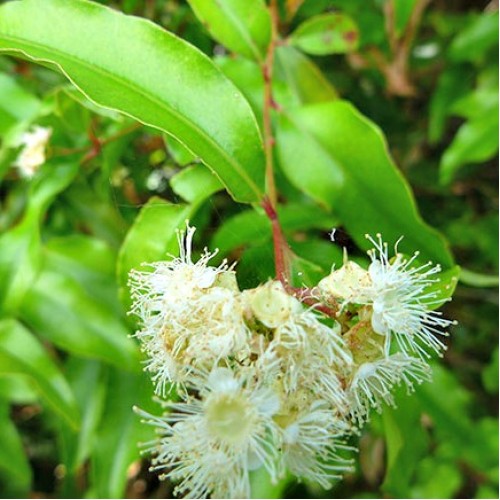
Syzygium anisatum, with common names ringwood and aniseed tree, is a rare Australian rainforest tree with an aromatic leaf that has an essential oil profile comparable to true aniseed. The leaf from cultivated plantations is used as a bushfood spice and distilled for the essential oil, and is known in the trade as aniseed myrtle or anise myrtle. The ringwood tree has a dense crown and grows up to 145 feet The leaves are 6–12 cm long with prominently undulate margins and rich aniseed aroma when crushed. Flowers are white and sweetly scented, borne in panicles. The fruit are dry papery capsules around 5 mm long and are white in appearance. (Wikipedia)

Energetics

Energetic Properties

Anise Seed, Anise Star and Aniseed Myrtle all can help move obstacles out of our way, either mentally or in a tangible form so that we can feel sure-footed as we move ahead. This essential oil also is great oil to help us when we feel either overwhelmed or tired. It can help soothe our spirit, so we can either take a rest or gain the motivation we feel is needed. Anise star is also very effective in helping to clear the head so that you can see the bigger picture.  It is expansive and comforting at the same time.
 
The difference in the energetics arises when looking at the plant or tree itself.   (Get pictures of the plant and trees and see what you feel)
 
  • Anise Seed comes from a small plant with white flowers.  You would use her when you wanted to add the essence of softness and a bit of protection. She prefers full sun but likes to be sheltered from the wind, hence the protective aspect.  When looking at the plant the feeling of lightness and joy.  The white flowers are reminiscent of summer and easy going.
  • Star Anise comes from an evergreen tree and the seeds come from a star shaped pod.  You would use her when you wanted the essence of congruence and stability added to your blend. Also when you needed the energetics of everlasting and standing firm.
  • Aniseed myrtle comes from an Australian Rainforest Tree, You would use her in a blend when you wanted to bring in a feeling of strength, energy and coolness. Also, when you are trying to help someone begin something foreign and new. (as long as they are not from Australia)
Chemistry

Chemical Components

The chemistry of Anise Seed, Star Anise EO, Star Anise CO2 and Aniseed Myrtle is similar. These abstracts are high In trans anethole which is a component of the Ether chemical family.  While these oils have a pleasant, soft aroma, do not be fooled they are “Terminator” extracts and you must know when and how to use them. The ether family has quite a few safety issues, so please read them.


  1. Anethole: Anethole is the primary component in Aniseed Myrtle essential oil, responsible for its characteristic sweet and anise-like scent. It is also found in other plants like anise and fennel.
  2. Methyl chavicol: Also known as estragole, methyl chavicol contributes to the aroma of Aniseed Myrtle essential oil and is commonly found in various aromatic herbs and spices.
  3. Limonene: Limonene is a common terpene found in many essential oils. It provides a citrusy scent and is known for its uplifting and refreshing properties.
  4. Methyl eugenol: Methyl eugenol is another aromatic compound present in Aniseed Myrtle essential oil. It contributes to its complex fragrance and is found in various spices like basil and clove.
  5. Linalool: Linalool is a terpene alcohol commonly found in essential oils, including Aniseed Myrtle. It contributes to its floral and sweet aroma and is known for its calming and relaxing effects.
Safety Etc.

Safety Information

According to Tisserand & Young, Anise Seed Myrtle essential oil can be potentially carcinogenic, based on estragole & safrole content, may inhibit blood clotting & reproductive hormone modulation.
 
Anise Seed Myrte essential oil is contraindicated during pregnancy, breastfeeding, for those with endometriosis, estrogen dependent cancers & children under 5 yrs old
 
Indicated cautions: Diabetes & anticoagulant medication, peptic ulcer, hemophilia, major surgery & other bleeding disorders.
 
(E)-Anethole inhibits platelet aggregation. Essential oils high in (E)-anethole should therefore be avoided, especially in high or oral doses, before major surgery, and in anyone taking blood-thinning medication, or with blood coagulation issues. Essential oils with a high (E)-anethole content should be avoided during pregnancy. (E)-Anethole is weakly estrogenic in yeast cells. It is not estrogenic in breast cancer cells, but a metabolite of (E)-anethole is estrogenic. Given orally to female rats at 80 mg/kg/day for three days, (E)-anethole significantly increased uterine weight, suggesting estrogenic activity. In carcinogenesis studies, (E)-anethole did not cause breast cancer in either rats or mice.
 
Avoid old or oxidized oils.
Maximum daily oral dose: 53mg
Maximum dermal level per Tisserand & Young: 1.75% (based on 6.6% estragole & 0.1% safrole content) and dermal limits of 0.12% for estragole and 0.05% for safrole

References

Tisserand & Young Essential Oil Safety, 2nd Edition Churchill Livingstone Elsevier. Edinburg 2014 
Mojay, Gabriel. Aromatherapy for Healing the Spirit, Healing Arts Press, Rochester, VT 1997
Battaglia, S. The Complete Guide to Aromatherapy, 2nd Edition.  Queensland, Aust. 2003
Zeck, Robbi. The Blossoming Heart: Aromatherapy for Healing and Transformation. Aroma Tours, 2004.

Related Products

Clove Leaf Essential Oil

Clove Leaf Essential Oil

..

$8.00 Ex Tax: $8.00

Reviews (1)

Write a review

Note: HTML is not translated!
    Bad           Good
Powered By OpenCart
Stillpoint Aromatics © 2026