
Every order ships USPS Priority — $10.95 flat-rate USPS Priority shipping on all US orders, no minimum. Free shipping on domestic orders over $299.
Welcome to Stillpoint. Subscribe to our newsletter for sale details and new-product news · One discount code per order · Every order is hand-poured, packed with care in ceremony, and shipped as we receive it.

Canadian Fleabane Essential Oil | Energetic Detox & Boundary Repair | Erigeron canadensis

Erigeron canadensis

  • Canadian Fleabane Essential Oil | Energetic Detox & Boundary Repair | Erigeron canadensis

Average Rating: (see reviews)

$25.00 Ex Tax: $25.00

GC/MS Report

Gas Chromatography Analysis (%)

Monoterpenes

d-limonene 64.16
trans-β-ocimene 2.54
β-pinene 2.44
β-myrcene 1.96
other monoterpenes 0.47
α-pinene + α-thujene 0.22

Monoterpenols

other monoterpenols 0.12

Sesquiterpenols

other sesquiterpenols 0.31

Sesquiterpenes

trans alpha bergamotene 3.96
germacrene D 2.63
γ-curcumene 1.61
Z-E-beta farnesene 0.68
α-zingiberene 0.61
epi-β-santalene 0.45
α-curcumene 0.32
other sesquiterpenes 0.23
β-bisabolene 0.15
β-caryophyllene 0.13
β-sesquiphellandrene 0.12
curcumene isomer 0.12
β-elemene 0.10
δ-cadinene 0.10
β-curcumene 0.07
α-farnesene 0.07
γ-cadinene 0.03

Esters

matricaria ester mw=174 13.53
other esters 1.39

Ketones

other ketones 0.05

Oxides

1,8 cineole & β-phellandrene 0.14

Essential Facts

  • Latin Name: Erigeron canadensis
  • Country of Origin: Andorra
  • Botanical Family: Asteraceae
  • Plant Parts: Flowering plant/herb, Flowering tops, Leaves
  • Note Classification: Top/Middle
  • Cultivation Method: Distiller is Certified Organic
  • Method of Extraction: Steam or Hydro Distillation
  • Extraction Date: Summer 2024
  • Approx. Shelf Life: 6 years
  • Chemical Family: Monoterpenes, Sesquiterpenes
  • Batch: canflea
  • Aroma: Camphoraceous, Cool, Green, Herbaceous, Medicinal
  • Energetic Applications: 1st Chakra - survival and support, 3rd Chakra - personal power, 6th Chakra - perspective, Balancing, Expansive, Grounding, Purifying
  • Therapeutic Properties: Analgesic, Anti-inflammatory, Anti-microbial, Anti-spasmodic, Astringent, Expectorant, Strengthening, Vein tonic
Notes & Use

Suggested Uses

Anti-inflammatory – May help reduce inflammation in tissue, joints, skin, and mucous membranes

Astringent – Tones and tightens tissues; traditionally used for hemorrhoids, varicose veins, and capillary fragility

Hemostatic – Known to help reduce bleeding (historically used in poultices and compresses)

Analgesic – Can ease localized pain or discomfort, particularly with bruising or swelling

Vasoconstrictor – May support vascular tone, reduce puffiness, and assist with circulatory stagnation

Antimicrobial – Offers mild antimicrobial support; useful in topical preparations for wound care

Expectorant – Can help clear mucus and open airways, especially when congestion is damp or stagnant

Antispasmodic – May ease cramping or muscular tightness, particularly when associated with inflammation


Energetic Detoxifier – Clears the subtle body and supports energetic “reset” after emotional overwhelm or spiritual work

Personal Use

Canadian Fleabane Essential Oil (Erigeron canadensis)
Wild. Sharp. Rooted in resistance. Canadian Fleabane (also known as Horseweed) doesn’t announce itself with sweetness—it clears the path with astringent, herbaceous force. The essential oil, steam distilled from the flowering tops of Erigeron canadensis, is intense, medicinal, and direct—with a sharp, camphoraceous-green aroma that tells you right away: this is plant medicine, not perfume.

Stillpoint’s Canadian Fleabane is distilled from plants grown wild in North America, where this native species has long been used in traditional medicine for its astringent, anti-inflammatory, and spiritual clearing properties. It’s the kind of oil you turn to when you need to pull something out by the root—energetically, emotionally, or physically.
This isn’t a trendy oil. It’s an underestimated powerhouse—and like most wild things, it doesn’t care to be tamed.

Therapeutic Applications

Anti-inflammatory + Astringent Support:
Canadian Fleabane is a potent anti-inflammatory and astringent, historically used for conditions involving excess heat, swelling, and bleeding. It may assist with varicose veins, hemorrhoids, bruising, and capillary fragility. Topically, in low dilution, it can help tone tissue and reduce fluid stagnation, especially in blends for the vascular or lymphatic systems.

Pain + Muscle Tension:
This oil offers analgesic and anti-spasmodic properties and may support relief of joint pain, muscular tension, or minor injury. Especially useful when pain is sharp, inflamed, or energetically “stuck.” Think of it as clearing heat and contraction.

Wound Healing + Skin Repair:
Traditionally used in poultices for cuts, abrasions, and minor wounds, Canadian Fleabane essential oil may assist in supporting skin regeneration while providing antimicrobial protection. Always use diluted, and avoid on deep or open wounds unless under the guidance of a trained practitioner.

Respiratory Clearing:
The camphoraceous tone of this oil makes it helpful for clearing congestion in the lungs and sinuses, especially when combined with other respiratory allies. It may support bronchial dilation and mucus reduction, especially when illness lingers.

Menstrual + Pelvic Support:
Historically used to address excessive bleeding and uterine congestion, this oil may support pelvic stagnation, especially when paired with castor oil compresses. Use with care due to its potency and action on circulation and tone.
 

Traditional Use

Before it was distilled, Canadian Fleabane was pounded into poultices, steeped into infusions, and burned in smoke rituals. This native North American plant has a long history in Indigenous and early settler medicine for its ability to stop bleeding, reduce swelling, expel illness, and clear spiritual interference.

Used by various First Nations peoples, Fleabane was considered an astringent plant of protection—applied to wounds, taken as a tea for internal bleeding, and used ceremonially to dispel heavy or toxic energy. It was also burned in cleansing rituals to clear spaces of illness, death, or spiritual stagnation, acting as a kind of plant-based boundary keeper.

Early settlers and folk herbalists used Fleabane for its hemostatic (bleeding-stopping) properties—especially for hemorrhoids, uterine bleeding, and blood in the urine. Women would use it after childbirth or heavy menstrual cycles to restore tone and reclaim their center.

Also known as Horseweed, this plant was used to “drive out disease and keep away bad spirits.” Crushed and carried in sachets, it was believed to repel negative energies, insects, and curses alike. The name “Fleabane” itself reflects this—many believed it literally banished pests, both seen and unseen.

In the hands of herbalists, midwives, and medicine carriers, Canadian Fleabane was not gentle—it was decisive. It moved what needed to move. It pulled out what didn’t belong. And it reminded the body how to reclaim its boundaries—on all levels.

Botany

Botanical Name: Erigeron canadensis
Synonyms: Formerly known as Conyza canadensis
Common Names: Canadian Fleabane, Horseweed, Butterweed, Hogweed
Plant Family: Asteraceae (Daisy family)
Plant Type: Annual herb
Origin: Native to North America; now naturalized in many parts of the world, including Europe and Asia
Habitat: Roadsides, disturbed soils, fields, wastelands—this plant thrives in the places most others avoid.

 Growth + Appearance
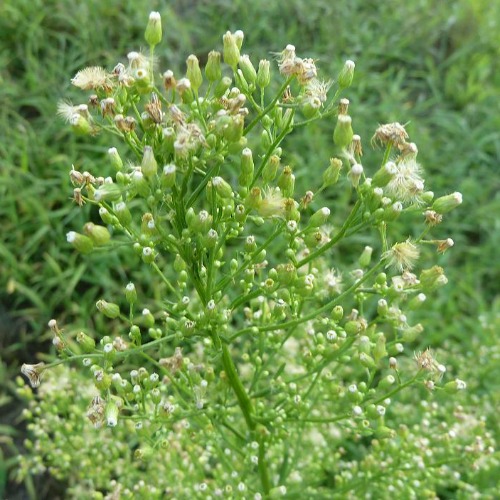
  • Grows upright, up to 5 feet (1.5 meters) tall
  • Has a central stalk that branches near the top
  • Leaves are narrow, bristly, and arranged alternately along the stem
  • Produces tiny white to pale pink flowers in dense clusters—like a delicate cloud on top of a wild stick
  • The seeds are fluffy and wind-dispersed, much like dandelions, making it an incredible colonizer of open or disturbed spaces

Botanical Energetic Message
Canadian Fleabane is a first responder plant—it moves in after trauma, disruption, or imbalance in the ecosystem and starts to rebuild. It shows up where the land has been broken… and begins the work of reclamation.
That resilience translates right into the oil:
  • First in. Clears the field. Reclaims space.
It’s part of the Asteraceae family, which includes Yarrow, Chamomile, and Mugwort—all allies in boundary work, energetic hygiene, and psychic tuning.
Energetics

Energetic Properties

Canadian Fleabane is energetic precision. This is an oil for spiritual detox, boundary enforcement, and soul clarity. It doesn’t soothe the nervous system—it cleans the field. When energy is messy, grief has become stagnant, or you’re carrying what isn’t yours, Fleabane steps in with surgical clarity and says, “Let it go. Now.”

This is an oil of extraction—energetically and emotionally. It pulls out stuck emotion, clears spiritual debris, and cuts cords you didn’t consent to. It’s especially powerful for empaths, trauma workers, and anyone who has absorbed too much from others and forgotten where they end.

Fleabane doesn’t work gently—it works fast. It drives out, reinforces boundaries, and pulls your spirit back into alignment with your body.

Energetic Themes:
  • Clearing energetic clutter or spiritual “residue”
  • Releasing grief, cords, and emotional entanglements
  • Reestablishing psychic and emotional boundaries
  • Supporting energetic detox after ceremony, client work, or trauma
  • Remembering your own energetic edges
  • Reclaiming clarity when your field has been “pierced”

Spiritual Use:
Use Canadian Fleabane in post-session auric cleansing, cord-cutting rituals, or as an anointing oil when you’re doing grief or shadow work and need to stay clear. It pairs well with oils like Black Spruce, Mugwort, Myrrh, or Blue Cypress for deep vibrational boundary work.

This is the oil for when you’re saying:
“I’ve carried enough. I need it gone. I want myself back.”

Traditional & Folklore

Indigenous Traditions
Erigeron canadensis was a powerful ally in First Nations and Indigenous medicine across North America, particularly among tribes like the Cherokee, Iroquois, and Ojibwa. She was seen not just as medicine—but as protection.
Used For:
  • Burned as a smudge to ward off negative spirits and clear energy (especially after conflict or illness)
  • Brewed as a tea or decoction for digestive issues, internal bleeding, and painful menstruation
  • Crushed and applied as a poultice for wounds, swelling, or snakebites
  • Infused into sweat lodge rituals for energetic cleansing and purification
In Cherokee tradition, she was sometimes carried in medicine bundles as a form of spiritual protection—particularly for those who were spiritually sensitive or walking between worlds (seers, shamans, and grief-tenders).

Colonial Herbal Use
In early American settler medicine, Canadian Fleabane was part of the Eclectic and Appalachian herbal pharmacopeia.
  • The leaves and flowers were dried and burned as an insect repellent (hence the name “fleabane”)
  • Used internally as a styptic—to stop hemorrhage and excessive menstrual bleeding
  • Employed as a tonic for urinary tract issues (especially bladder inflammation or infection)
  • Known as a “poor man’s remedy”—she grew everywhere, and she worked
Folklore said that if Canadian Fleabane started popping up around your home, it was a sign of coming change—or a need for energetic cleansing. She was believed to help protect the household from both disease and unwanted spiritual influences.

Folk Magic & Spirit Work
In Appalachian and folk magical traditions, Canadian Fleabane was used for:
  • Breaking hexes or energetic attachments
  • Cleansing spaces of grief or lingering sorrow after death
  • Protecting spiritual workers who were channeling or journeying into other realms
  • Undoing harmful bindings or psychic cords in love spells or family curses
Sprinkling the dried herb across a doorstep was believed to keep unwanted spirits or ill-intentioned people from entering your home. Burning it during a new moon was used to banish what no longer served—energetically, emotionally, or physically.

Energetic Signature in Folklore
  • Shape-shifter and guardian—it changes form quickly, grows wherever it wants, and protects what it loves
  • Said to “see what others miss”—symbolizing clarity, especially for people who feel energetically overwhelmed or foggy
  • Carries the spirit of the wild healer—one who lives on the margins, serves the in-between, and doesn’t wait for permission

Ancestral Whisper
“I was the first to return after the fire.”
“I come to cut the cords and scatter the fear.”
“Don’t underestimate what grows from disturbed ground.”
Chemistry

Chemical Components

Canadian Fleabane essential oil is rich in monoterpenes and sesquiterpenes, giving it its strong, sharp, herbaceous-green scent and its potent astringent, anti-inflammatory, and wound-supporting properties. This is a chemistry that clears, tightens, and restores—not soft, not subtle, but fast-acting and effective.

Key Constituents:

  • Limonene – A monoterpene known for its anti-inflammatory, antioxidant, and mood-lifting effects. It supports immune response and also enhances the penetration of other oils when used in blends.

  • β-Caryophyllene – A sesquiterpene with analgesic, anti-inflammatory, and endocannabinoid-modulating effects. Grounding, pain-relieving, and emotionally stabilizing.

  • Myrcene – Calming to muscles and nerves; supports relief from tension and inflammation.

  • α-Pinene – Known for its bronchodilating, antimicrobial, and alertness-enhancing properties. Excellent for respiratory clarity and energetic sharpness.

  • Camphene + Germacrene D – Add to the oil’s cooling, decongestant, and antimicrobial qualities, especially useful for skin and joint applications.

  •  

    Erigeronone (unique ketone) – A compound found in small amounts, possibly responsible for some of its astringent, hemostatic, and circulatory actions.


Recipes & Blends

Recipes & Blends

1. Cord-Clearing Anointing Oil
Purpose: Cuts energetic cords, releases attachments, restores sovereignty
Use: Anoint solar plexus, back of neck, wrists, and soles of feet after sessions or ritual
  • 10 mL Jojoba or Marula oil
  • 3 drops Canadian Fleabane
  • 2 drops Mugwort (Artemisia vulgaris)
  • 2 drops Palo Santo (Bursera graveolens)
  • 1 drop Spikenard (Nardostachys jatamansi)

2. Energetic Detox Bath Blend
Purpose: Clears emotional residue and spiritual stagnation
Use: Add to warm water with salts and soak for 20 minutes post-ceremony, travel, or intense interactions
  • 1 tablespoon Epsom or magnesium flakes
  • 1 tablespoon black lava or sea salt
  • 4 drops Canadian Fleabane
  • 3 drops Black Spruce (Picea mariana)
  • 2 drops Lavender (Lavandula angustifolia)
  • 1 tablespoon sesame or castor oil (as a dispersant)

3. Bruise + Vessel Repair Topical Blend
Purpose: Supports capillary healing, swelling, and post-trauma skin recovery
Use: Apply gently to affected area 2–3x daily (avoid broken skin)
  • 1 oz Arnica-infused carrier oil
  • 3 drops Canadian Fleabane
  • 2 drops Helichrysum (Helichrysum italicum)
  • 2 drops Cypress (Cupressus sempervirens)
  • Optional: 1 drop German Chamomile (Matricaria recutita) for added anti-inflammatory support

4. Field Flush Inhaler
Purpose: Clears energetic clutter, mental fog, or grief overload
Use: Inhale deeply 2–4x/day during emotionally charged or energetically murky times
  • 5 drops Canadian Fleabane
  • 3 drops Laurel Leaf (Laurus nobilis)
  • 2 drops Frankincense (Boswellia carterii)
  • 1 drop Tulsi (Ocimum sanctum)
Safety Etc.

Safety Information

Canadian Fleabane essential oil is a potent oil that should always be used in low dilution—typically no more than 1% topically. Due to its high monoterpene content and potential for mucous membrane irritation, avoid use near the face, eyes, and sensitive areas. Not recommended for use during pregnancy, on children, or in cases of epilepsy or chronic bleeding disorders. Not for internal use. Store away from heat and light to prevent oxidation.

Reviews (0)

Write a review

Note: HTML is not translated!
    Bad           Good
Powered By OpenCart
Stillpoint Aromatics © 2026