
Every order ships USPS Priority — $10.95 flat-rate USPS Priority shipping on all US orders, no minimum. Free shipping on domestic orders over $299.
Welcome to Stillpoint. Subscribe to our newsletter for sale details and new-product news · One discount code per order · Every order is hand-poured, packed with care in ceremony, and shipped as we receive it.

Honey Myrtle Essential Oil | Breath, Cleansing + Clarity

Melaleuca teretifolia

  • Honey Myrtle Essential Oil | Breath, Cleansing + Clarity

Average Rating: (see reviews)

$12.00 Ex Tax: $12.00
GC/MS Report
Current: Not Provided

GC/MS Report


Distilled: January 2016

Gas Chromatography Analysis (%)

Monoterpenes

myrcene 10.72
α-pinene 0.91
d-limonene 0.72
β-pinene 0.39
γ-terpinene 0.11
trans-β-ocimene 0.03
α-terpinene 0.02
para-cymenene 0.02
β-phellandrene 0.01
sabinene 0.01
terpinolene 0.01

Monoterpenols

geraniol 5.21
nerol 3.12
linalol 0.75
α-terpineol 0.69
cis-piperitol 0.12
trans-p-mentha-2,8,dien-1-ol 0.08
cis-p-mentha-2,8-dien-1-ol 0.02

Sesquiterpenols

viridiflorol 0.02
ledol 0.01

Sesquiterpenes

β-elemene 0.23
β-caryophyllene 0.19
bicyclogermacrene 0.08
allo-aromadendrene 0.05
β-maaliene 0.03

Esters

geranyl acetate 1.20
neryl acetate 0.69
myrtenyl acetate 0.03
Neryl formate 0.02
geranyl formate 0.02
methyl geranate 0.02

Aliphatic Aldehydes

geranial 43.00
neral 30.60
trans-Isocitral 2.32
exo-Isocitral 0.18
n-Nonanal 0.09
citronellal 0.06
trans-Chrysanthanal 0.02

Ketones

6-methyl-5-hepten-2-one 0.38

Oxides

1,8-cineole 1.84
trans-Carvone oxide 0.09
cis-Linalool oxide (furanoid) 0.04
caryophyllene oxide 0.01

Phenols

eugenol 0.10

Essential Facts

  • Latin Name: Melaleuca teretifolia
  • Country of Origin: Afghanistan
  • Botanical Family: Myrtaceae
  • Plant Parts: Leaves, Twigs/Branches
  • Note Classification: Top/Middle
  • Cultivation Method: Wild Harvested
  • Method of Extraction: Steam or Hydro Distillation
  • Extraction Date: January 2026
  • Approx. Shelf Life: 6 years
  • Chemical Family: Aldehydes
  • Aroma: Citrus, Cool, Fresh, Lemony
  • Energetic Applications: 2nd Chakra - relationships, creation energy, 3rd Chakra - personal power, 6th Chakra - perspective, Balancing, Clarity, Protective, Uplifting
  • Therapeutic Properties: Analgesic, Anti-bacterial, Anti-convulsant, Anti-depressant, Anti-fungal, Anti-inflammatory, Anti-spasmodic, Anti-viral, Calming, CNS tonic, Hypotensive, Insect repellent, Sedative, Tonic
Notes & Use

Personal Use

Honey Myrtle Essential Oil
Melaleuca teretifolia

Lemony | Honeyed | Brightly Clearing

Honey Myrtle does not smell like Tea Tree with better manners. It is its own thing entirely — bright, lemony, sweet, herbaceous, and surprisingly warm, with a soft honeyed undertone that keeps the sharpness from becoming harsh.

Its aroma is fresh, citrusy, lemon-like, clean, lightly floral, and gently sweet, with that golden “honey myrtle” roundness underneath the bright citral edge. Think Lemon Myrtle with more softness. Lemongrass with less blade. Tea Tree’s botanical cousin who walked into the room carrying sunshine instead of a first-aid kit.

This is an oil for clearing. For freshness. For mental fog, stale air, respiratory heaviness, emotional dullness, and the kind of energetic buildup that makes a room — or a person — feel sour, tired, and too full.

Honey Myrtle is high in citral, the same broad aromatic family direction that gives Lemon Myrtle, Lemongrass, May Chang, and Lemon Tea Tree their strong lemony character. That citral-rich profile gives Honey Myrtle its crisp, cleansing, antimicrobial-leaning aromatic personality, but the honeyed undertone makes it feel warmer and less severe than some sharper lemon oils.

Stillpoint’s Honey Myrtle essential oil is steam distilled from the terminal branches, leaves, and aromatic plant material of Melaleuca teretifolia, a lemon-scented member of the Myrtaceae family associated with Australia. Honey Myrtle oil is known for its sweet, fresh, herbaceous, lemony aroma with slight honey-like undertones, and commercial material is typically produced from branch and leaf distillation.

This oil is for clearing without stripping. For brightness without brittleness. For cleaning the air, waking the mind, supporting the breath, and bringing a little golden light into places that have gotten stale.

Honey Myrtle says: open the damn window, but make it kind.

Therapeutic Applications
Respiratory Support + Clear Breathing
  • Honey Myrtle essential oil is especially valued for its bright, lemony, clearing aroma.
  • Its citral-rich profile makes it useful in aromatic respiratory blends when the breath feels heavy, stale, congested, or restricted.
  • It may support a sense of clearer breathing through:
    • Steam-style inhalation practices
    • Shower blends
    • Diffuser blends
    • Personal inhalers
    • Chest rubs at very low dilution
    • Room-clearing sprays during seasonal crud
  • Honey Myrtle does not bring the deep camphor force of Eucalyptus or the medicinal punch of Tea Tree.
  • It clears through brightness — sharp, clean, lemony, and alive.
  • This makes it especially helpful when someone wants respiratory freshness without feeling like they walked face-first into a medicine cabinet.
Seasonal Wellness + Immune-Season Support
  • Honey Myrtle may be useful in seasonal wellness blends, especially when the atmosphere feels loaded, the house feels stuffy, or the body needs aromatic support during cold-and-crud season.
  • Its strong lemony aroma makes it appropriate for blends traditionally used to support:
    • Fresh air
    • Respiratory ease
    • Environmental cleansing
    • Seasonal immune support
    • Household wellness routines
    • Recovery-room freshness
  • It can be especially useful in diffuser blends when the whole damn room feels like it needs to be washed in sunlight.
  • Use thoughtfully, especially around children, pets, and sensitive individuals, because citral-rich oils can be intense.
Cleansing + Antimicrobial-Oriented Aromatic Use
  • Honey Myrtle is a strong choice for cleansing aromatic blends.
  • Its chemistry is associated with fresh, sharp, lemony aldehydes, especially citral components, which are commonly used in essential oil work for cleansing, purifying, and antimicrobial-oriented formulas.
  • It may be useful in:
    • Cleaning blends
    • Room sprays
    • Bathroom sprays
    • Kitchen sprays
    • Diffuser blends
    • Trash-bin freshening blends
    • Sickroom-style aromatic blends
    • Surface-adjacent aromatic formulas, used appropriately
  • This is one of Honey Myrtle’s strongest therapeutic lanes.
  • It helps shift the feeling of a space from stale, sour, or heavy into clean, bright, and breathable.
  • The caution is simple: this is a powerful oil. It does not need to be dumped into a blend like someone is trying to sanitize the gates of hell.
Skin + Topical Cleansing Support
  • Honey Myrtle may be useful in carefully diluted topical blends where cleansing, freshness, and skin clarity are desired.
  • It may be included in very low dilution in:
    • Foot oils
    • Deodorizing body blends
    • Scalp freshness blends
    • Oily-skin formulations
    • Spot-use cleansing blends
    • Body oils for freshness and tone
  • Because Honey Myrtle is citral-rich, it has a higher potential for skin irritation than softer oils.
  • This is not an oil to use casually at high dilution on the face or sensitive skin.
  • For topical work, low dilution is the medicine.
  • More is not better. More is where the skin starts writing complaint letters.
Deodorizing + Body Freshness
  • Honey Myrtle’s bright lemon-honey aroma makes it excellent for deodorizing blends.
  • It may support freshness in formulas for:
    • Feet
    • Shoes
    • Gym bags
    • Bathrooms
    • Linens
    • Body sprays
    • Natural deodorant-style blends
    • Stale rooms and closed-up spaces
  • Its sweetness gives it a softer edge than some sharper lemon oils, while still keeping the formula clean and direct.
  • Honey Myrtle is especially helpful when you want freshness without a synthetic lemon-cleaner smell.
Mental Clarity + Focus
  • Honey Myrtle may support mental brightness and clarity when the mind feels foggy, tired, or crowded.
  • Its lemony aldehyde-rich aroma can feel sharp, awakening, and clarifying.
  • It may be useful during:
    • Study
    • Writing
    • Teaching preparation
    • Morning rituals
    • Reset breaks
    • Cleaning and organizing
    • Post-overwhelm regrouping
  • This is not a dreamy oil.
  • Honey Myrtle helps cut through mental sludge.
  • It brings the kind of clarity that says: enough spinning, open the window, pick one thing, begin.
Emotional Heaviness + Mood Support
  • Honey Myrtle may support emotional uplift when the mood feels dull, stale, irritated, or weighed down.
  • It is especially useful when someone feels:
    • Flat
    • Foggy
    • Heavy
    • Sour
    • Irritable
    • Emotionally cluttered
    • Tired from too much indoor air or too much people-energy
  • It does not offer deep, velvety comfort like Rose or Sandalwood.
  • Honey Myrtle brings brightness, movement, and a clean emotional reset.
  • It helps shift the field without pretending everything is magically fine.
  • This is honest brightness — not toxic positivity in a citrus costume.
Nervous System Reset + Overwhelm Clearing
  • Honey Myrtle may be helpful when the nervous system feels crowded, overstimulated, or stuck in mental-emotional static.
  • It can support a sense of reset when someone feels:
    • Overloaded
    • Mentally scattered
    • Emotionally stale
    • Irritated by everything
    • Tired but not peaceful
    • Surrounded by too much energetic residue
  • Its aroma is clearing rather than sedating.
  • It does not tuck the nervous system into bed.
  • It helps clear the noise so the body can find its next breath.
Energetic Clearing + Atmospheric Renewal
  • Energetically, Honey Myrtle is a strong atmospheric clearing oil.
  • It may support the release of stale, sour, stagnant, or emotionally dense energy in a room or personal field.
  • Useful after:
    • Arguments
    • Illness
    • Heavy conversations
    • Too many people in a space
    • Long indoor days
    • Emotional processing
    • Periods of lethargy or low mood
  • Honey Myrtle clears with lemon light and a honeyed edge.
  • It is bright, but not cruel.
  • It helps the room exhale. It helps the mind sharpen. It helps the spirit remember that freshness is allowed.
General Therapeutic Summary
  • Honey Myrtle is best understood as a clearing, respiratory-supportive, cleansing, deodorizing, mentally brightening, emotionally refreshing oil.
  • Its strongest therapeutic lanes are:
    • Respiratory freshness
    • Seasonal wellness blends
    • Cleansing aromatic formulas
    • Deodorizing support
    • Skin and scalp freshness at low dilution
    • Mental clarity
    • Emotional reset
    • Energetic and atmospheric clearing
  • Its main caution is its strength.
  • Honey Myrtle is beautiful, but it is not shy. Use it low, use it wisely, and let its brightness do the work without turning the volume up to eleven.

Traditional Use

Respiratory Freshness | Skin Cleansing | Bush Medicine

Honey Myrtle, Melaleuca teretifolia, is a Western Australian aromatic shrub in the Myrtaceae family. Like many Australian aromatic plants, its traditional use is practical, direct, and connected to the breath, skin, wounds, and the clearing power of fragrant leaves.
This section is about the plant itself — not only the essential oil. The leaves, bark, vapors, and infusions all tell the story of Honey Myrtle as a working medicinal plant: bright, lemony, cleansing, and used where the body needed air, freshness, and tending.

Respiratory Support + Colds
  • Honey Myrtle has traditional use in respiratory and cold-season support, especially through its aromatic leaves.
  • The leaves were traditionally crushed so the vapors could be inhaled.
  • Traditional uses include:
    • Colds
    • Congestion
    • Heavy breathing
    • Respiratory discomfort
    • Clearing the head and chest through aromatic vapors
  • Leaf infusions were also traditionally used for colds and congestion.
  • This places Honey Myrtle in the practical herbal medicine lane of aromatic leaf plants used when the body needed breath, clearing, and fresh air.
Headaches + Heavy-Headedness
  • Honey Myrtle has also been traditionally associated with headache support.
  • Crushed leaves and aromatic vapors were used when the head felt heavy, congested, or uncomfortable.
  • Traditional uses include:
    • Headaches
    • Heavy head
    • Cold-related head discomfort
    • Congested head feeling
    • Mental dullness connected to respiratory heaviness
  • This does not mean Honey Myrtle is a cure for headaches.
  • It means the traditional plant use points to its bright, clearing, head-opening quality.
Skin, Wounds + Topical Plant Use
  • Honey Myrtle has a traditional relationship with skin and topical care.
  • The bark was traditionally soaked and applied to wounds.
  • Traditional topical uses include:
    • Wound care
    • Skin cleansing
    • Topical plant preparations
    • Bark applications
    • Cleansing support where the skin needed attention
  • This fits the broader practical use of aromatic Australian plants for skin, wounds, and first-aid-style support.
  • The plant’s traditional message here is simple: cleanse, tend, and support the body where it needs care.
Infusions + Herbal Preparations
  • Honey Myrtle was used as more than an aromatic plant.
  • Traditional preparations included:
    • Crushed leaves
    • Leaf vapors
    • Leaf infusions
    • Soaked bark
    • Topical applications
  • Leaf infusions were traditionally used for congestion, colds, and headaches.
  • This matters because the essential oil is only one expression of Honey Myrtle.
  • The whole plant carries the fuller herbal story: leaves, bark, water, vapor, skin, breath, and recovery.
Cleansing + Antimicrobial Plant Character
  • Honey Myrtle is known for its strong lemony aromatic character.
  • Traditionally, this kind of aromatic strength made sense in plant preparations used for:
    • Skin cleansing
    • Respiratory clearing
    • Wound-related support
    • Freshening stagnant conditions
    • Supporting cleanliness in the body and home
  • Honey Myrtle is not soft little flower medicine.
  • It is bright, cleansing, and direct.
  • It knows how to cut through funk.
Household + Environmental Freshness
  • Honey Myrtle also belongs to the practical world of household aromatic plants.
  • Traditional and practical uses include:
    • Clearing stale air
    • Freshening rooms
    • Supporting household cleanliness
    • Deodorizing spaces
    • Bringing lemony aromatic freshness into the home
    • Helping the environment feel cleaner and lighter
  • Its lemon-honey scent gives it a natural place in cleaning, freshening, and deodorizing preparations.
Emotional + Nervous System Benefits
  • The traditional plant use of Honey Myrtle is mostly physical and practical, but its emotional benefit is easy to understand through its aromatic character.
  • Honey Myrtle may support:
    • Mental freshness
    • Emotional brightness
    • A sense of clearing
    • Relief from stale, heavy, or dull energy
    • A cleaner inner atmosphere
    • The feeling of “I can breathe again”
  • Its traditional use for colds, congestion, and head heaviness gives us a body-based emotional clue: when the head and chest clear, the spirit often feels less trapped.
  • Honey Myrtle does not offer deep grief medicine in the Rose or Myrrh sense.
  • It offers fresh air.
  • And sometimes fresh air is the medicine.

Botany

Melaleuca teretifolia, commonly known as Honey Myrtle or Marsh Honey Myrtle, is an aromatic shrub or small tree native to southwest Western Australia. A member of the Myrtaceae family, it belongs to the same broad botanical family as Tea Tree, Niaouli, Cajeput, Eucalyptus, Myrtle, and Clove — plants often known for strong aromatic leaves, cleansing qualities, and practical medicinal use.

The essential oil is steam distilled from the leaves, terminal branches, and flowering tops. Honey Myrtle grows in sandy soils, clay, winter-wet depressions, swamps, and seasonally damp areas. Its bright lemon-honey aroma comes from a plant rooted in low, wet places — a plant that transforms heaviness, moisture, and stagnation into clarity, freshness, and breath.

Botanical Profile
  • Botanical Name: Melaleuca teretifolia
  • Family: Myrtaceae
  • Common Names: Honey Myrtle, Marsh Honey Myrtle, Banbar
  • Plant Type: Aromatic shrub or small tree
  • Part Used for Distillation: Leaves, terminal branches, and flowering tops
  • Growth Habit: Upright, woody, branching shrub or small tree; typically grows in dense, resilient form in seasonally wet or swampy habitats
  • Height: Usually about 1–5 meters tall, depending on habitat and growing conditions
  • Flowering Season: Primarily late spring into summer, depending on seasonal conditions
  • Harvest Time for Distillation: Fresh aerial plant material is harvested when the aromatic compounds are well developed
Physical Characteristics
  • Leaves: Long, narrow, linear to needle-like leaves, often rounded in cross-section and sharply pointed
  • Bark: Light-colored, papery bark typical of many Melaleuca species
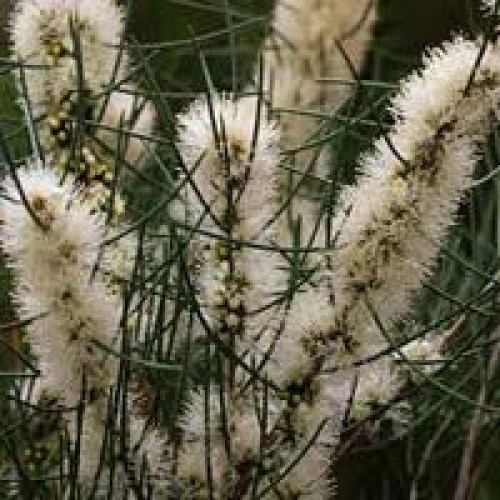
  • Flowers: Small white, cream, or pale pink flowers arranged in rounded clusters
  • Flowering Pattern: Flowers may appear along older branches, not only at the newest tips
  • Fruit: Small woody capsules that remain after flowering and hold the seeds
  • Aroma: Bright, lemony, honeyed, fresh, clean, herbaceous, and sharply clearing when the leaves are crushed or distilled
Native Habitat + Growth Conditions
  • Native To: Southwest Western Australia
  • Preferred Soil: Sandy soils, clay, and seasonally damp soils with adequate drainage
  • Sunlight: Bright, open growing conditions
  • Climate: Mediterranean-style climate with wet winters and dry summers
  • Water Relationship: Strong affinity for winter-wet depressions, swamps, and low-lying damp areas
  • Ecological Notes: Adapted to seasonal wetness, heat, challenging soils, and regeneration after environmental stress
Energetic Botanical Signature
Honey Myrtle teaches through brightness rising from wet ground. It grows in damp, swampy, seasonally saturated places, yet its aromatic expression is clean, lemony, honeyed, and sharp. That is the doctrine: the plant does not deny heaviness — it transforms it. It knows how to root in the low places, where water collects and things can stagnate, and still produce clarity, freshness, and breath.

Its narrow pointed leaves speak to focus and energetic precision, while its papery bark speaks to protection, shedding, and renewal. Even more beautifully, its flowers may emerge along older wood, not only from new growth. Honey Myrtle carries the teaching that freshness does not only come from starting over. Sometimes sweetness, clarity, and light rise from the parts of us that have already endured.
Energetics

Energetic Properties

Golden Clearing • Mental Brightness • Breath Renewal

Honey Myrtle is an oil of bright clearing.
It does not move like a soft floral. It does not sit beside you and hold your hand in the dark. It comes in like sunlight hitting a room that has been closed for too long — lemon-bright, honey-warm, sharp enough to cut through the fog, but not so cold that it feels sterile.

Energetically, Honey Myrtle speaks to the places where the field has gone stale.

The mind that keeps circling the same thought.
The room that still feels full after everyone has left.
The chest that wants a deeper breath.
The spirit that is not broken, but feels dull, congested, and coated in too much invisible residue.

Honey Myrtle clears.

Not in a brutal way. Not like bleach. Not like “burn it all down and start over.” It clears like fresh air through a window, like lemon peel crushed between the fingers, like a clean cloth over a dusty altar.

This oil is especially helpful when emotional heaviness has turned into mental fog, irritability, lethargy, or that weird internal sourness where everything feels annoying and nothing feels alive.

Honey Myrtle brings brightness back.
Not fake brightness. Not “just choose joy” nonsense. Real brightness. The kind that gives the nervous system a little more air, the mind a little more room, and the spirit enough light to remember there is still movement available.

She says:
Breathe.
Clear the room.
Stop letting old energy sit on your chest.
You are allowed to feel fresh again.

Energetic Themes
  • Clearing stale emotional residue from the body, room, or energy field
  • Supporting mental brightness when the mind feels foggy, dull, or overloaded
  • Helping release irritability, sourness, and emotional heaviness
  • Supporting breath renewal when the chest or field feels congested
  • Bringing freshness after illness, emotional processing, conflict, or long indoor stagnation
  • Helping shift lethargy without harsh stimulation
  • Supporting clarity when thoughts feel repetitive or crowded
  • Encouraging emotional reset after too much people-energy
  • Helping the spirit feel less coated, less burdened, and less trapped in stale air
  • Supporting cleansing rituals, home clearing, and energetic hygiene
  • Bringing lightness without bypassing grief, stress, or real human crap
  • Helping the body and field remember that freshness is allowed
Chakra Connections

Solar Plexus Chakra
Honey Myrtle has a strong relationship with the solar plexus because of its bright, sharp, clarifying nature.
When the solar plexus is bogged down, energy can feel heavy, cloudy, irritable, indecisive, or emotionally sour. There may be a sense of “I need to do something, but I can’t get through the fog.”

Honey Myrtle helps clear the static around the will.

It does not create false confidence. It helps remove the energetic film that makes action feel impossible. It brings light to the center of the body and helps the system remember that clarity can return one breath, one choice, one clean step at a time.

Honey Myrtle says:
I clear the fog.
I reclaim my center.
I choose the next clean step.

Heart Chakra
Honey Myrtle touches the heart through freshness.
It is not the oil for deep heart-melting grief work in the way Rose, Neroli, or Myrrh might be. It does not descend into the wound and weep with you. That is not its job.

Its medicine is different.

Honey Myrtle clears the air around the heart when the emotional field feels stale, irritated, closed-in, or heavy from too much holding. It can be supportive after conflict, after illness, after caregiving, after emotional conversations, or after a long stretch of feeling like the room has no oxygen.

It helps the heart feel less crowded.
Not fixed.
Not magically healed.
Just less trapped.
And sometimes that little bit of space is the beginning of everything.

Throat Chakra
Honey Myrtle has a strong clearing relationship with the throat and upper respiratory field.
Energetically, it may support expression when words feel stuck behind fog, fatigue, or emotional buildup. It helps clear the channel between breath and speech, especially when the throat feels tight from unsaid things, overstimulation, or stale emotional air.

This is not a soft, watery throat oil.
It is clean, lemon-bright, and direct.

Honey Myrtle helps the throat say: clear the channel, speak cleanly, stop swallowing the atmosphere of the whole damn room.

Third Eye Chakra
Honey Myrtle can be helpful for the third eye when mental fog, overthinking, or energetic clutter makes intuition feel muffled.
It does not bring the deep dream-world medicine of Mugwort or Blue Tansy. It is more like cleaning the glass.
When the mind is cluttered, the intuitive signal can feel distorted. Honey Myrtle helps freshen the mental field so perception feels clearer, lighter, and less tangled.
It supports clean seeing.
Not dramatic visions. Not mystical fireworks. Just the simple sacred relief of being able to think, sense, and notice without ten layers of static interfering.
Spiritual Use
  • Useful before rituals focused on clearing, renewal, fresh starts, and energetic hygiene
  • Supportive in house-clearing or room-clearing practices after illness, conflict, grief work, heavy conversations, or too much people-energy
  • Helpful before meditation when the mind feels foggy, dull, or crowded
  • Useful in breathwork when the chest or upper field feels stale, heavy, or congested
  • Supportive before writing, teaching, studying, or decision-making when clarity is needed
  • Helpful in solar plexus work when the will feels buried under mental clutter or emotional heaviness
  • Useful in throat chakra work when expression needs to become cleaner and more direct
  • Supportive in cleansing sprays, diffuser blends, and threshold rituals for beginning again
  • Helpful after emotional processing when the room needs to be cleared but the heart still needs kindness
  • Useful when someone needs brightness, but not spiritual bypassing dressed up as positivity
Energetic Cautions
Honey Myrtle is strong, bright, and citral-rich, so energetically it can feel too sharp when someone is raw, cracked open, grieving deeply, or in need of deep containment.

This does not make it bad medicine. It means timing matters.

If the emotional body is already tender, Honey Myrtle may need to be softened with gentler oils such as Sweet Orange, Neroli, Lavender, Rosalina, Sandalwood, or Cedarwood. Used alone or too strongly, it can feel like someone opened every window when you were still trying to find your blanket.

Honey Myrtle is best when there is stagnation, fog, stale air, emotional residue, irritability, or heaviness that needs clearing.
It is less ideal when someone needs deep mothering, quiet holding, or cocoon medicine.

This oil does not tuck you in.
It opens the windows, washes the bowl, clears the table, and says: let’s get some fresh air in here.

Honey Myrtle is golden clearing.
It helps the mind brighten, the breath return, the room reset, and the field feel less loaded. It reminds us that cleansing does not have to be cruel, and brightness does not have to be fake.

Freshness can be sacred.
A clean breath can be a beginning.

Affirmation
I clear the stale air from my body, mind, and spirit. I welcome fresh breath, clean light, and the golden clarity that helps me begin again.

Traditional & Folklore

Honey Myrtle does not come with a big temple mythology wrapped around it.

Its folklore is quieter, earthier, and more practical — rooted in Western Australia, aromatic leaves, sweet nectar, paperbark, smoke, wetland edges, and the long human relationship with Melaleuca plants as shelter, medicine, wrapping, sweetness, cleansing, and breath.

This is not a plant of Roåman crowns or Greek gods. It belongs to bush medicine, household usefulness, and the old magic of plants that help people breathe, cleanse, build, wrap, heal, and survive.

Australian Bush Medicine + Breath Folklore
  • Honey Myrtle, Melaleuca teretifolia, has traditional medicinal associations among Indigenous peoples of Western Australia.
  • The leaves were traditionally crushed so the vapors could be inhaled for colds and headaches.
  • Leaf infusions were also used for congestion, colds, and headaches.
  • Bark preparations were soaked and applied to wounds.
  • That places Honey Myrtle in the folklore of breath, clearing, wound-tending, and practical plant medicine.
  • This is not decorative folklore.
  • This is the old human truth: when the head is heavy, when the breath is blocked, when the skin needs tending, the plant offers scent, vapor, water, bark, and care. 
Honey, Nectar + Sweetness
  • The name Honey Myrtle points to the sweetness associated with many Melaleuca flowers.
  • Melaleuca flowers can produce sweet nectar, and some Australian bush-food sources describe sucking nectar from the flowers or soaking flowers in water to make a sweet drink.
  • That gives Honey Myrtle a folklore thread of sweetness drawn from wild places.
  • Not sugar-bowl sweetness.
  • Field sweetness. Flower sweetness. Nectar found in the middle of heat, wet ground, and survival.
  • Symbolically, this gives Honey Myrtle an important energetic teaching: even cleansing plants can carry sweetness.
  • It clears, yes.
  • But it does not clear like punishment.
  • It clears with a little honey in its hands.
Paperbark, Wrapping + Protection
  • Honey Myrtle belongs to the larger Melaleuca lineage, many of which are known as paperbarks or tea trees.
  • Across different Melaleuca species, Aboriginal Australians used bark for practical purposes such as shelter, bandages, wrapping, roofing, and food preparation.
  • I would be careful here: this does not mean every one of those uses belongs specifically to Melaleuca teretifolia.
  • But it does place Honey Myrtle in a wider plant-family folklore of protection, covering, wrapping, tending, and shelter.
  • Paperbark medicine is deeply symbolic.
  • It says: some layers protect life. Some layers wrap the wound. Some layers shelter the fire until it is safe to burn again. 
Wetland Edge + Swamp-Light Symbolism
  • Honey Myrtle is also called Marsh Honey Myrtle, and it grows naturally in moist, poorly drained soils and winter-wet or swampy places in southwest Western Australia.
  • This gives the plant a strong symbolic relationship with the wetland edge — the place between water and land, stagnation and renewal, heaviness and breath.
  • Folklorically, wetland plants often carry liminal energy because they grow where boundaries blur.
  • Honey Myrtle’s specific medicine is that it rises from damp, low ground with a bright lemon-honey scent.
  • That is the plant’s magic.
  • It does not reject the swamp.
  • It transforms it.
  • It turns heavy ground into clear breath.
Clearing, Smoke + Household Freshness
  • Honey Myrtle’s strong lemony scent connects it to the old practical magic of aromatic plants used to freshen, clear, and shift the feeling of a space.
  • While I would not claim a specific ancient smoke-ceremony tradition for Honey Myrtle unless we have a solid source, the plant’s aromatic profile clearly places it in the household folklore of cleansing and air renewal.
  • The leaves, vapors, and infusions all point in the same direction:
    • clear the head
    • clear the breath
    • clear the room
    • clear what has gone stale
  • This is broom-and-window magic.
  • Wash the bowl.
  • Open the door.
  • Let the sour air leave.
  • Honey Myrtle is not here to make a spiritual production out of freshness. It is here to get the room breathing again.
Luck, Prosperity + “Honey” Symbolism
  • There is not strong evidence that Honey Myrtle specifically carried a formal “luck” or “prosperity” tradition like Basil, Cinnamon, Ginger, or Bay.
  • But symbolically, honey and nectar have long been associated across cultures with blessing, sweetness, attraction, pleasure, and the generosity of nature.
  • For Honey Myrtle, I would keep this as symbolic interpretation rather than historical claim.
  • Its honey note suggests:
    • sweetness after clearing
    • attraction without force
    • emotional softening
    • blessing through freshness
    • the return of something pleasant after heaviness
  • The medicine is not “this plant brings money.”
  • The medicine is: clear the stale air so sweetness can return.
The Folklore Medicine
  • Honey Myrtle’s folklore is not grand and dramatic.
  • It is practical, bright, and alive.
  • It is the folklore of crushed leaves for breath, infusions for congestion, bark for wounds, nectar sweetness, paperbark protection, and marsh plants that know how to rise clean from wet ground.
  • It belongs to the old sacred work of tending the body and the home:
    • breathe easier
    • cleanse the wound
    • sweeten the field
    • protect what is tender
    • clear what has gone stale
    • let fresh air return
Honey Myrtle says: open the window, wash the wound, take in the sweetness, and let the old heaviness leave the room.
Chemistry

Chemical Components

Honey Myrtle essential oil has a bright, lemony, honeyed chemistry that explains why it feels so clearing, sharp, fresh, and mentally awakening.

It is not just “citrus-like.” It is citral-rich, which means its aroma is strongly shaped by the aldehydes geranial and neral — the same citral components that give oils like Lemon Myrtle, Lemongrass, May Chang, and Lemon Tea Tree their intense lemony brightness.

Honey Myrtle, Melaleuca teretifolia, is especially interesting because it is a Melaleuca that does not smell like the classic Tea Tree lane. It has its own bright lemon-honey profile. Commercial Honey Myrtle oil is commonly described as containing about 65–72% citral, with smaller amounts of myrcene, geraniol, isocitral, limonene, alpha-pinene, and linalool, depending on chemotype, source, and distillation. 

There are also different chemovars of Melaleuca teretifolia. Research on wild Western Australian material found both citral-rich and 1,8-cineole-rich forms, which means the chemistry can shift depending on plant genetics and source. This matters because not every “Honey Myrtle” oil is automatically the same chemical creature. 

That’s the chemistry of Honey Myrtle’s gift: lemon brightness with antimicrobial-leaning strength, respiratory freshness, atmospheric clearing, and mental clarity — but also skin-sensitivity potential if someone uses it like more is better. More is not better. More is how your skin starts cussing you out.

Main Chemical Families

Aldehydes
  • Honey Myrtle essential oil is primarily shaped by monoterpene aldehydes, especially the citral components geranial and neral.
  • These constituents give Honey Myrtle its:
    • Strong lemony aroma
    • Bright top note
    • Sharp clearing quality
    • Fresh, clean, penetrating scent
    • Antimicrobial-oriented aromatic profile
  • Aldehyde-rich oils are often used in cleansing, deodorizing, respiratory, and atmospheric clearing blends.
  • They can also be more irritating to the skin and mucous membranes than softer oil families.
  • This is why Honey Myrtle belongs in low dilution, not in “dump half the bottle in because we’re spiritually disinfecting the house” territory.
Energetically, the aldehydes are the blade of light in Honey Myrtle. They cut through fog, funk, and stale emotional air.

Citral: Geranial + Neral
  • Citral is not one single molecule, but a natural mixture of two isomers:
    • Geranial
    • Neral
  • In Honey Myrtle, citral is the dominant aromatic force.
  • Geranial tends to smell sharper, brighter, and more forceful.
  • Neral tends to feel slightly softer, rounder, and more lemon-peel-like.
  • Together, they create the intense lemon-honey brightness Honey Myrtle is known for.
  • Citral-rich Honey Myrtle may support:
    • Respiratory freshness
    • Deodorizing blends
    • Cleansing aromatic formulas
    • Mental clarity
    • Seasonal wellness blends
    • Stale-air clearing
    • Body and foot freshness formulas
  • Citral also brings the main safety caution: possible skin irritation or sensitization when used too strong.
This is the heart of Honey Myrtle chemistry: bright, clean, direct, and not here to be subtle.

Monoterpenes
  • Honey Myrtle may contain monoterpenes such as myrcene, limonene, and alpha-pinene, depending on the oil.
  • Paperbark Oils lists myrcene around 9–11% in typical Honey Myrtle oil, with smaller amounts of limonene and alpha-pinene. 
  • These lighter constituents help contribute to:
    • Diffusion
    • Freshness
    • Air movement
    • Brightness
    • Atmospheric clearing
    • The lively top-note character of the oil
  • Myrcene may add a softer, green, slightly balsamic depth beneath the sharp citral brightness.
  • Limonene supports the citrus-like lift.
  • Alpha-pinene adds a fresh, clean, airy quality.
Energetically, the monoterpenes are the air and movement under the lemon blade. They keep Honey Myrtle from feeling flat or one-dimensional.

Alcohols
  • Honey Myrtle may contain small amounts of geraniol, linalool, and nerol.
  • These constituents can soften the aroma slightly and add floral, fresh, or gently sweet undertones.
  • They may contribute to:
    • The honeyed softness
    • A light floral nuance
    • Emotional balance
    • Skin-supportive aromatic impressions
    • A smoother finish beneath the sharper citral
  • These are not the dominant chemistry in Honey Myrtle, but they matter.
  • They help explain why Honey Myrtle can smell less harsh than some other strong lemony oils.
Energetically, the alcohols are the golden edge. They keep the clearing from feeling cruel.

1,8-Cineole Chemovar Note
  • Some Melaleuca teretifolia material has been identified as 1,8-cineole-rich, while other material is citral-rich.
  • One study of Western Australian Melaleuca teretifolia chemotypes reported a cineole-rich form at approximately 84% 1,8-cineole, while another form was identified as a citral source. 
  • This means the exact GC/MS matters.
  • For Stillpoint’s Honey Myrtle profile, we are describing the familiar citral-rich Honey Myrtle aromatic type unless your supplier GC/MS says otherwise.
  • If the GC/MS shows unusually high 1,8-cineole, the therapeutic and safety language should shift more toward eucalyptus-like respiratory chemistry.
This is the part where the plant reminds us not to get cocky. Same botanical name does not always mean same chemistry.

Therapeutic Implications of This Chemistry

Respiratory freshness:
  • The citral-rich, lemony aldehyde profile supports Honey Myrtle’s use in respiratory freshness blends, diffuser blends, shower blends, and inhalers when the breath or air feels stale, heavy, or congested.
Cleansing + antimicrobial-oriented use:
  • Citral-rich oils are often valued for cleansing and antimicrobial-oriented aromatic applications, and Honey Myrtle’s high citral profile makes this one of its strongest practical lanes.
Seasonal wellness:
  • Honey Myrtle may be useful in seasonal diffuser blends, room sprays, and wellness support formulas when the home or body needs a bright, clean aromatic reset.
Deodorizing:
  • The sharp lemon-honey aroma makes Honey Myrtle excellent in deodorizing blends for rooms, feet, linens, bathrooms, kitchens, and stale indoor air.
Skin + topical freshness:
  • Honey Myrtle may be useful in very low dilution for topical cleansing, foot blends, scalp freshness, and body-care formulas, but the citral content means it must be used with respect.
Mental clarity:
  • The bright aldehyde profile may support focus, alertness, and mental clearing when the mind feels foggy, dull, crowded, or heavy.
Emotional clearing:
  • Energetically, this chemistry supports the release of stale emotional residue, irritability, sluggishness, and “closed room” energy.
  • It brings brightness without pretending everything is sweet.
This chemistry does not cuddle the system.
It clears, sharpens, freshens, and wakes things up.

Honey Myrtle is lemon light with a honeyed edge — bright enough to cut through heaviness, warm enough to keep the clearing from feeling sterile, and strong enough to remind the whole field that fresh air is medicine.
Recipes & Blends

Recipes & Blends

Bright Breath Room + Chest Blend
Physical Support | Respiratory Freshness + Seasonal Clearing
  • Honey Myrtle Essential Oil (Melaleuca teretifolia): 5 drops
  • Rosalina Essential Oil (Melaleuca ericifolia): 10 drops
  • Eucalyptus Radiata Essential Oil (Eucalyptus radiata): 6 drops
  • Black Spruce Essential Oil (Picea mariana): 7 drops
  • Sweet Orange Essential Oil (Citrus sinensis): 12 drops
This blend is designed for respiratory freshness, seasonal clearing, and spaces that feel heavy, stale, or loaded with cold-season funk.
  • Honey Myrtle brings bright lemony clearing and sharp aromatic freshness
  • Rosalina supports gentle respiratory comfort with a softer Melaleuca profile
  • Eucalyptus Radiata supports clear breathing and open-air movement
  • Black Spruce brings energetic backbone and forest-like respiratory support
  • Sweet Orange softens the sharper edges and brings warmth, brightness, and comfort
Use in a diffuser, personal inhaler, shower steam blend, or very low dilution chest blend. For topical use, dilute well. Because Honey Myrtle is citral-rich, keep topical dilution low, especially for sensitive skin.


Fresh Feet + Body Clean Blend
Physical Support | Deodorizing + Skin Freshness
  • Honey Myrtle Essential Oil (Melaleuca teretifolia): 4 drops
  • Tea Tree Essential Oil (Melaleuca alternifolia): 8 drops
  • Palmarosa Essential Oil (Cymbopogon martinii var. motia): 7 drops
  • Cedarwood Virginia Essential Oil (Juniperus virginiana): 8 drops
  • Peppermint Essential Oil (Mentha × piperita): 5 drops
  • Lavender Essential Oil (Lavandula angustifolia): 8 drops
This blend is for feet, body freshness, scalp freshness, and deodorizing body-care formulas when things need to feel cleaner, brighter, and less funky.
  • Honey Myrtle brings lemony cleansing and deodorizing power
  • Tea Tree supports classic topical cleansing care
  • Palmarosa brings skin-supportive freshness and a softer floral-green balance
  • Cedarwood Virginia adds dry, grounding, deodorizing depth
  • Peppermint brings cool freshness and a clean sensory lift
  • Lavender supports skin comfort and helps soften the sharper cleansing oils
Dilute before topical use. A 1% dilution is generally appropriate for body freshness blends; use lower for sensitive skin. Avoid broken, irritated, inflamed, or freshly shaved skin. This is not a “more is better” blend. This is a “respect the citral and don’t start shit with your skin” blend.


Clean Light Ritual Blend
Energetic Support | Field Clearing + Fresh Starts
  • Honey Myrtle Essential Oil (Melaleuca teretifolia): 5 drops
  • Fragonia Essential Oil (Agonis fragrans): 8 drops
  • Lemon Verbena Essential Oil (Aloysia citriodora): 2 drops
  • Ho Wood Essential Oil (Cinnamomum camphora ct. linalool): 10 drops
  • Cedarwood Atlas Essential Oil (Cedrus atlantica): 6 drops
  • Green Mandarin Essential Oil (Citrus reticulata): 9 drops
This blend is for clearing the field after illness, conflict, heavy conversations, too much people-energy, or any time the room feels like it has been holding its breath.
  • Honey Myrtle clears stale energy and brings sharp lemon-honey brightness
  • Fragonia supports emotional harmony and energetic balance
  • Lemon Verbena adds a piercing, luminous clarity — use lightly because she is not subtle
  • Ho Wood softens the nervous system and keeps the blend from becoming too sharp
  • Cedarwood Atlas grounds the clearing into the body
  • Green Mandarin brings fresh emotional movement and gentle hope
Use before ritual, journaling, house clearing, meditation, or after emotionally loaded work. Dilute before applying to pulse points, chest, back of neck, feet, or solar plexus. Because both Honey Myrtle and Lemon Verbena can be skin-irritating if overused, this blend should stay at a low topical dilution.


Golden Breath Threshold Blend
Energetic Support | Mental Fog + Breath Renewal
  • Honey Myrtle Essential Oil (Melaleuca teretifolia): 4 drops
  • Rhododendron Essential Oil (Rhododendron anthopogon): 6 drops
  • Cardamom Essential Oil (Elettaria cardamomum): 5 drops
  • Frankincense Essential Oil (Boswellia carterii): 7 drops
  • Neroli Essential Oil (Citrus aurantium var. amara): 3 drops
  • Siberian Fir Essential Oil (Abies sibirica): 8 drops
  • Lime Essential Oil (Citrus aurantifolia): 7 drops
This blend is for the moment when the mind feels foggy, the breath feels shallow, and the spirit needs a clean doorway back into itself.
  • Honey Myrtle brings bright clearing and golden freshness
  • Rhododendron opens spaciousness around the breath and upper field
  • Cardamom brings warmth, courage, and gentle movement through the chest and belly
  • Frankincense supports breath, stillness, and spiritual focus
  • Neroli brings tenderness to the heart and nervous system
  • Siberian Fir strengthens the breath and supports uprightness
  • Lime brings bright movement, clarity, and emotional freshness
Use before breathwork, meditation, teaching, threshold rituals, or any practice where clarity and fresh air are needed. Dilute well before topical use. If using expressed Lime, avoid sun or UV exposure on the area of application after topical use unless the oil is steam distilled or otherwise non-phototoxic.


Affirmation
I clear the stale air from my body, mind, and spirit. I welcome fresh breath, clean light, and the golden clarity that helps me begin again.
Safety Etc.

Safety Information

Honey Myrtle essential oil is a strong, citral-rich oil and should be used with care. It is bright, beautiful, and useful — but it is not a casual “dump it in everything” oil. The main concern is skin irritation or sensitization, especially if used too strong.

Topical Use
  • Dilute before applying to the skin.
  • General adult dilution: 0.5–1%.
  • For sensitive skin: 0.25–0.5%.
  • Avoid high dilution topical use.
  • Avoid applying undiluted.
  • Avoid broken, irritated, inflamed, or freshly shaved skin.
  • Patch testing is recommended.
Skin Sensitivity
  • Honey Myrtle is rich in citral, which can be irritating to sensitive skin.
  • Use extra caution with people who have:
    • Sensitive skin
    • Fragrance sensitivity
    • Eczema-prone skin
    • Dermatitis
    • History of essential oil reactions
    • Reactive or easily irritated skin
  • Discontinue use if redness, burning, itching, rash, or discomfort occurs.
  • Low dilution is the friend here. More is not better. More is how the skin starts yelling.
Phototoxicity
  • Honey Myrtle essential oil is not known to be phototoxic.
Diffusion + Inhalation
  • Use in short intervals.
  • Diffuse in a well-ventilated space.
  • Use less than you think you need.
  • Avoid prolonged diffusion around children, pets, elderly individuals, or anyone with respiratory sensitivity.
  • Because Honey Myrtle is strong and lemony, it can become overwhelming if overused.
Internal Use
  • Internal use is not recommended unless supervised by a qualified practitioner trained in aromatic medicine.
Pregnancy & Lactation
  • Use cautiously during pregnancy and lactation.
  • Avoid heavy or frequent use.
  • Use very low dilution only.
  • Avoid use during pregnancy unless guided by a qualified practitioner.
Pediatric Use
  • Use cautiously with children.
  • Avoid use with infants and very young children unless guided by a qualified practitioner.
  • Use very low dilution only.
  • Avoid applying near the face, mouth, nose, eyes, or hands.
  • Diffuse only with good ventilation and for short periods.
Medical Considerations
Use caution with:
  • Very sensitive skin
  • Fragrance allergies
  • Asthma or respiratory sensitivity
  • Active dermatitis, eczema, or inflammatory skin conditions
  • Pregnancy or lactation
  • Individuals under medical care or on multiple medications
Pets
  • Use thoughtful care around animals.
  • Do not apply directly to pets unless guided by a qualified animal aromatherapy professional.
  • Use good ventilation if diffusing.
  • Allow animals to leave the room.
  • Avoid diffusing around birds.
  • Keep bottles out of reach.
Storage
  • Store in a cool, dark place.
  • Keep away from heat, light, and oxygen.
  • Keep the cap tightly closed.
  • Keep out of reach of children and pets.
General Safety Note
Honey Myrtle is clearing, bright, and powerful. Its main safety issue is not mystery — it is strength. Use it low, use it wisely, and respect the citral. A little Honey Myrtle goes a long way, and honestly, that’s part of its medicine.

References

  • Australian Native Plants Society Australia.Melaleuca teretifolia.”
    Useful for physical plant description, leaves, flowers, growth form, and Australian native plant context.
  • Battaglia, Salvatore. The Complete Guide to Aromatherapy, 3rd ed., Vol. I: Foundations & Materia Medica. Black Pepper Creative, 2018.
  • Brophy, J. J., Craven, L. A., & Doran, J. C. Melaleucas: Their Botany, Essential Oils and Uses. Australian Centre for International Agricultural Research, 2013.
    Excellent Australian reference for the Melaleuca genus, botany, essential oils, and practical uses across species.
  • Carson, C. F., Hammer, K. A., & Riley, T. V.Melaleuca alternifolia — Tea Tree Oil: A Review of Antimicrobial and Other Medicinal Properties.” Clinical Microbiology Reviews, 2006.
    Useful for broader Melaleuca antimicrobial context, not as direct Honey Myrtle evidence.
  • Dosoky, N. S., et al. “Maternal Reproductive Toxicity of Some Essential Oils and Their Constituents.” International Journal of Molecular Sciences, 2021.
    Useful for citral safety context.
  • Down Under Enterprises. “Honey Myrtle: The Tea Tree Special to Western Australia.”
    Useful for Australian industry context, Indigenous name Banbar, Western Australian origin, and traditional-use notes.
  • FloraBase — Western Australian Herbarium.Melaleuca teretifolia.” Department of Biodiversity, Conservation and Attractions, Western Australia.
    Strong source for native range, habitat, flowering, and growth conditions.
  • Holmes, Peter. Aromatica: A Clinical Guide to Essential Oil Therapeutics, Volumes 1 and 2. Singing Dragon.
  • Kairey, L., et al. “Efficacy and Safety of Melaleuca alternifolia Tea Tree Oil for Human Health Outcomes.” Frontiers in Pharmacology, 2023.
    Current safety and clinical context for Tea Tree oil; use only as broader Melaleuca comparison.
  • Orchard, A., et al. “Commercial Essential Oils as Potential Antimicrobials to Treat Skin Diseases.” Evidence-Based Complementary and Alternative Medicine, 2017.
    Useful for antimicrobial and skin-relevant essential oil context.
  • Paperbark Oils. “Honey Myrtle Oil.”
    Useful Australian supplier/industry source for Honey Myrtle oil, plant part, INCI, and typical chemistry.
  • Rhind, Jennifer Peace. Essential Oils: A Handbook for Aromatherapy Practice. Singing Dragon.
  • Rhind, Jennifer Peace. Fragrance and Wellbeing: Plant Aromatics and Their Influence on the Psyche. Singing Dragon.
  • Southwell, I. A.Backhousia citriodora F. Muell. — Lemon Myrtle, an Unrivalled Source of Citral.” Molecules, 2021.
    Useful for citral-rich Australian lemon-scented oils and comparison with Lemon Myrtle.
  • Southwell, I., Russell, M., Smith, R. L., Brophy, J. J., & Day, J.Melaleuca teretifolia, a Novel Aromatic and Medicinal Plant from Australia.” Acta Horticulturae, 2005.
    Important for Honey Myrtle specifically, including Melaleuca teretifolia, Banbar/Marsh Honey Myrtle, Australian origin, chemotypes, citral, 1,8-cineole, and chemical variation.
  • Tisserand, Robert, and Rodney Young. Essential Oil Safety: A Guide for Health Care Professionals. 2nd ed., Churchill Livingstone Elsevier, 2014.

Reviews (2)

Write a review

Note: HTML is not translated!
    Bad           Good
Powered By OpenCart
Stillpoint Aromatics © 2026