
Personal Use
Distilled from the needles of the rare and high-altitude Corkbark Fir, this oil offers a breath of sacred forest air—clean, elevating, and grounding all at once. Native to the subalpine forests of the American Southwest, this particular variety of Abies lasiocarpa is known for its silver-blue needles, resin-rich wood, and vibrant resilience at extreme elevations. Its aroma is crisp, coniferous, and gently balsamic—like sunlight through pine branches after snowfall.
Corkbark Fir connects breath to spirit, body to earth. Used in ceremony and ritual by Indigenous peoples of the Southwest, this tree carries both medicine and memory. Stillpoint’s limited reserve distillation was done with deep respect, in small quantities, and offered only when available. This is not just a fir oil—it’s a communion with alpine stillness.
Respiratory Support:
Corkbark Fir’s clean, expansive aroma may help open the lungs, deepen the breath, and ease mild congestion or tightness in the chest. Its expectorant and bronchodilating properties make it a supportive ally during seasonal respiratory challenges or emotional contraction.
Corkbark Fir’s clean, expansive aroma may help open the lungs, deepen the breath, and ease mild congestion or tightness in the chest. Its expectorant and bronchodilating properties make it a supportive ally during seasonal respiratory challenges or emotional contraction.
Muscle and Joint Comfort:
Traditionally used in forest medicine to ease physical discomfort, this fir oil may assist with sore muscles, stiffness, or overuse. It can be blended into massage oils or used in compresses for its mild analgesic and anti-inflammatory qualities.
Traditionally used in forest medicine to ease physical discomfort, this fir oil may assist with sore muscles, stiffness, or overuse. It can be blended into massage oils or used in compresses for its mild analgesic and anti-inflammatory qualities.
Adrenal and Nervous System Restoration:
Corkbark Fir’s scent is both uplifting and stabilizing. It may help reduce the effects of stress, tension, and emotional depletion by supporting the adrenals and grounding the nervous system. This is a go-to oil for emotional fatigue, overwhelm, and feeling energetically “scattered.”
Corkbark Fir’s scent is both uplifting and stabilizing. It may help reduce the effects of stress, tension, and emotional depletion by supporting the adrenals and grounding the nervous system. This is a go-to oil for emotional fatigue, overwhelm, and feeling energetically “scattered.”
Immune and Energetic Resilience:
Its antimicrobial properties paired with its vibrational strength make it ideal for diffusing or using in bath blends during times of immune stress or recovery. It helps create a boundary of strength, both physically and energetically.
Its antimicrobial properties paired with its vibrational strength make it ideal for diffusing or using in bath blends during times of immune stress or recovery. It helps create a boundary of strength, both physically and energetically.
Skin Support and Wound Care:
With its gentle antiseptic and regenerative qualities, Corkbark Fir may support minor skin concerns such as abrasions or dry, irritated skin when properly diluted. Its fresh scent and purifying action also make it a welcome addition to cleansers and balms.
With its gentle antiseptic and regenerative qualities, Corkbark Fir may support minor skin concerns such as abrasions or dry, irritated skin when properly diluted. Its fresh scent and purifying action also make it a welcome addition to cleansers and balms.
Traditional Use
Corkbark Fir has long been used in Indigenous and traditional forest medicine as both a physical remedy and a spiritual ally. Known for thriving in extreme subalpine environments—often over 9,000 feet in elevation—this tree was seen as a bridge between worlds, carrying the clarity of sky and the grounding of earth.
Breath, Lungs, and Vital Force:
Native peoples of the Southwest and Pacific Northwest used fir needles, resin, and bark in steam inhalations, teas, and poultices to support respiratory health. The tree was called on to ease cough, clear lung congestion, and restore vitality to those weakened by illness or harsh environmental conditions. Its connection to the lungs was also seen energetically—as a way to release grief, expand breath, and reconnect with life force.
Wound Cleansing and Protection:
The resin and needle infusions were also used traditionally to cleanse wounds, soothe skin irritations, and reduce inflammation. Applied externally, it was believed to purify and protect the body, accelerating healing and warding off infection.
Ritual, Ceremony, and Energetic Clearing:
Burned as incense or used in ceremonial bundles, Corkbark Fir was valued for its ability to clear negative energy and call in clarity. It was often part of ritual purification, grounding, and visioning practices, particularly when spiritual guidance or ancestral connection was needed.
Symbol of Resilience and Renewal:
Because it grows where few others can—on steep slopes, rocky ridges, and in snow-covered terrain—Corkbark Fir became a symbol of endurance, adaptability, and high-altitude clarity. Its medicine was believed to help people reclaim strength after hardship, anchor into their purpose, and breathe new life into the spirit after emotional loss or depletion.
Botany
Corkbark Fir (Abies lasiocarpa var. arizonica) is a rare, high-altitude subspecies of Subalpine Fir found in the rugged mountainous regions of the southwestern United States, particularly in northern Arizona and parts of New Mexico. Belonging to the Pinaceae family, it is one of the few firs adapted to survive at extreme elevations—often above 9,000 feet—where cold, wind, and thin air dominate.
Botanical Name: Abies lasiocarpa var. arizonica
Family: Pinaceae
Common Names: Corkbark Fir, Subalpine Fir (Arizona variety)
Plant Type: Evergreen coniferous tree
Part Used: Needles and small branches (steam distilled)
Common Names: Corkbark Fir, Subalpine Fir (Arizona variety)
Plant Type: Evergreen coniferous tree
Part Used: Needles and small branches (steam distilled)
Physical Characteristics
-
Height: Typically reaches 30–60 feet (10–18 meters), though often stunted at higher elevations due to wind exposure
-
Bark: Distinctive light gray to silvery-white and thick—almost “cork-like” in texture, giving the tree its common name
-
Needles: Short, soft, and silver-blue to deep green; grow in a spiral arrangement around the branch, creating a dense, cushiony texture
-
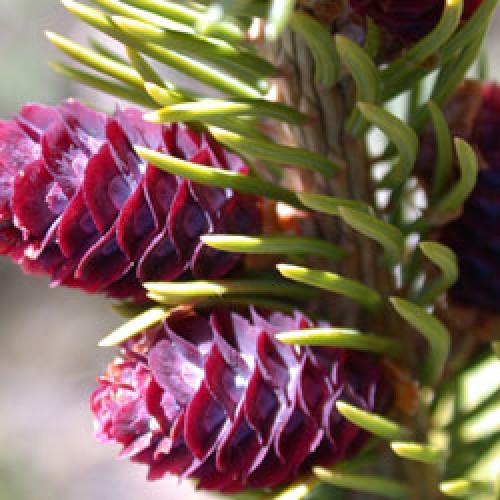
Cones: Upright, cylindrical, and purplish when immature—disintegrate on the tree to release seeds
Native Habitat and Growth Conditions
-
Native Region: High-elevation forests of Arizona, New Mexico, and southern Colorado
-
Preferred Environment: Cold, subalpine climates with full sun and well-drained rocky or volcanic soils
-
Ecological Role: Often one of the last tree species before the tree line, Corkbark Fir plays a key role in stabilizing alpine ecosystems and providing habitat for high-altitude wildlife
