
Suggested Uses
-
2nd Chakra – Relationships, Creation Energy
-
3rd Chakra – Personal Power
-
4th Chakra – Unconditional Love
-
6th Chakra – Perspective (especially for balancing inner and outer vision)
And for the energetic themes:
-
Balancing
-
Clarity
-
Energizing (especially chi and spirit restoration)
-
Grounding
-
Introspective
-
Protective
-
Purifying
-
Transformative
-
Uplifting
Personal Use
This isn’t your average berry. Stillpoint’s Schisandra CO₂ extract opens like an ancient forest waking at dawn—earthy, tart, slightly resinous, and distinctly medicinal. She greets the nose with a deep, fermented sourness—almost vinegary at first sniff—but it softens quickly into something warmer, fruit-leathered, and strangely comforting. There’s a trace of dried plum, sun-warmed bark, and the shadow of smoke trailing behind it all.
This is the scent of survival and wisdom—a five-flavored fruit with a five-element soul. Known in Chinese medicine to encompass all taste profiles (sweet, sour, salty, bitter, pungent), Schisandra is complex, layered, and hard to pin down. That truth carries in her aromatic fingerprint. She doesn’t fall neatly into floral, fruity, or herbaceous. She belongs to all—and none.
Our extract is made from the dried fruits of organically grown Schisandra chinensis, using a total CO₂ extraction method that preserves both volatile and non-volatile compounds. It holds a dense, almost chewy aroma—low-toned and somatic, more root than candy. This isn’t a perfume oil. It’s plant medicine, potent and unapologetic.
Use her when you need your body to remember what strength feels like—not the performative kind, but the cellular, grounded kind that builds from the blood outward.
Therapeutic Applications
Schisandra may be best known as an adaptogen, but she’s so much more than a “stress herb.” This CO₂ extract is a powerhouse of support for the liver, lungs, nervous system, and skin—offering whole-body resilience with deep biochemical intelligence. In Traditional Chinese Medicine (TCM), she’s known for “calming the heart and quieting the spirit,” while simultaneously enhancing energy, mental focus, and physical endurance.
Here’s what she may support:
1. Liver Support + Detoxification
Schisandra is considered hepatoprotective, meaning she helps protect and regenerate liver cells. Rich in lignans like schisandrin and gomisin, she may help the liver detoxify environmental pollutants, pharmaceuticals, and metabolic waste—making this extract a key ally for liver-cleansing blends or long-term constitutional support.
Schisandra is considered hepatoprotective, meaning she helps protect and regenerate liver cells. Rich in lignans like schisandrin and gomisin, she may help the liver detoxify environmental pollutants, pharmaceuticals, and metabolic waste—making this extract a key ally for liver-cleansing blends or long-term constitutional support.
2. Stress + Adrenal Regulation
As a revered adaptogen, Schisandra may help modulate the HPA axis—supporting adrenal resilience, balancing cortisol levels, and enhancing the body’s response to stress. Unlike some stimulating adaptogens, she offers steady, sustainable energy without creating overdrive or crash.
As a revered adaptogen, Schisandra may help modulate the HPA axis—supporting adrenal resilience, balancing cortisol levels, and enhancing the body’s response to stress. Unlike some stimulating adaptogens, she offers steady, sustainable energy without creating overdrive or crash.
3. Respiratory Tonic
In TCM, Schisandra is used to tonify the lungs, reduce coughing, and soothe wheezing—especially in chronic respiratory conditions with deficiency or weakness. Her moistening and astringent properties may help ease dry, irritated lungs and rebuild vitality over time.
In TCM, Schisandra is used to tonify the lungs, reduce coughing, and soothe wheezing—especially in chronic respiratory conditions with deficiency or weakness. Her moistening and astringent properties may help ease dry, irritated lungs and rebuild vitality over time.
4. Mental Focus + Cognitive Clarity
This extract is known for improving concentration, memory, and alertness—particularly when fog, fatigue, or low motivation are present. Schisandra may support neurotransmitter balance and cerebral circulation, making her a strong addition to brain health or productivity blends.
This extract is known for improving concentration, memory, and alertness—particularly when fog, fatigue, or low motivation are present. Schisandra may support neurotransmitter balance and cerebral circulation, making her a strong addition to brain health or productivity blends.
5. Skin + Beauty from Within
Through her liver-supportive and antioxidant actions, Schisandra may indirectly improve skin clarity, tone, and resilience. She’s often used in TCM beauty formulas to nourish the blood, tonify Qi, and promote radiant, clear skin.
Through her liver-supportive and antioxidant actions, Schisandra may indirectly improve skin clarity, tone, and resilience. She’s often used in TCM beauty formulas to nourish the blood, tonify Qi, and promote radiant, clear skin.
6. Immune Support + Vitality
Traditionally used to “secure the essence,” Schisandra may strengthen immunity, support sexual vitality, and reduce burnout or exhaustion—especially when depletion or long-term stress is the root cause.
Traditionally used to “secure the essence,” Schisandra may strengthen immunity, support sexual vitality, and reduce burnout or exhaustion—especially when depletion or long-term stress is the root cause.
Traditional Use
Schisandra has earned her place in nearly every corner of classical herbal medicine. In Traditional Chinese Medicine (TCM), she’s one of the few herbs known to “enter all five organs,” offering multi-system support that’s both profound and precise. Her name in Chinese—Wu Wei Zi, meaning "Five Flavor Fruit"—reflects her complexity and completeness. From the lungs to the liver, the womb to the heart, she has long been used to preserve vitality, clear fatigue, and restore balance when life’s demands have taken their toll.
Liver Protection + Vital Energy
In TCM, Schisandra has been revered for centuries as a premier liver tonic. She was traditionally used to regenerate Qi, protect liver function, and support detoxification. Schisandra berries were prescribed for jaundice, poor appetite, and chronic fatigue—especially in those with depleted Qi or “damp heat” in the liver.
In TCM, Schisandra has been revered for centuries as a premier liver tonic. She was traditionally used to regenerate Qi, protect liver function, and support detoxification. Schisandra berries were prescribed for jaundice, poor appetite, and chronic fatigue—especially in those with depleted Qi or “damp heat” in the liver.
Lung + Respiratory Restoration
She was often used to stop chronic coughs, wheezing, and shortness of breath—especially in conditions marked by deficiency or dryness. Folk formulas included her to “secure the Lung Qi” and build strength in those recovering from long illness, asthma, or tuberculosis-like symptoms.
She was often used to stop chronic coughs, wheezing, and shortness of breath—especially in conditions marked by deficiency or dryness. Folk formulas included her to “secure the Lung Qi” and build strength in those recovering from long illness, asthma, or tuberculosis-like symptoms.
Sexual + Reproductive Resilience
In Chinese, Mongolian, and Tibetan traditions, Schisandra was considered a sexual and reproductive tonic—used to increase fertility, support the Kidney Jing (essence), and regulate menstrual cycles. Postpartum women were often given Schisandra in decoctions to restore strength, rebuild blood, and stabilize mood.
In Chinese, Mongolian, and Tibetan traditions, Schisandra was considered a sexual and reproductive tonic—used to increase fertility, support the Kidney Jing (essence), and regulate menstrual cycles. Postpartum women were often given Schisandra in decoctions to restore strength, rebuild blood, and stabilize mood.
Cognitive Clarity + Emotional Balance
Practitioners of ancient Daoist medicine turned to Schisandra to “calm the Heart and quiet the Spirit.” She was said to bring sharpness to the mind, composure to the emotions, and endurance to the will. Students, monks, and martial artists used her to strengthen focus, memory, and meditative presence.
Practitioners of ancient Daoist medicine turned to Schisandra to “calm the Heart and quiet the Spirit.” She was said to bring sharpness to the mind, composure to the emotions, and endurance to the will. Students, monks, and martial artists used her to strengthen focus, memory, and meditative presence.
Longevity + Preservation of Essence
Schisandra’s reputation as a “life-preserving berry” extended through royal courts, healing temples, and local apothecaries. In longevity tonics, she was prized not just for her effect on energy and immunity, but for her ability to preserve the body’s essence—Jing—particularly when depletion or chronic stress was present.
Schisandra’s reputation as a “life-preserving berry” extended through royal courts, healing temples, and local apothecaries. In longevity tonics, she was prized not just for her effect on energy and immunity, but for her ability to preserve the body’s essence—Jing—particularly when depletion or chronic stress was present.
Culinary + Spiritual Use
Schisandra was also included in fortified wines, elixirs, and ceremonial teas—especially in rituals for grounding, protection, and inner balance. In Siberian and Taoist traditions, she was thought to shield the spirit while awakening the higher mind.
Schisandra was also included in fortified wines, elixirs, and ceremonial teas—especially in rituals for grounding, protection, and inner balance. In Siberian and Taoist traditions, she was thought to shield the spirit while awakening the higher mind.
Botany
Schisandra chinensis, commonly known as Schisandra, Wu Wei Zi, or Five-Flavor Berry, is a deciduous woody vine in the Schisandraceae family. She climbs with quiet determination, coiling herself up trees in forests across northeastern China, the Russian Far East, and the Korean peninsula. Her name reflects her medicine—Wu Wei Zi means “Five Flavors,” referring to her uniquely complex berries that are simultaneously sweet, sour, salty, bitter, and pungent.
This fruiting vine grows in mixed coniferous and deciduous forests, often clinging to birch, oak, or pine. She thrives in dappled light and nutrient-rich forest floors, sending out clusters of fragrant white-pink flowers in spring that give way to cascading strands of crimson berries by late summer. The berries are gathered when fully ripe, then gently dried to preserve their chemistry for CO₂ extraction.
Schisandra’s botanical presence is one of duality—soft but strong, nourishing yet cleansing. She is both protector and clarifier, a tonic for those who live long with stress or who carry the weight of survival in their bones.
Botanical Name: Schisandra chinensis
Family: Schisandraceae
Common Names: Schisandra, Five-Flavor Berry, Wu Wei Zi
Plant Type: Deciduous woody vine
Part Used for Extraction: Fully ripe berries (dried)
Growth Habit: Perennial climber; twining stems that can reach up to 25 feet (8 meters)
Flowering Season: Spring (April–May), depending on region
Harvest Time for CO₂ Extraction: Late summer to early autumn, when berries are fully red and ripe
Family: Schisandraceae
Common Names: Schisandra, Five-Flavor Berry, Wu Wei Zi
Plant Type: Deciduous woody vine
Part Used for Extraction: Fully ripe berries (dried)
Growth Habit: Perennial climber; twining stems that can reach up to 25 feet (8 meters)
Flowering Season: Spring (April–May), depending on region
Harvest Time for CO₂ Extraction: Late summer to early autumn, when berries are fully red and ripe
Physical Characteristics:
-
Leaves: Ovate, slightly serrated, green and glossy with a papery texture
-
Stems: Slender, twining, reddish-brown, requiring a support structure to grow upright
-
Flowers: Small, waxy, white to pale pink, often single-sexed and fragrant
-
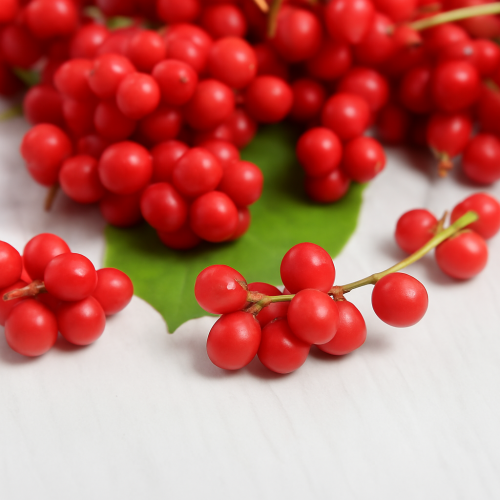
Fruits: Bright red, soft berries in grape-like clusters; each contains two crescent-shaped seeds
-
Roots: Fibrous, shallow, with a strong connection to the forest floor’s nutrient web
Native Habitat + Growth Conditions:
-
Native To: Northeastern China, Russian Far East (Amur region), Korea
-
Preferred Soil: Loamy, well-drained, rich in organic matter
-
Sunlight: Partial shade to dappled sun
-
Climate: Cool, temperate forests with high humidity and rainfall
-
Ecological Notes: Grows in symbiosis with host trees; berries attract birds and mammals for seed dispersal
Energetic Botanical Signature
Schisandra grows like a prayer—rooted in the dark soil, reaching toward the light, wrapping herself around what supports her. She doesn’t force her way upward; she partners. Her power is in connection, integration, and persistence—not domination.
Her fruit is not simple. It’s layered, paradoxical, almost alchemical. She carries all five flavors within her body, just as she holds the five elements, five organ systems, and five directions of traditional medicine. Her medicine whispers: You are allowed to be complex. You are allowed to hold contradictions. You are still whole.
Where others tone down their intensity to be palatable, Schisandra teaches us to embrace fullness. To metabolize stress. To nourish essence while moving through change. She doesn’t purge or push—she restores from within.
This is the plant that says: You can be tender and fierce. Boundaried and open. You don’t have to choose—your power lives in integration.
