
Every order ships USPS Priority — $10.95 flat-rate USPS Priority shipping on all US orders, no minimum. Free shipping on domestic orders over $299.
Welcome to Stillpoint. Subscribe to our newsletter for sale details and new-product news · One discount code per order · Every order is hand-poured, packed with care in ceremony, and shipped as we receive it.

Arnica CO₂ Extract 4% in Organic Sunflower Oil | Post-Impact Body Care

Arnica montana

  • Arnica CO₂ Extract 4% in Organic Sunflower Oil | Post-Impact Body Care

Average Rating: (see reviews)

$27.00 Ex Tax: $27.00

Essential Facts

  • Latin Name: Arnica montana
  • Country of Origin: Cuba
  • Botanical Family: Asteraceae
  • Plant Parts: Flowers
  • Cultivation Method: Organically Grown
  • Method of Extraction: CO2 Total Extraction
  • Extraction Date: May 2025
  • Approx. Shelf Life: 4 plus years
  • Batch: arnCo2to
Notes & Use

Personal Use

Arnica Flower CO₂-to Extract in Organic Sunflower Oil
Arnica montana
Standardized to 3.5–4.5% Sesquiterpene Lactones

Arnica Flower CO₂-to Extract is a concentrated botanical extract made from the dried flowers of Arnica montana using supercritical carbon dioxide extraction, then standardized in organic sunflower oil for consistent potency.

This is not an essential oil. It is not a simple herbal-infused oil. It is a CO₂ total extract — meaning carbon dioxide is used under pressure to draw out a broader range of oil-soluble plant constituents from the dried arnica flowers, including heavier compounds that would not normally appear in a steam-distilled essential oil.

The finished material is 70% organic sunflower oil and 30% Arnica flower CO₂-to extract, standardized to 3.5–4.5% sesquiterpene lactones. It also naturally contains triterpenediol esters, including faradiol and arnidiol esters, along with waxes, resins, and a small amount of essential oil.

That chemistry matters.

The sunflower oil is not just filler. It makes this potent arnica extract more stable, measurable, and practical for formulation. Arnica’s sesquiterpene lactones are part of what gives the plant its strong traditional reputation in topical preparations, but they are also why Arnica must be used with respect.

Standardizing the extract in organic sunflower oil helps create a consistent botanical ingredient that can be used more accurately in body oils, balms, salves, massage blends, and targeted topical products.

Traditional Therapeutic Uses of Arnica
Arnica has a long history of external use in traditional herbal medicine and body-care preparations. It has traditionally been used to support the body after physical impact, strain, overuse, and localized tissue stress.
Arnica preparations have traditionally been used for:
  • Bruises and discoloration after impact
  • Bumps, knocks, and minor physical trauma
  • Sprains and strains
  • Overworked muscles
  • Muscle tension and soreness
  • Joint discomfort
  • Stiffness after exertion
  • Post-activity body care
  • Areas that feel tender after impact or strain
  • Minor swelling associated with bumps or bruises
  • Skin affected by minor insect bites
  • Traditional external preparations for rheumatic muscle and joint complaints
The supplier literature notes that Arnica flower preparations have been traditionally used externally for injury-related concerns, including haematomas, bruises, and sprains, as well as rheumatic muscle and joint complaints and inflammation caused by insect bites.
In plain English: Arnica is the plant people reach for when the body has been hit, strained, overworked, or pissed off.

Why CO₂ Extraction Matters
CO₂ extraction uses natural carbon dioxide under pressure to extract plant constituents without leaving solvent residues behind. In this material, the process produces a rich, dark, oil-soluble extract that carries more than just volatile aromatic compounds.
That is the difference.

A steam-distilled essential oil captures the volatile aromatic fraction of a plant. A CO₂ total extract can capture a broader spectrum of lipophilic constituents, including heavier plant compounds such as resins, waxes, triterpenediol esters, and other oil-soluble constituents.

With Arnica, that matters because the therapeutic identity of the plant is not simply about aroma. It is about the heavier constituents associated with Arnica’s traditional topical use.
This extract gives formulators a way to work with Arnica in a more concentrated, standardized, and chemically meaningful form than a simple infused oil.

Why It Is Standardized in Organic Sunflower Oil
This Arnica Flower CO₂-to Extract is standardized in organic sunflower oil to create a consistent sesquiterpene lactone content.
That matters because Arnica is powerful. Strong does not mean “use more.” Strong means “use wisely.”

The organic sunflower oil helps make the concentrated CO₂ extract:
  • Easier to measure
  • Easier to blend
  • More consistent from batch to batch
  • More practical for topical formulation
  • More manageable than a thick, concentrated CO₂ extract on its own
This is why it belongs in the carrier/base oil section of the website, but it should not be treated like a plain carrier oil. It is an oil-based botanical active.

Suggested Use
Use as an ingredient in properly diluted topical formulations.

Suggested formulation range: 0.5–2% of the finished product, depending on the purpose of the formula, the sensitivity of the user, and the other ingredients included.

Best suited for:
  • Massage oils
  • Body oils
  • Balms and salves
  • Bruise-support formulations
  • Muscle and joint blends
  • Post-activity body-care products
  • Targeted topical formulas for bumps, strain, and overuse
Mix well before use.
Important Safety
For external use only. Do not ingest.

Do not apply directly to the skin as-is. This is a concentrated formulation ingredient, not a finished ready-to-use body oil.

Do not use on:
  • Broken skin
  • Open wounds
  • Deep cuts
  • Abrasions
  • Actively irritated skin
  • Eyes or mucous membranes
Avoid with known sensitivity or allergy to plants in the Asteraceae/Compositae family. Patch testing is recommended.
Keep away from children.

The supplier notes that this extract is intended as a basic ingredient for product formulation and is not intended for direct application to the skin in cosmetics, perfumery, or aromatherapy.

Aromatic / Physical Profile
  • Dark brown
  • Liquid to viscous at room temperature
  • Characteristic herbal odor
  • Oil-soluble
  • Practically insoluble in water
  • CO₂ total extract standardized in organic sunflower oil
Storage
Store cool, tightly closed, and away from light. Mix before use.
The supplier notes that unopened containers are stable for at least two years when stored away from light under appropriate conditions.

Energetic Note
Arnica is the plant of impact.

She belongs to the bruise, the bump, the shock, the place where the body says, “What the hell just happened?”

Energetically, Arnica helps call presence back into the body after collision, strain, or physical overwhelm. She is not soft, floaty medicine. She is direct, grounded, and fiercely restorative — the yellow-flowered ally that meets the body at the point of impact and says: come back here, repair is possible.

Botany

Botanical Name: Arnica montana
Family: Asteraceae / Compositae
Common Names: Arnica, Mountain Arnica, Leopard’s Bane, Mountain Tobacco, Wolf’s Bane
Plant Type: Herbaceous perennial
Part Used: Flowers
Growth Cycle: Perennial
Native Habitat: Mountain regions of Europe, especially alpine and subalpine meadows
Preferred Growing Conditions: Open grasslands, mountain pastures, acidic soils, and well-drained meadowlands with good sunlight

Arnica montana is a perennial flowering plant native to the mountainous regions of Europe. It grows in alpine and subalpine meadows, open grasslands, and upland pastures, where the terrain is exposed, the soil is often acidic, and the plant must adapt to wind, elevation, and changing mountain weather.

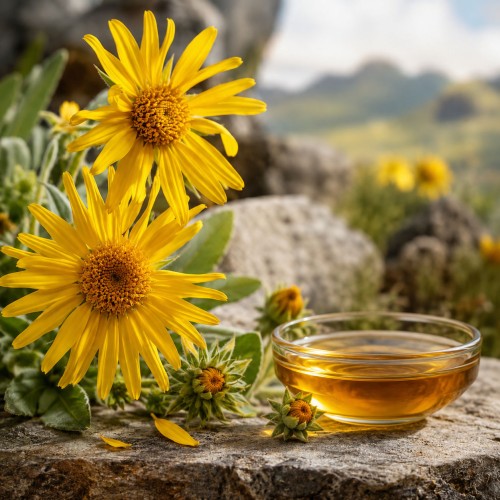
The plant typically grows low to moderately tall, with a basal rosette of oval to lance-shaped leaves close to the ground and upright flowering stems that carry bright golden-yellow flower heads. The flowers are daisy-like in appearance, with a central disc surrounded by yellow ray florets. They are often slightly irregular, giving Arnica a wild, untamed look rather than a polished ornamental appearance.

The flowers are the primary plant part used in traditional herbal preparations. They contain a complex range of naturally occurring constituents, including sesquiterpene lactones, triterpenediol esters such as faradiol and arnidiol esters, flavonoids, phenolic acids, carotenoids, small amounts of essential oil, waxes, and resins.

As a member of the Asteraceae family, Arnica is botanically related to plants such as chamomile, calendula, echinacea, yarrow, and daisies. This plant family includes many botanicals traditionally associated with skin, tissue, immune response, boundary repair, and inflammatory processes. Arnica, however, has a more specific and forceful traditional role: external use after impact, strain, bruising, sprains, and muscular overuse.

Ecologically, Arnica montana is also important because it grows in mountain meadow ecosystems that are increasingly vulnerable to overharvesting, habitat loss, and agricultural changes. True Arnica montana is not a casual weed. It is a mountain plant with specific habitat needs, and responsible sourcing matters.

Energetic Botanical Signature
Arnica’s botanical signature is written all over her body.

She grows close to the ground but sends up bright yellow flowers — solar, visible, unmistakable. That combination matters. Arnica is not airy, decorative medicine. She is grounded solar medicine. Light brought down into the body. Fire held close to the earth.

Her habitat tells the same story. Arnica grows in mountain meadows, exposed to wind, weather, altitude, and rugged terrain. She belongs to places where the body has to adapt, brace, recover, and keep going. There is nothing fragile or precious about her medicine. She is not here to float you into softness. She is here for the moment after impact.

The flower is the part used, and that also makes sense. The golden bloom carries the visible medicine of the plant: brightness after bruising, warmth after shock, movement after stagnation. Arnica’s energy goes toward the place that got hit — the bruise, the bump, the strain, the tissue that recoiled and said, “Nope, I’m out.”

Energetically, Arnica helps call presence back into the body after collision, strain, or physical overwhelm. She works where shock has landed in the tissue. She does not erase the impact. She helps the body remember how to return from it.
Her signature is direct, physical, and fiercely restorative.
Arnica says: come back here.

Come back into the body.
Repair is still possible.
Energetics

Traditional & Folklore

Arnica’s folklore belongs to the mountains.

Unlike plants with long, elaborate Greek or Roman mythologies, Arnica montana comes to us more through European folk medicine, alpine tradition, old herbal practice, and mountain magic. Its story is not one of temples and gods. It is the story of the fall, the bruise, the hard road, the weathered body, and the plant growing in high meadows where survival itself becomes medicine.

The name “Arnica” is often traced to the Greek arnakis, meaning “lamb’s coat,” likely referring to the soft, downy quality of parts of the plant. Its species name, montana, means “of the mountains,” and that may be the most important part of its identity. Arnica is mountain medicine — shaped by altitude, exposure, endurance, and wild terrain. 

In European folk tradition, Arnica became known as a plant for the aftermath of impact: falls, blows, bruises, sprains, strain, and the physical consequences of hard labor. It was used in external preparations such as compresses, washes, salves, infused oils, and tinctures. This was the plant people reached for when the body had been knocked around by life — literally.
Its folk names carry the old warnings and old respect.

“Leopard’s Bane” and “Wolf’s Bane” suggest a plant with force, danger, and protective power. In older plant language, “bane” often pointed to something potent — something that could harm if misused, but also carried strength when handled properly. Arnica was not treated as a sweet little meadow flower. It was recognized as a strong plant, one that belonged in the hands of people who understood its boundaries.

“Mountain Tobacco” points to another strand of folk history. The dried leaves were reportedly smoked or used as a tobacco substitute in some regions, though this is absolutely not a recommended or safe modern use. Still, the name tells us something important: Arnica was part of lived folk practice, not just formal medicine. It belonged to the people of the mountains, the workers, the healers, the households, and the old ways.

There are also magical traditions around Arnica as a protective plant. In some folk practices, Arnica was scattered around property or fields to protect the home, guard crops, and support fertility in the land. Some traditions connect it with protection against harmful spirits or crop-damaging forces — the old “corn demon” kind of folklore where plants were used not only as medicine for the body, but as boundary medicine for the home and field. 

That matters.

Because Arnica’s magic is not airy. It is not decorative. It is not perfume-and-prayer magic. It is boundary magic. Field magic. Bruise magic. Mountain magic. The kind of magic that says: protect the body, protect the land, protect what has been struck, and help life return.

Its bright yellow flowers also carry a solar signature. In folk understanding, yellow flowering plants were often associated with vitality, warmth, movement, and the return of life-force. Arnica brings that solar medicine into the dense, physical places of the body — the bruise, the swelling, the strained muscle, the shocked tissue, the place that needs warmth and movement again.

So Arnica’s folklore is simple, old, and powerful:
It is the plant of the fall.
The plant of the bruise.
The plant of the field boundary.
The mountain ally for impact, protection, and return.

Arnica does not have to be dressed up in borrowed mythology. Her own story is strong enough. She belongs to the old mountain people, the hard workers, the herbalists, the field keepers, and the bodies that got back up after being knocked down.
Chemistry

Chemical Components

Arnica Flower CO₂-to Extract is not an essential oil, so its chemistry should not be understood only through volatile aromatic molecules. This is a CO₂ total extract, which means it carries a broader oil-soluble profile from the dried flowers of Arnica montana, including heavier plant constituents that would not normally be present in a steam-distilled essential oil.

This extract is standardized in organic sunflower oil to a consistent 3.5–4.5% sesquiterpene lactone content. The finished material is 70% organic sunflower oil and 30% Arnica flower CO₂-to extract, making it an oil-based botanical active rather than a simple carrier oil or essential oil.

The primary chemistry of interest is the sesquiterpene lactone fraction, which is strongly associated with Arnica’s traditional use in topical preparations for bruising, sprains, bumps, and overworked tissue. These compounds are part of what gives Arnica its force, but they are also why the extract needs respect in formulation. Potent chemistry is not a “more is better” situation. It is a “use it correctly or don’t use it” situation.

The extract also contains triterpenediol esters, including faradiol and arnidiol esters, along with a small amount of essential oil, waxes, and resins. These heavier constituents help explain why Arnica CO₂ is so different from an aromatic essential oil. Its value is not just in scent. Its deeper relevance comes from the broader lipid-soluble plant chemistry carried into the extract.

Because this extract is standardized in sunflower oil, the chemistry becomes more practical for topical formulation. The sunflower oil helps make the concentrated CO₂ extract more measurable, blendable, and consistent from batch to batch, while still preserving the concentrated botanical profile of the Arnica flower.

Aromatically, the extract is described as dark brown, liquid to viscous at room temperature, with a characteristic odor. It is not used primarily for perfume structure or aromatic note-building. It is used because Arnica’s CO₂ chemistry brings real botanical substance to body oils, balms, salves, massage blends, and targeted topical formulas.

In plain English: this is not a pretty-smelling essential oil pretending to be medicine. This is a concentrated Arnica extract with heavier chemistry, standardized potency, and a very specific place in topical formulation.
Recipes & Blends

Recipes & Blends

General Formulation Range
For most finished topical products:
  • 0.5% = gentle targeted support
  • 1% = good general-use body oil / balm level
  • 2% = stronger targeted formula for specific areas
  • I would not go higher without a specific reason and a stronger safety review.
Quick Measurement Guide
For 1 oz / 30 ml finished product:
  • 0.5% Arnica CO₂ Extract = 0.15 ml, about 3 drops
  • 1% Arnica CO₂ Extract = 0.3 ml, about 6 drops
  • 2% Arnica CO₂ Extract = 0.6 ml, about 12 drops
For 2 oz / 60 ml finished product:
  • 0.5% = 0.3 ml, about 6 drops
  • 1% = 0.6 ml, about 12 drops
  • 2% = 1.2 ml, about 24 drops
These are approximate because CO₂ extracts can be thicker and drop size varies. For production, weighing is better than drops.


Bruise + Bump Body Oil
Purpose: For bumps, bruises, knocks, and post-impact tenderness.

Formula for 1 oz / 30 ml
  • Arnica Flower CO₂-to Extract in Sunflower Oil (Arnica montana) — 6 drops / about 1%
  • Tamanu Oil (Calophyllum inophyllum) — 5 ml
  • Calendula Infused Oil (Calendula officinalis) — 10 ml
  • Jojoba (Simmondsia chinensis) — 15 ml
Optional essential oils:
  • Helichrysum Essential Oil (Helichrysum italicum) — 3 drops
  • Lavender Essential Oil (Lavandula angustifolia) — 3 drops
How to Use
Apply a small amount to the affected area 1–3 times daily as needed.
Do not use on broken skin, cuts, abrasions, open wounds, or actively irritated skin.

Why It Works
Arnica CO₂ brings the traditional post-impact support. Tamanu and Calendula are both excellent for skin and tissue support, while Jojoba keeps the formula stable and skin-friendly. Helichrysum and Lavender add gentle aromatic support for tenderness and tissue recovery.


Overworked Muscle Massage Oil
Purpose: For muscles that feel tight, sore, tired, or overused after activity.

Formula for 2 oz / 60 ml
  • Arnica Flower CO₂-to Extract in Sunflower Oil (Arnica montana) — 12 drops / about 1%
  • Sesame Oil (Sesamum indicum) — 20 ml
  • Jojoba (Simmondsia chinensis) — 20 ml
  • St. John’s Wort Infused Oil (Hypericum perforatum) — 10 ml
  • Calendula Infused Oil (Calendula officinalis) — 10 ml
Optional essential oils:
  • Sweet Marjoram Essential Oil (Origanum majorana) — 8 drops
  • Black Pepper Essential Oil (Piper nigrum) — 4 drops
  • Lavender Essential Oil (Lavandula angustifolia) — 10 drops
This gives a little under 2% essential oil dilution, appropriate for adult localized body use.

How to Use
Massage into overworked muscles after activity, gardening, hiking, workouts, or long days on your feet.
Avoid broken skin and sensitive areas.

Why It Works
Arnica supports the post-strain, post-impact piece. Sesame brings warmth and movement. St. John’s Wort infused oil is traditionally used in topical preparations for nerve-like discomfort and tenderness. Sweet Marjoram softens muscle tension, Black Pepper brings warmth, and Lavender keeps the blend from becoming too sharp.


Joint + Overuse Balm
Purpose: For knees, hands, shoulders, hips, or areas that feel stiff or overused.

Formula for 2 oz / 56 g Balm
  • Arnica Flower CO₂-to Extract in Sunflower Oil (Arnica montana) — 1.1 g / 2%
  • Jojoba (Simmondsia chinensis) — 20 g
  • Calendula Infused Oil (Calendula officinalis) — 15 g
  • Sesame Oil (Sesamum indicum) — 10 g
  • Beeswax (Cera alba) — 8 g
  • Shea Butter (Butyrospermum parkii) — 2 g
Optional essential oils:
  • Ginger Essential Oil (Zingiber officinale) — 4 drops
  • Sweet Marjoram Essential Oil (Origanum majorana) — 6 drops
  • Frankincense Essential Oil (Boswellia carterii or Boswellia sacra) — 6 drops
  • Lavender Essential Oil (Lavandula angustifolia) — 8 drops
How to Make
Melt the beeswax, shea butter, and carrier oils gently over low heat. Remove from heat. Let cool slightly, then stir in the Arnica CO₂ and essential oils. Pour into jars and allow to set.

How to Use
Apply a small amount to targeted areas as needed.

Why It Works
This is the stronger one. The 2% Arnica CO₂ level makes sense for targeted use, not full-body slathering. The balm format keeps it localized, while the warming and softening oils support areas that feel stiff, overused, or cranky.

After-Hike / After-Garden Body Oil
Purpose: For the whole “my body did more than it was emotionally prepared for” situation.

Formula for 4 oz / 120 ml
  • Arnica Flower CO₂-to Extract in Sunflower Oil (Arnica montana) — 24 drops / about 1%
  • Sunflower Oil (Helianthus annuus) — 40 ml
  • Jojoba (Simmondsia chinensis) — 40 ml
  • Calendula Infused Oil (Calendula officinalis) — 20 ml
  • Rosehip Seed Oil (Rosa canina or Rosa rubiginosa) — 10 ml
  • Tamanu Oil (Calophyllum inophyllum) — 10 ml
Optional essential oils:
  • Lavender Essential Oil (Lavandula angustifolia) — 20 drops
  • Sweet Marjoram Essential Oil (Origanum majorana) — 12 drops
  • Black Spruce Essential Oil (Picea mariana) — 10 drops
  • Frankincense Essential Oil (Boswellia carterii or Boswellia sacra) — 8 drops
How to Use
Apply after hiking, gardening, cleaning, lifting, traveling, or physical overuse.
Do not use on broken or scraped skin.

Why It Works
This is a beautiful “return to the body” formula. Arnica supports the areas that feel knocked around. Calendula and Tamanu support skin comfort. Black Spruce brings breath and recovery energy, Sweet Marjoram softens, Lavender calms, and Frankincense adds depth and grounding.


Simple Professional Formula — No Essential Oils
Purpose: For people who want the Arnica support without aromatics.

Formula for 1 oz / 30 ml
  • Arnica Flower CO₂-to Extract in Sunflower Oil (Arnica montana) — 6 drops / about 1%
  • Calendula Infused Oil (Calendula officinalis) — 15 ml
  • Jojoba (Simmondsia chinensis) — 10 ml
  • Tamanu Oil (Calophyllum inophyllum) — 5 ml
How to Use
Apply sparingly to bruised, bumped, or overworked areas.

Why It Works
Simple. Clean. No essential oils. This is a good option for people who are sensitive to aromatics but still want a targeted botanical body oil.


Safety for All Arnica CO₂ Recipes
For external use only. Do not ingest.
Do not use on:
  • Broken skin
  • Open wounds
  • Deep cuts
  • Abrasions
  • Actively irritated skin
  • Eyes
  • Mucous membranes
Avoid with known allergy or sensitivity to plants in the Asteraceae/Compositae family.
Patch testing is recommended.
Avoid during pregnancy and nursing unless guided by a qualified practitioner.
Keep away from children and pets.

Use only in properly diluted topical formulations. This Arnica CO₂ extract is a concentrated formulation ingredient, not a ready-to-use body oil. The supplier specifically notes it is not intended for direct application to skin as-is.

Energetic Note
Arnica is for the body after impact. These recipes are not about pretending the hit didn’t happen. They are about helping the body come back into the place that got bruised, strained, shocked, or overworked.
She is the mountain flower that says: yes, that hurt. Now come back. Repair is possible.
Safety Etc.

Safety Information

For external use only. Do not ingest.

This is a concentrated botanical formulation ingredient, not a ready-to-use body oil. Do not apply directly to the skin as-is. Use only in properly diluted topical formulations.

Do not use on:
  • Broken skin
  • Open wounds
  • Deep cuts
  • Abrasions
  • Actively irritated skin
  • Eyes
  • Mucous membranes
Avoid use if you have a known allergy or sensitivity to plants in the Asteraceae/Compositae family, which includes plants such as arnica, chamomile, calendula, ragweed, daisies, and echinacea.

Patch testing is recommended before use, especially for sensitive skin.
Avoid use during pregnancy or nursing unless guided by a qualified practitioner.

Keep away from children and pets.
Do not use internally. Arnica is not safe for internal use unless prepared in a legally compliant, professionally manufactured product specifically intended for that purpose.

Use caution with children, elders, and people with highly reactive or compromised skin.

The supplier notes that this material is intended as a basic ingredient for product formulation and is not intended for direct application to the skin in cosmetics, perfumery, or aromatherapy. The supplier safety information also recommends avoiding contact with skin, eyes, and clothing during raw-material handling and using appropriate protective gloves and eye/face protection.

Suggested formulation range: 0.5–2% of the finished product, depending on the purpose of the formula, the sensitivity of the user, and the other ingredients used.

This information is for educational purposes only and has not been evaluated by the FDA. This product is not intended to diagnose, treat, cure, or prevent any disease.

References

  • Buckle, J. Clinical Aromatherapy: Essential Oils in Healthcare. 3rd ed. Churchill Livingstone / Elsevier, 2015.
  • Hoffmann, D. Medical Herbalism: The Science and Practice of Herbal Medicine. Healing Arts Press, 2003.
  • Mills, S., & Bone, K. Principles and Practice of Phytotherapy: Modern Herbal Medicine. 2nd ed. Churchill Livingstone / Elsevier, 2013.
  • Tisserand, R., & Young, R. Essential Oil Safety: A Guide for Health Care Professionals. 2nd ed. Churchill Livingstone / Elsevier, 2014.
  • Battaglia, S. The Complete Guide to Aromatherapy. 3rd ed. Black Pepper Creative, 2018.
  • Wichtl, M. Herbal Drugs and Phytopharmaceuticals: A Handbook for Practice on a Scientific Basis. 3rd ed. Medpharm Scientific Publishers, 2004.
  • Mukhopadhyay, M. Natural Extracts Using Supercritical Carbon Dioxide. CRC Press, 2000.
  • Reverchon, E., & De Marco, I. “Supercritical Fluid Extraction and Fractionation of Natural Matter.” The Journal of Supercritical Fluids, 38(2), 146–166, 2006.
  • European Commission. CosIng Database: Cosmetic Ingredients and Substances. European Commission. 

Reviews (2)

Write a review

Note: HTML is not translated!
    Bad           Good
Powered By OpenCart
Stillpoint Aromatics © 2026