Personal Use
Fun Facts:
-
The Time Traveler's Wood Preservative: Cedarwood oil is like a time machine for your woodwork. In its mission to preserve and protect, it harkens back to its ancestors, used in ancient times to construct and preserve the mighty pyramids. Coat your treasured wooden artifacts in this essence of endurance, and let them stand the test of time.
-
The Old-World Photographer's Secret: Imagine being in a dimly lit room, the smell of cedarwood oil hanging heavy in the air. This was the reality of photographers from a bygone era. This woody elixir was their trusty aide in the challenging process of developing early photographs, making it a snapshot in the timeline of photographic evolution.
-
The Moth Magician: Are moths staging a rebellion in your wardrobes? Use the mystical properties of cedarwood oil to banish them. Few drops on a cotton ball and voila! Your clothes are no longer a moth's feast.
-
The Green Thumb's Weapon: Armed with cedarwood oil, gardeners wage war against plant-munching pests. This nature-friendly soldier, when sprayed on the foliage, shows who's boss, all without harming Mother Earth.
-
The Sportsman's Scent-Shield: Does your gym gear reek of relentless effort? The invigorating aroma of cedarwood oil swoops in to save the day, transforming your gym bag from a fortress of funk to a bastion of freshness.
-
The Soapmaker's Muse: Crafters of artisanal soaps treasure the masculine, earthy aroma of cedarwood oil. It's a journey into the heart of a forest, encapsulated within the humble confines of a soap bar.
-
The Spiritual Synergist: In sacred rituals and spiritual ceremonies, cedarwood oil has been revered as a grounding force. It's a bridge between the physical world and the realm of the intangible, fostering a connection that calms and purifies the spirit.
Traditional Use
Atlas Cedarwood (Cedrus atlantica) oil has a variety of uses that are attributed to its constituents, such as α-cedrene, β-cedrene, thujopsene, and cedrol. However, it should be noted that while some uses have been supported by scientific research, others are more anecdotal or traditional in nature. Here are some potential uses:
-
Sedative: Cedarwood oil is often used in aromatherapy due to its potential calming and soothing effects. Some research suggests that inhalation of cedarwood oil can have sedative effects, possibly due to the presence of cedrol, which might have a relaxing effect on the nervous system.
-
Antiseptic Properties: Cedarwood oil has been traditionally used for its potential antiseptic properties. Some studies have shown that the oil can inhibit the growth of certain bacteria and fungi, suggesting potential applications in preventing infections.
-
Anti-Inflammatory Effects: There is some research indicating that cedarwood oil may have anti-inflammatory properties, making it potentially useful in alleviating symptoms of conditions associated with inflammation.
-
Insect Repellent: The oil is also known for its insecticidal properties. It has been used to repel insects like mosquitoes and moths. Certain components of cedarwood oil, like cedrol and cedrene, may have repellant effects against certain types of insects.
-
Dermatological Uses: Anecdotal evidence suggests that cedarwood oil may help with skin conditions such as acne and eczema. However, more rigorous scientific research is needed in this area.
-
Hair Growth: There is some preliminary evidence suggesting that cedarwood oil may promote hair growth. A study published in the Archives of Dermatology found that a mixture of essential oils, including cedarwood oil, improved hair growth in people with alopecia areata, a condition that causes hair loss.
Botany
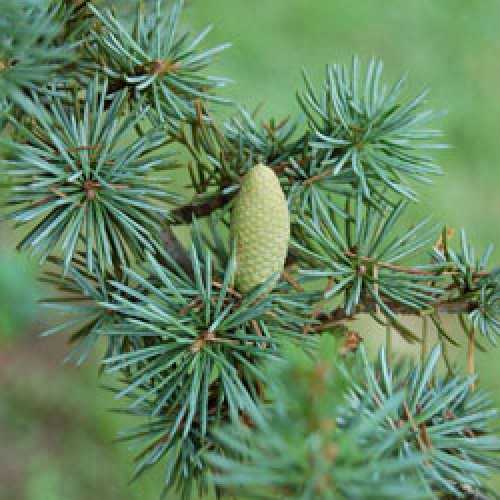
The Atlas cedar (Cedrus atlantica) is a species of cedar that can be found in the Atlas Mountains of Morocco and Algeria, hence the name. This evergreen coniferous tree can grow up to 30-40 meters tall, and in some exceptional cases, can reach up to 60 meters.
The Atlas cedar is closely related to other species of Cedrus genus, including the Lebanon cedar (Cedrus libani) and the Deodar cedar (Cedrus deodara). It can be differentiated by the shoot leaves, which are usually needle-like, and typically clustered in whorls on short shoots. This is a common feature among all Cedrus species.
The Atlas cedar's needles are slightly shorter athan those of other Cedars, typically about 2 cm long. The cones of the Atlas cedar are roughly barrel-shaped, 6-12 cm long, and mature in two years. When mature, they disintegrate to release the winged seeds.
The bark of the Atlas cedar is grey to silver-grey, and the wood it yields is highly aromatic. The bark also gets slightly fissured with age.
The Atlas cedar is not only valued for its ornamental qualities but also for its wood, which is used in carpentry and cabinetry. It is also valued for its essential oil, which is used in aromatherapy and perfumery. The tree is considered endangered in its native range due to overexploitation for timber and grazing pressure. Conservation efforts are ongoing to protect this species.