
Personal Use
Arnica Flower CO₂-to Extract in Organic Sunflower Oil
Arnica montana
Standardized to 3.5–4.5% Sesquiterpene Lactones
Arnica Flower CO₂-to Extract is a concentrated botanical extract made from the dried flowers of Arnica montana using supercritical carbon dioxide extraction, then standardized in organic sunflower oil for consistent potency.
This is not an essential oil. It is not a simple herbal-infused oil. It is a CO₂ total extract — meaning carbon dioxide is used under pressure to draw out a broader range of oil-soluble plant constituents from the dried arnica flowers, including heavier compounds that would not normally appear in a steam-distilled essential oil.
The finished material is 70% organic sunflower oil and 30% Arnica flower CO₂-to extract, standardized to 3.5–4.5% sesquiterpene lactones. It also naturally contains triterpenediol esters, including faradiol and arnidiol esters, along with waxes, resins, and a small amount of essential oil.
That chemistry matters.
The sunflower oil is not just filler. It makes this potent arnica extract more stable, measurable, and practical for formulation. Arnica’s sesquiterpene lactones are part of what gives the plant its strong traditional reputation in topical preparations, but they are also why Arnica must be used with respect.
Standardizing the extract in organic sunflower oil helps create a consistent botanical ingredient that can be used more accurately in body oils, balms, salves, massage blends, and targeted topical products.
Traditional Therapeutic Uses of Arnica
Arnica has a long history of external use in traditional herbal medicine and body-care preparations. It has traditionally been used to support the body after physical impact, strain, overuse, and localized tissue stress.
Arnica preparations have traditionally been used for:
-
Bruises and discoloration after impact
-
Bumps, knocks, and minor physical trauma
-
Sprains and strains
-
Overworked muscles
-
Muscle tension and soreness
-
Joint discomfort
-
Stiffness after exertion
-
Post-activity body care
-
Areas that feel tender after impact or strain
-
Minor swelling associated with bumps or bruises
-
Skin affected by minor insect bites
-
Traditional external preparations for rheumatic muscle and joint complaints
The supplier literature notes that Arnica flower preparations have been traditionally used externally for injury-related concerns, including haematomas, bruises, and sprains, as well as rheumatic muscle and joint complaints and inflammation caused by insect bites.
In plain English: Arnica is the plant people reach for when the body has been hit, strained, overworked, or pissed off.
Why CO₂ Extraction Matters
CO₂ extraction uses natural carbon dioxide under pressure to extract plant constituents without leaving solvent residues behind. In this material, the process produces a rich, dark, oil-soluble extract that carries more than just volatile aromatic compounds.
That is the difference.
A steam-distilled essential oil captures the volatile aromatic fraction of a plant. A CO₂ total extract can capture a broader spectrum of lipophilic constituents, including heavier plant compounds such as resins, waxes, triterpenediol esters, and other oil-soluble constituents.
With Arnica, that matters because the therapeutic identity of the plant is not simply about aroma. It is about the heavier constituents associated with Arnica’s traditional topical use.
This extract gives formulators a way to work with Arnica in a more concentrated, standardized, and chemically meaningful form than a simple infused oil.
Why It Is Standardized in Organic Sunflower Oil
This Arnica Flower CO₂-to Extract is standardized in organic sunflower oil to create a consistent sesquiterpene lactone content.
That matters because Arnica is powerful. Strong does not mean “use more.” Strong means “use wisely.”
The organic sunflower oil helps make the concentrated CO₂ extract:
-
Easier to measure
-
Easier to blend
-
More consistent from batch to batch
-
More practical for topical formulation
-
More manageable than a thick, concentrated CO₂ extract on its own
This is why it belongs in the carrier/base oil section of the website, but it should not be treated like a plain carrier oil. It is an oil-based botanical active.
Suggested Use
Use as an ingredient in properly diluted topical formulations.
Suggested formulation range: 0.5–2% of the finished product, depending on the purpose of the formula, the sensitivity of the user, and the other ingredients included.
Best suited for:
-
Massage oils
-
Body oils
-
Balms and salves
-
Bruise-support formulations
-
Muscle and joint blends
-
Post-activity body-care products
-
Targeted topical formulas for bumps, strain, and overuse
Mix well before use.
Important Safety
For external use only. Do not ingest.
Do not apply directly to the skin as-is. This is a concentrated formulation ingredient, not a finished ready-to-use body oil.
Do not use on:
-
Broken skin
-
Open wounds
-
Deep cuts
-
Abrasions
-
Actively irritated skin
-
Eyes or mucous membranes
Avoid with known sensitivity or allergy to plants in the Asteraceae/Compositae family. Patch testing is recommended.
Keep away from children.
The supplier notes that this extract is intended as a basic ingredient for product formulation and is not intended for direct application to the skin in cosmetics, perfumery, or aromatherapy.
Aromatic / Physical Profile
-
Dark brown
-
Liquid to viscous at room temperature
-
Characteristic herbal odor
-
Oil-soluble
-
Practically insoluble in water
-
CO₂ total extract standardized in organic sunflower oil
Storage
Store cool, tightly closed, and away from light. Mix before use.
The supplier notes that unopened containers are stable for at least two years when stored away from light under appropriate conditions.
Energetic Note
Arnica is the plant of impact.
She belongs to the bruise, the bump, the shock, the place where the body says, “What the hell just happened?”
Energetically, Arnica helps call presence back into the body after collision, strain, or physical overwhelm. She is not soft, floaty medicine. She is direct, grounded, and fiercely restorative — the yellow-flowered ally that meets the body at the point of impact and says: come back here, repair is possible.
Botany
Botanical Name: Arnica montana
Family: Asteraceae / Compositae
Common Names: Arnica, Mountain Arnica, Leopard’s Bane, Mountain Tobacco, Wolf’s Bane
Plant Type: Herbaceous perennial
Part Used: Flowers
Growth Cycle: Perennial
Native Habitat: Mountain regions of Europe, especially alpine and subalpine meadows
Preferred Growing Conditions: Open grasslands, mountain pastures, acidic soils, and well-drained meadowlands with good sunlight
Common Names: Arnica, Mountain Arnica, Leopard’s Bane, Mountain Tobacco, Wolf’s Bane
Plant Type: Herbaceous perennial
Part Used: Flowers
Growth Cycle: Perennial
Native Habitat: Mountain regions of Europe, especially alpine and subalpine meadows
Preferred Growing Conditions: Open grasslands, mountain pastures, acidic soils, and well-drained meadowlands with good sunlight
Arnica montana is a perennial flowering plant native to the mountainous regions of Europe. It grows in alpine and subalpine meadows, open grasslands, and upland pastures, where the terrain is exposed, the soil is often acidic, and the plant must adapt to wind, elevation, and changing mountain weather.
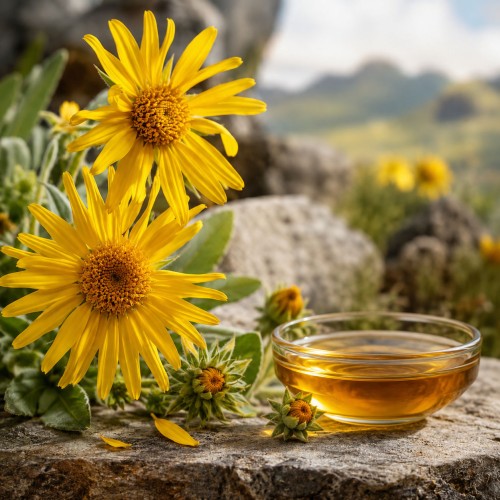
The plant typically grows low to moderately tall, with a basal rosette of oval to lance-shaped leaves close to the ground and upright flowering stems that carry bright golden-yellow flower heads. The flowers are daisy-like in appearance, with a central disc surrounded by yellow ray florets. They are often slightly irregular, giving Arnica a wild, untamed look rather than a polished ornamental appearance.
The flowers are the primary plant part used in traditional herbal preparations. They contain a complex range of naturally occurring constituents, including sesquiterpene lactones, triterpenediol esters such as faradiol and arnidiol esters, flavonoids, phenolic acids, carotenoids, small amounts of essential oil, waxes, and resins.
As a member of the Asteraceae family, Arnica is botanically related to plants such as chamomile, calendula, echinacea, yarrow, and daisies. This plant family includes many botanicals traditionally associated with skin, tissue, immune response, boundary repair, and inflammatory processes. Arnica, however, has a more specific and forceful traditional role: external use after impact, strain, bruising, sprains, and muscular overuse.
Ecologically, Arnica montana is also important because it grows in mountain meadow ecosystems that are increasingly vulnerable to overharvesting, habitat loss, and agricultural changes. True Arnica montana is not a casual weed. It is a mountain plant with specific habitat needs, and responsible sourcing matters.
Energetic Botanical Signature
Arnica’s botanical signature is written all over her body.
She grows close to the ground but sends up bright yellow flowers — solar, visible, unmistakable. That combination matters. Arnica is not airy, decorative medicine. She is grounded solar medicine. Light brought down into the body. Fire held close to the earth.
Her habitat tells the same story. Arnica grows in mountain meadows, exposed to wind, weather, altitude, and rugged terrain. She belongs to places where the body has to adapt, brace, recover, and keep going. There is nothing fragile or precious about her medicine. She is not here to float you into softness. She is here for the moment after impact.
The flower is the part used, and that also makes sense. The golden bloom carries the visible medicine of the plant: brightness after bruising, warmth after shock, movement after stagnation. Arnica’s energy goes toward the place that got hit — the bruise, the bump, the strain, the tissue that recoiled and said, “Nope, I’m out.”
Energetically, Arnica helps call presence back into the body after collision, strain, or physical overwhelm. She works where shock has landed in the tissue. She does not erase the impact. She helps the body remember how to return from it.
Her signature is direct, physical, and fiercely restorative.
Arnica says: come back here.
Come back into the body.
Repair is still possible.
