
Every order ships USPS Priority — $10.95 flat-rate USPS Priority shipping on all US orders, no minimum. Free shipping on domestic orders over $299.
Welcome to Stillpoint. Subscribe to our newsletter for sale details and new-product news · One discount code per order · Every order is hand-poured, packed with care in ceremony, and shipped as we receive it.

Rabbitbrush Essential Oil - Limited Reserve

Ericameria nauseosa

  • Rabbitbrush Essential Oil - Limited Reserve

Average Rating: (see reviews)

$15.00 Ex Tax: $15.00

Essential Facts

  • Latin Name: Ericameria nauseosa
  • Country of Origin: Cameroon
  • Botanical Family: Asteraceae
  • Plant Parts: Flowering plant/herb
  • Note Classification: Middle
  • Cultivation Method: Wild Harvested
  • Method of Extraction: Steam or Hydro Distillation
  • Extraction Date: Summer 2025
  • Approx. Shelf Life: 6 years
  • Chemical Family: Monoterpenes
  • Batch: rbtbrsh
  • Aroma: Astringent, Coniferous, Cool, Earthy, Exotic, Herbaceous, Pungent, Slightly bitter, Woody
  • Energetic Applications: 1st Chakra - survival and support, 3rd Chakra - personal power, 5th Chakra - speaking truth, Energizing, Grounding, Introspective, Protective, Purifying
  • Therapeutic Properties: Expectorant
Notes & Use

Personal Use

Rabbitbrush is has an unique aroma.  This is one of my most favoite oils from the Southwest.  It is extremely effective for colds and flu especially when dealing with thick mucous.  

However, my favorite use for this essential oil is in the energetic realm.  Rabbitbrush connects us to our power while alowing us to reach for the unlimited. She offers protective qualities and also allows us to delve into our own psyhce to uncover and to integrate past trauma. 

Traditional Use

  1. Respiratory Support: Like the traditional uses of the rabbitbrush plant, the essential oil may have properties that can help with respiratory conditions such as coughs, colds, and congestion.
  2. Skin Support: Rabbitbrush essential oil may have potential benefits for itchy skin, rashes, or other minor skin irritations.
  3. Aromatic and Spiritual Uses: The unique aroma of rabbitbrush essential oil may be used for its aromatic qualities, such as in diffusers or during spiritual practices to promote purification, relaxation, and connection with nature.

Botany

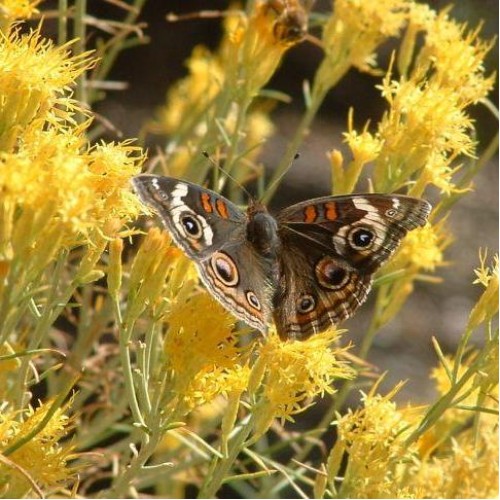
Ericameria nauseosa, commonly known as rubber rabbitbrush or gray rabbitbrush, is a flowering shrub native to western North America. It belongs to the Asteraceae family, which includes sunflowers, daisies, and asters. Rubber rabbitbrush is known for its distinct grayish-green foliage and bright yellow flowers, which appear in late summer and fall. 

  • Size: Rubber rabbitbrush typically grows between 2 and 5 feet (0.6-1.5 meters) tall.
  • Leaves: The leaves are narrow, linear, and covered in fine hairs, giving them a grayish-green appearance.
  • Flowers: The bright yellow flowers are small and clustered in dense, showy inflorescences at the end of branches. Flowering usually occurs from late summer to fall.
  • Fruits: After flowering, the plant produces small, dry fruits known as achenes. Each achene contains a single seed and is dispersed by wind.
Energetics

Traditional & Folklore

  1. Medicinal Uses: Native American tribes utilized various parts of the rabbitbrush plant for medicinal purposes. For instance, the Shoshone tribe used the leaves and flowers to create a medicinal tea to treat respiratory conditions, sore throats, and colds. The tea was also used as a wash for itchy skin and rashes.
  2. Spiritual and Ceremonial Significance: Rabbitbrush held spiritual significance for some Native American tribes. It was believed that burning rabbitbrush as incense or using it in smudging ceremonies could purify and cleanse an individual or a space. The smoke was thought to carry prayers and messages to the spirit world.
  3. Protection Against Evil Spirits: In some Native American traditions, rabbitbrush was considered protective against evil spirits and negative energy. It was believed that hanging bundles of dried rabbitbrush in homes or wearing it as a talisman could ward off malevolent forces and bring good luck.
  4. Animal Associations: The name "rabbitbrush" itself suggests a connection with rabbits. Some tribes believed that rabbits had a special affinity for rabbitbrush and used the plant as a way to lure or attract rabbits during hunting. Additionally, rabbits were sometimes associated with fertility and abundance, and rabbitbrush may have been linked to these themes as well.
  5. Seasonal Indicators: The blooming of rabbitbrush was often considered a sign of the changing seasons for Native American tribes. The appearance of the vibrant yellow flowers of rabbitbrush in late summer and fall indicated the transition from summer to autumn, and the arrival of cooler weather and harvest time.
Chemistry

Chemical Components

Rabbit Brush is a monoterpene rich oil with the two primary constituents being d limonene and cis-beta- ocimene.

Recipes & Blends

Recipes & Blends

  • Breath Easy Stock Blend:
    • 3 drops Rabbitbrush essential oil
    • 2 drops Eucalyptus dives essential oil
    • 3 drops Peppermint essential oil
    • 6 drop Lemon essential oil
       
  • Auric Cleanse Stock Blend:
    • 3 drops Rabbitbrush essential oil
    • 2 drops Sage (True) essential oil
    • 2 drops Frankincense sacra essential oil
    • 2 drops Mugwort essential oil
       
  • Root and Ground Stock Blend
    • 3 drops Rabbitbrush essential oil
    • 3 drops Indian Cedarwood essential oil
    • 2 drops Patchouli essential oil
    • 2 drop Vetiver essential oil
       
  • Spiritual Connection Stock Blend:
    • 3 drops Rabbitbrush essential oil
    • 2 drops Sandalwood essential oil
    • 5 drops Frankincense essential oil
    • 1 drop Agarwood essential oil

Related Products

Balsam Copaiba Essential Oil

Balsam Copaiba Essential Oil

..

$11.00 Ex Tax: $11.00

Reviews (0)

Write a review

Note: HTML is not translated!
    Bad           Good
Powered By OpenCart
Stillpoint Aromatics © 2026
